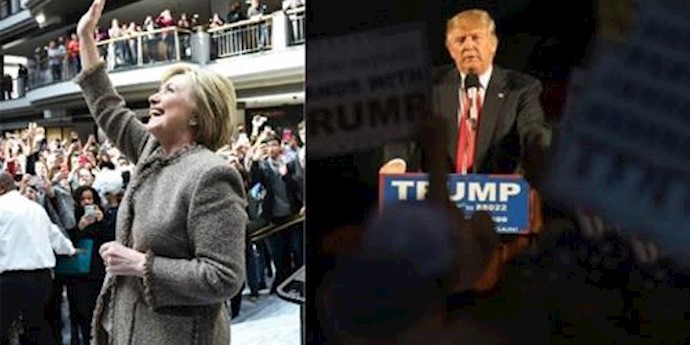
Republican Donald Trump and Democrat Hillary Clinton each earned a series of big primary wins on Tuesday as the two presidential frontrunners looked more likely to be facing off against one another in the race for the White House.
Trump took Alabama, Arkansas, Georgia, Massachusetts, Tennessee, Vermont and Virginia, while Clinton won Alabama, Arkansas, Georgia, Massachusetts, Tennessee, Texas and Virginia. Alaska had not finished tallying its results early on Wednesday.
Senator Marco Rubio of Florida, the favourite of the Republican establishment, won Minnesota.
Republican Ted Cruz, a Texas senator, won his home state and neighbouring Oklahoma, bolstering his argument that he had the best chance to stop the controversial Trump.
Clinton, the former secretary of state, won enough states to take a big step towards wrapping up her nomination fight with rival Bernie Sanders, a Democratic socialist senator from Vermont.
Sanders won his home state of Vermont, along with Colorado, Minnesota and Oklahoma, four of five states he was targeting for victory on Tuesday. He thanked cheering supporters in his hometown of Burlington, Vermont, and assailed the Republican frontrunner.
Super Tuesday is the biggest single day of state-by-state contests to select party nominees for the November 8 election to succeed Democratic President Barack Obama. Voting stretches from eastern states to Texas and Minnesota.
Trump, 69, has worried many in the Republican establishment with proposals such as building a wall along the US southern border with Mexico, deporting 11 million illegal immigrants and slapping a temporary ban on Muslims entering the country.
But while his campaign has confounded many Republican leaders, the New York real estate developer cites his high poll numbers as proof he is not dividing the party but expanding its ranks. He preached unity as he looked beyond the day’s voting to campaign in Ohio, which votes on March 15.
With a string of victories on Tuesday, Trump expanded his strong lead over Cruz, Rubio, Ohio Governor John Kasich and retired neurosurgeon Ben Carson, intensifying worries among Republican leaders that the billionaire could inflict long-term damage on the party.
“The reality is that none of the Republican candidates seem to be able to beat Trump outside of where they live,” former state director for the Obama campaign in Florida, Steve Schale, told FRANCE 24 on Wednesday. “It’s going to be hard for them to stop Trump. He’s a phenomenon — we can’t take him for granted. If too many people believe that [he can’t become president], that’s how he could win.”
Even as Trump advances, many Republican Party leaders do not support him and worry that he would be easily defeated in November if Clinton became the Democratic nominee.
Clinton took advantage of her strong performance with black voters to cruise to big wins in several Southern states, where African Americans make up a big bloc of the Democratic electorate.
The night was seen as a pivotal point in the course of the long election process. We’re going to see the contours of the general election campaign starting to be drawn after tonight,” FRANCE 24 international affairs editor Douglas Herbert said.
Source: AFP, 2 March 2016