The Obama administration on Tuesday just barely met a deadline set by the head of the powerful Senate Armed Services Committee to produce more information surrounding the Jan. 12 detention of 10 Navy sailors by Iran after their two small riverine boats drifted into Iranian territorial waters, launching what remains a highly charged incident.
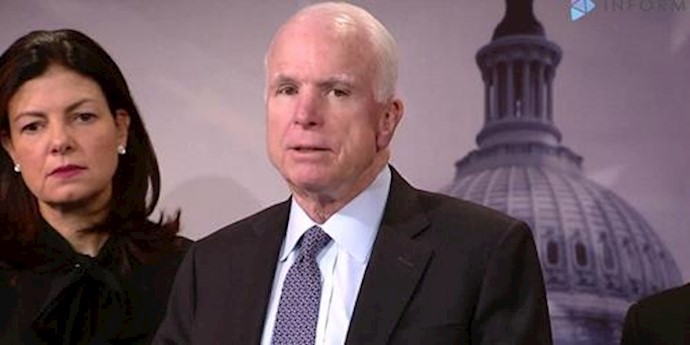
Fed up with waiting for answers, committee Chairman Sen. John McCain in February threatened to issue subpoenas to the 10 sailors if he did not receive a briefing on the incident by March 1. The date does not appear to have any particular significance, short of a signal to the administration that the senator, himself a former Navy pilot and prisoner of war, demanded more timely information for a process that some say has lasted longer than the average non-criminal military investigation.
“Chairman McCain has been briefed on the facts surrounding the detention and treatment of 10 U.S. Navy sailors by the Islamic Republic of Iran as determined by the U.S. Navy’s investigation of this incident,” committee spokesman Dustin Walker says in an email. “The facts confirm what has been clear from the beginning: that Iran’s behavior was a blatant violation of international law and centuries of maritime tradition.”
“It is time for administration officials who praised Iran’s illegal behavior to repudiate their past statements, affirm basic legal principles, and defend the character and reputation of our sailors from continued Iranian smears,” Walker says.
Walker declined to say who briefed McCain or to provide any other information about the investigation.
Conservative members of Congress have taken particular issue with statements from Secretary of State John Kerry and Defense Secretary Ash Carter that Obama’s recent agreement with Iran over its nuclear deal created the diplomatic process that allowed for American officials to negotiate the release of the sailors after 16 hours.
McCain’s briefing late Tuesday came down to the proverbial wire. Walker said earlier in the afternoon that the White House had up until then offered no further information to Congress, aside from some general details about the crew’s mission and that they had experienced a navigation error, but nothing following their detention. McCain was at that time still considering beginning the committee process for issuing subpoenas.
Foreign Policy magazine published a feature Tuesday afternoon citing unnamed officials who offered the first inside details about the incident.
A Navy official confirmed to U.S. News the investigative team turned over its initial findings Monday to Vice Adm. Kevin Donegan, commander of the 5th Fleet, who is responsible for Navy operations in the Middle East. He has 30 days to make a decision on continuing the investigation, revising the report, or approving it and forwarding it up his chain of command. The official declined to offer any of the findings so far.
“Our focus is on ensuring we gain an accurate, complete and fair understanding of these events. It would be inappropriate to discuss details until the investigation is complete,” the official said.
But the official account of what actually happened in the Jan. 12 incident will take up to two months to become public. Chief of Naval Operations Adm. John Richardson told Congress on Tuesday the investigation is still in progress and requires more time.
Until then, he says, he expects to face continued pressure from Congress for details and from Navy sailors who remain concerned about how the incident will affect rules governing how they operate near countries like Iran in the future.
“There is a lot of talk about this thing,” Richardson told the House Appropriations Defense Subcommittee. “That’s why we need to go through the disciplined process of a formal investigation, so that we can find the truth of the matter and address what we find.”
Officials familiar with the investigation process say an incident like this is tricky to process, since it requires coordination with the State Department and elements of the White House’s national security staff to determine how the ultimate findings comport with U.S. policy.
Iran remains a particularly sensitive issue for this administration, eager to prove its landmark agreement to limit Iran’s nuclear program has not emboldened the Islamic Republic.
Indeed, Richardson said Tuesday that Iran’s “maligned intent” remains across several areas.
“We applaud the agreement that would eliminate a nuclear threat from Iran, but from our perspective, so much has not changed in terms of what we have to do to watch Iran, secure that region for safe passage of resources through the Strait of Hormuz, and operating in the Gulf,” he said.
“These sailors, by international law, should not have been captured and detained. I think we’ve made that very clear,” Richardson added. “And so [it’s] another indication of the type of threat we’re dealing with here.”