
Conference in Washington August 30, 2014 commemorating 52 martyrs of 1 September 2013 massacre in Camp Ashraf
First I want to offer my support and prayers to the families here who have lost loved ones at Camp Ashraf, and I also want to say how incredibly personally moving each of the personal testaments have been here today. I mean truly we are all Ashraf.
I’m quite honored to be here with my colleagues on today’s panel. They are among the world’s leading experts on several of the critical elements of the 10-point plan, everything from nuclear disarmament to an independent judiciary to voters’ rights. But I want to focus on a specific point, point number 5. To me it’s the most important one, and that is complete gender equality. My friend and former boss Hillary Clinton made history in 1995 by travelling to Beijing for a global women’s summit to argue that women’s rights are human rights and human rights are women’s rights.
Madame Rajavi and her writing and through her own life has taken the concept a step further, pointing out that the fight for women’s inequality is indistinguishable from the fight for global peace. Mrs. Rajavi speaks about principles that there is a cold heart political reality to it. Without point number 5 you won’t have the power, or the moral authority for that matter, necessary to achieve one through 4 and six through ten. For me, women like Mrs. Rajavi and Soona (Ms. Soona Samsami, NCRI Representative in the US) are examples of why the fights for gender equality are so important. Fortunately, Mrs. Rajavi’s Beijing moment comes every year when supporters gather for NCRI’s conference. The last one in Paris, which I had the absolute privilege of attending, drew more supporters than the Democratic and Republican conventions combined. That crowd in Paris, and the spirit that it conveyed, was a powerful example of a better life waiting for the people in Iran. I saw a sea of people committed to a free Iran, people committed to ending the torture and executions there, and people committed to fighting for gender equality. I saw the same current, commitment and tenaciousness demonstrated in Beijing 25 years ago.
My second point is this if you want to change attitudes about gender, about what is acceptable behavior and what is not, you need to act at every level. Women are about the third of the residents in Camp Liberty and they play a leadership role there. Over 50% of the 500 members of the National Council of Resistance of Iran are women. Its leader is a woman. The fact that the NCRI leadership consists of so many women is incredibly important for your success today because for the impact it will have on the women who will rise through the NCRI’s ranks and for the examples you are setting for younger women back in Iran. I have seen the power here in the United States firsthand. Hillary didn’t just endorse policies to help women, but she put them in key positions, and once they were there created a work environment that allowed them to have meaningful, demanding careers, and raise a family.
When you consider what Mrs. Rajavi and her colleagues have gone through, comparing it to American politics may seem trivial. Soona and I have talked about the young, talented Iranian women ready to take greater control over their own lives. For them the women in NCRI and their role in NCRI’s growing success are powerful role models.
My third and final point is there is a momentum behind in the kind of battle we are talking about today. Gains in economic power lead to gains in political power. The prosperity Iranians are enjoying outside of Iran should inspire those still there. Meanwhile, progress in one nation should shine a light on corruption and injustice in another, and of course social media and other new technologies are creating an entirely new momentum of their own. One that can literally delivery Madame Rajavi’s stirring words to millions of followers in seconds. Today I stand here across the street from the White House talking about how to save young women half a world away.
What can we do? The first thing we can do is remember Madame Rajavi’s advice that equality is a critical step in the road to world peace. And the second is to follow her example. Mrs. Rajavi and her team filled a stadium full of people, drawing supporters from across the world, to create an example that the tyrants in Iran will have a hard time ignoring.
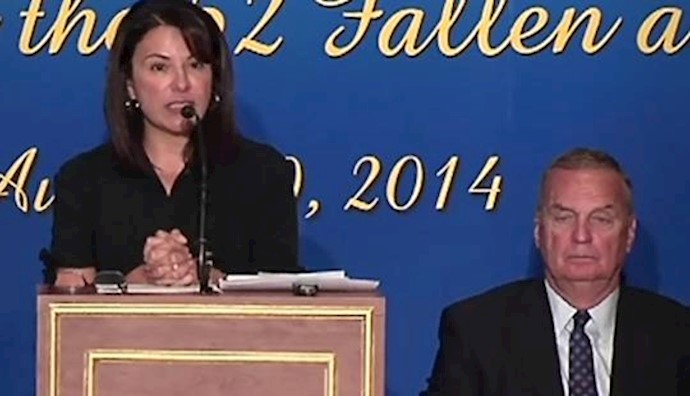
Patricia Solis Doyle: Mrs. Rajavi says women’s inequality is indistinguishable from fight for global peace
RELATED ARTICLES