
Introduction
Historically and culturally speaking, the Lion and the Sun have existed as potent mythological symbols of Iran for thousands of years. While true that the background colors of Iranian flags have varied across the centuries, the Lion and Sun motifs have endured the test of time. It is also important to note that the primary standards of the Achaemenid and Partho-Sassanian eras were (as generally agreed at this time) the Eagle standard and the Drafsh-e-Kaviani (the Standard of Kaveh) respectively. However, it is possible that the simultaneous depiction of the Lion-Sun motif may have existed during the late Sassanian era as well, pending the conclusion of the analyses of the finds made in late December 2006 by an Iranian archaeological team at the ancient Castle of Nishabur and Shadiakh.
Lion and Sun, Historical roots and The God Mithras
The sun has been a major ancient Iranic symbol and has appeared alongside the moon and heaven on the banners, standards and flags of Iran since pre-Achaemenid times (Khorasani, 2006, pp.316; Nayenuri, 1965, pp.1).
Mithras, who was to become the Sun-God, is perhaps one of the best known Iranic gods, and was at one time widely worshipped in the Roman Empire. Mithra in Avestan is translated as “pact, contract, covenent“. As the god who controls the order of the cosmos, hence the change of seasons and night into day. Mithra “was associated with fire and the sun…” [Sarkhosh-Curtis, 1993. P. 13]
Over the course of time Mehr or Mithras (Meher in Armenia) and the Sun were to be considered as the same entity (Khorasani, 2006, pp.320).
Lion and Sun, The First Simultaneous Representation as a Motif
The simultaneous representation of the lion (Shir e Iran) and the Sun has often been attributed to the post-Islamic era, especially from the 13th century AD. In reality, the Lion-Sun motif first appeared together at least as early as the Achaemenid era. However there is evidence that their simultaneous appearance occurred even earlier.
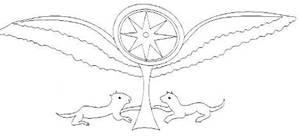
Khorasani (2006, pp.320) and Nayenuri (1965, pp. 78) note that the oldest evidence for the simultaneous representation of the Lion and the Sun date to a cylinder of King Sausetar dated to 1450 BC. The image is that of a sun-disc resting on a base flanked by two wings, with two lions guarding at the base.
The primacy of the sun as a major symbol appears to have taken place at a later date during the Achaemenid dynasty, as the moon had played this role during Xerxes’ invasion of Greece in 480 BC (Khorasani, 2006, pp.317; Nayernuri, 1965, pp.28). In Iranic mythology, the Goddess Anahita is the virgin mother of the Sun-God Mithra.
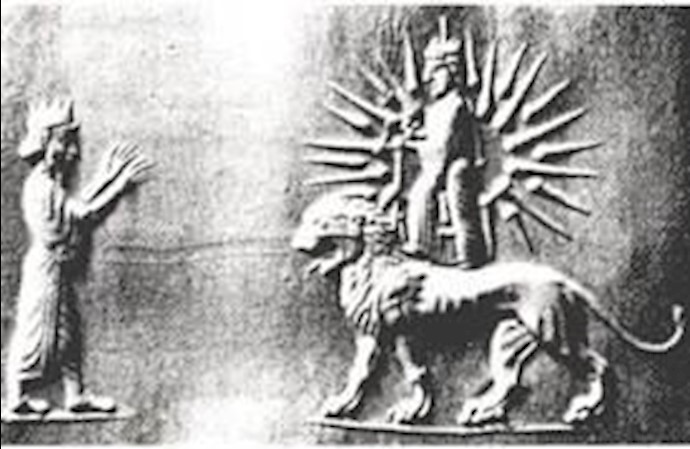
A plaque from Achaemenid times depicting such a motif seen with Artaxerxes II (404-359 BC ) being faced with the figure of goddess Anahita who is depicted as riding a lion – in the background (of Anahita) is the clear depiction of the sun.
As noted already, the sun is a manifestation of the ancient Iranic god Mithras, whose cult predates the Achaemenid dynasty. The sitting figure of Anahita represents fertility and life. The temples of Anahita often had canals for water streams, most likely representing another aspect of the life-giving force of the godess Anahita. In a sense the manifestation of Mithras and Anahita go beyond mere tribal symbols – they are an expression of ancient Iranian mysticism and theology.
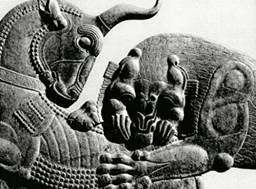
It is also important to note the astrological relationship between the Lion and Sun in Iranic mythology, a relationship that has spanned across centuries of time. As noted by Nafisi (1949, pp.55) the unique relationship between the Lion and the Sun is an ancient Iranian concept which views this relationship as a Zodiac sign.
Lion and Sun in The Partho-Sassanian Era, connections to Mithras
The Parthian dynasty (c. 250 BC-224 AD) was the first Iranic dynasty to succeed the post-Alexandrian Seleucids in Iran. As noted by Tertullian, the Parthian standard displayed an image of the sun (Apologeticum, 16).
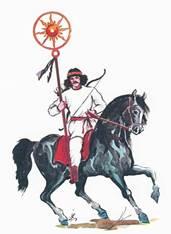
The Sassanians (224-651 AD) defeated the Parthians at Hormuzgan in 224 AD. The Sun-God was to increase in significance during the Sassanian dynasty. Stone inscriptions of Ardashir for example do mention the name of Mithras or “Mehr”, which as stated earlier is manifested by the sun symbol.
The Sun-God Mithras known as “Mehr” is also the name of various Partho-Sassanian and other Iranic kings: Mehr-dad (in Iranic) or Mithradates (n Greco-Roman sources) is now a major entity. Mehr or Mithras is clearly displayed in Sassanian relief work at Tagh-e-Bostan near Kermanshah. In the excavations of Shadiakh, Nishabur, there are traces of lion and sun dating back to the foundation of the city of Nishbur in the 3rd century AD.
Mithras or Mehr, manifested in the Sun, as Paul Kriwaczek puts it, “stood for the contract, therefore for fairness, therefore for justice, therefore for honesty, therefore for truth, therefore for light.“
Lion and Sun in the rise of Turco-Persian Civilization, A shared Legacy between Iranians and Turks
After the overthrow of the Sassanian Persian Empire by the Arabo-Islamic forces (637-651 AD), the use of images on flags ceased with the arrival of the Caliphate. However the Iranian use of imagery in the arts did not cease and these very soon re-emerged in venues such as metal works, masonry, etc.
The Ghaznavids are known to have displayed a number of heraldic figures that resembled those found in pre-Islamic Iran. Examples of Ghaznavid patronage of ancient Iranian motifs include the ancient Shir e Iran (Lion of Persia/Iran) and other ancient Iranian motifs such as Homa (Iranic Griffin) (Nafisi, 1949, pp. 45, 48-58; Yusofi, 1962, pp. 422).
The Seljuk dynasty (ruled in Iran 1037-1194 AD) became a great patron of Iranian arts, language, literature and culture. The Seljuks virtually revived a number of ancient Iranian mythological themes such as the Simugh (Iranic Phoenix), Homa (Iranic Griffin), the Stara (Iranic for “Star”), Shir e Iran (Lion of Persia/Iran), etc. (Consult Nafisi and Minovi in references).
Illustration of the ancient Simurgh (Iranic Phoenix) on banners from the Seljuk era (Nafisi, 1949, pp. 46, 57). Seljuk banners also depicted Lions in the Iranian manner.
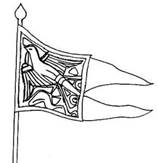
Revival of the Lion and Sun as an Iranian pre-islamic Symbols in the Safavids era
The Safavid dynasty (1501-1722) was the first Iranian dynasty which finally reunited much of the old realms of the pre-Islamic Sassanian state. While certainly true that the Safavids were fierce proponents of the Shia branch of Islam, they were very cognizant of the Iranian national ethos and identity. The flag of Iran at the time of shah Ismail II was a basic green color inset with the yellow figure of the sun. This flag soon changed into the Lion-Sun motif retaining its green background.
As in Sassanian times, the sun is used to refer to Iran as “Khorsheed e Iran” or “the Sun of Iran“. This is of keen interest as the western rivals of the Safavids, the Ottoman Turks, had adopted the crescent shaped moon as their symbol. As noted earlier, the pre-Islamic Sassanians had referred to the Romano-Byzantines to the west as being symbolized by the moon. By the time of the Safavids, the Ottoman Turks had fully displaced the Byzantines in Anatolia. As in Sassanian times both the lion and the sun acquired an exalted status, however in this case, these two motifs became central to the Iranian flag.
However, it is important to note that the Safavid selection of the sun and lion motif was also applied within a Shiite Islamic context as well. The sun of Mithras was in pre-Islamic Iran, yet another display of the celestial “Farr” or “Divine Glory“. By the post-Islamic era and especially by the onset of the Shiite Safavids, the “Farr” had been redefined as “Nur” or “light” in Arabic. The Prophet of Islam and the Imam Ali were ascribed with the “Nur ol Anwar” or “light of lights“. It is of interest that Iranian post-Islamic arts often portray divine figures in possession of the “Nur ol Anwar” as being bestowed with halos of light (consult Qazvini, 1979, pp. 165), without actually revealing their faces.
The lion motif was also “linked” to Shiite theology. The pre-Islamic lion of Persia also known as the “Shir e Khoda” or “Lion of God” now also referred to the Imam Ali as “Asadollah” or “Lion of God” in Arabic (consult Qazvini, 1979, pp. 165, 472). Interestingly the Safavids also claimed descent from the house of Imam Ali (Kasravi, 1944).
Retaining the Lion and Sun in Iranian Flag by The Qajars:
As noted by Nafisi (1949, p. 74), the Qajars considered themselves as the heirs of the Safavids. In this respect, Agha Mohammad Khan Qajar (1742-1797) was to retain the Lion-Sun motif as Iran’s primary symbol.
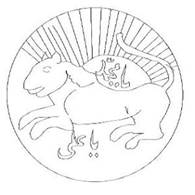
The Shahnameh epic of Ferdowsi does describe a flag depicting a lion wielding a sword. As noted by Khorasani (2006, p. 328), this coincides with the pre-Islamic Godarz Gahsvaz’s banner which displays a lion holding a sword.
The sword is an ancient and powerful symbol in Iranian theology. North Iranic peoples such as the Scythians and Sarmatians worshiped the sword as a mythological symbol (Littleton & Malcor, 2000). The veneration of the sword existed also among the Iranic peoples in pre-Islamic Persia. Despite the passage of thousands of years, this pre-Islamic ritual has survived among the Kurds. Given the ancient Iranian tradition of veneration for the sword, it is not altogether suspiring that post-Islamic Iranians (especially with the onset of Shiism during the Safavid era) would adopt the Zulfaqar, or the sword of Imam Ali as a potent religious symbol.
The appearance of the Green-white-red tri-color motif appears to have been later during the Qajar era. By 1886 the tricolor (Green-White-Red) legend was applied onto the Iranian flag bearing the Sword-wielding lion and Sun motif. In the Amir Kabir version of the Lion and Sun flag, the white portion was larger than the green and red. In 1906 Constitutional Revolution, an amendment was made to equalize the colors.
Lion and Sun on the 3-colored flag, Meaning of the colors:
The actual meaning of the colors is heavily debated. In general, Green is said to represent Islam, white peace and industriousness and red for courage. The latter color (red) was reported among Sassanian troops by Ammianus Marcellinus (24.8, 1).
Simply put, the tri-color Iranian flag with the Lion-Sun motif has been established as the national Iranian flag during the Constitutional Revolution which was greatly indebted to Sattar Khan. What is significant is that the Iranian flag during the Constitutional revolt was not solely representative of the ruling cast at the time – the Qajars.
In fact, it is by all appearances very similar to its predecessors in the 19th and early 20th centuries. In 1964,
The roots of the sword-wielding lion and sun can be traced back across the millennia to ancient Iranian mythology, astrology, statecraft, and cultural identity.