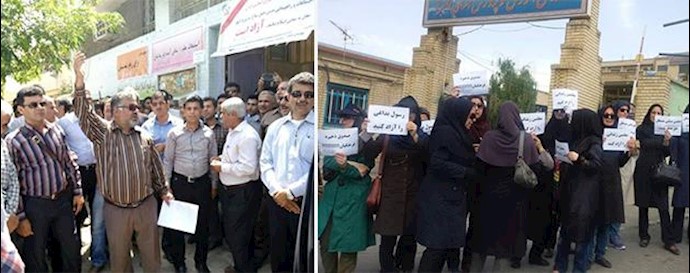
Gulf News – 06/04/2015 – Recent months have witnessed a series of unrelated, nationwide protests in Iran by teachers demanding salary hikes as well as ethnic groups decrying government abuse and calling for greater rights. With the exception of the teachers, most of the protests erupted spontaneously sparked by incidents as well as pent-up anger and frustration.
The protests potentially signal that Iran is not immune to the winds of change blowing across the Middle East and North Africa that is locked in multiple, often bloody conflicts between social and political forces demanding political change and conservative governments determined to cling to the status quo.
To be sure, Iran’s territorial integrity unlike that of Syria, Yemen, Iraq and Libya is not being called into question. Iran in contrast to many other nations in the region boasts a strong state, rooted institutions, an imperial history and a culture that dates back thousands of years.
Complicating the government’s need to manage and meet expectations once sanctions are lifted is a greater restiveness among ethnic minorities in provinces like Sistan and Balochistan, predominantly Azeri East Azerbaijan, Arabs in Khuzestan and primarily Kurdish West Azerbaijan. Demands for greater social, economic and cultural rights are being expounded by opposition groups operating largely from exile among which the Mujahedeen-e-Khalq has been the most prominent.
Mujahedeen who have associated themselves with the teacher protests as well as protests on the soccer pitch in the oil-rich Khuzestan capital of Ahwaz, has successfully got itself taken off US and European terrorism lists. The group has won endorsements from an impressive list of Western politicians and former senior government officials and military commanders on both sides of the Atlantic.
Speakers at this year’s mass rally in Paris include former chairman of the US Joint Chiefs of Staff General Hugh Shelton, former FBI director Louis Freeh, former CIA director James Woolsey, former US Homeland Security Secretary Tom Ridge, former French foreign minister Bernard Kouchner, former French defence and foreign minister Michelle Alliot-Marie, former Canadian prime minister ’Kim’ Campbell, former Algerian prime minister Sid Ahmed Ghozali, former Italian foreign minister Giulio Tertzi and a host of other luminaries from the United Nations and the European Commission.
The Mujahedeen appear to have focused on the demonstrations by teachers in a host of Iranian cities as well as Khuzestan where the group publicized recent protests on the soccer pitch.
Ethnic Arabs have long complained that the government has failed to reinvest oil profits to raise the region’s standards of living. The World Health Organization (WHO) identified Ahwaz in 2013 as Iran’s most polluted city.
The protests in East Azerbaijan and Khuzestan like a riot in Kurdish West Azerbaijan earlier this month, exposed the gap between the government in Tehran and various ethnic communities. Riots erupted in the majority Kurdish city of Mahabad after a 25-year old hotel maid died jumping from a fourth floor balcony as she tried to escape from an intelligence official allegedly trying to rape her.