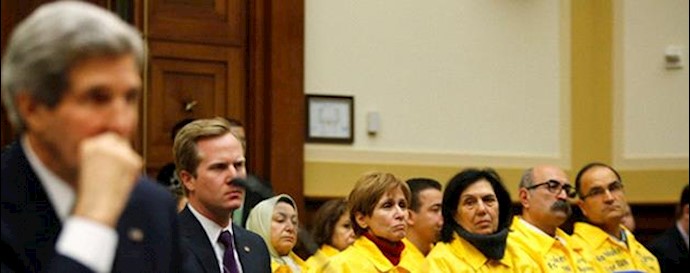
Lawmakers on Capitol Hill are taking a renewed interest in the Iranian opposition group Mujahedeen-e-Khalq (MEK) following the nuclear agreement with Tehran, Al Monitor reported.
Democrats and Republicans on the Senate Armed Services Committee on Oct. 7 urged the Obama administration to speed up the resettlement of the remaining MEK refugees in a camp near Baghdad. They also want the United States to put more pressure on Prime Minister Haider al-Abadi’s government to protect MEK members from alleged attacks by Tehran-backed assailants.
“These are people who peacefully disarmed and protected American soldiers when we went into Iraq,” said Sen. Thom Tillis, R-N.C. “And we made a promise that we would take care of them.”
“I think we need to put the pressure on [the administration],” Tillis said. “This is wrong. It’s not what America stands for.”
The State Department says it’s working diligently on the issue.
“The relocation of the remaining residents of Camp Hurriya outside of Iraq remains a high priority for the United States,” said a State Department official. “The State Department believes the only way the residents of Camp Hurriya can be made safe is by finding them safe, secure, and permanent locations to live outside of Iraq.”
While relocation efforts dominated the Oct. 7 hearing, the subtext was a much broader debate over whether — and how much — to continue to confront Iran despite the nuclear agreement.
Tehran had asked the United States to crack down on the MEK as part of the early talks that eventually led to this summer’s landmark agreement, the Wall Street Journal reported in June. Current and former officials told the newspaper that they refused.
Some of the MEK’s allies in Congress view the MEK members as “freedom fighters” who could present a viable, democratic alternative to the mullahs
Former Sen. Joseph Lieberman and two retired military officials urged lawmakers to keep the pressure on Iran — a message that resonated with members of both parties.
“I think we would be derelict and disloyal to our own national values if we did not find better ways – overt and covert – to support the democratic opposition to the dictatorial regime in Iran,” said Lieberman, a Democrat turned independent.
“Sen. Lieberman, I don’t think I could summarize any better than you just did,” answered committee chairman John McCain, R-Ariz. “We’ll continue this effort.”
Sen. Richard Blumenthal, D-Conn., said he was “struck” by Lieberman’s contention that some officials’ hopes for a “new era” in US-Iranian relations should not preclude Congress from keeping the pressure on Iran. Blumenthal is one of a handful of Democrats who have signed on to new Iran legislation from Sen. Ben Cardin, D-Md.
“I’d like to take this occasion to say that Iran is unlikely to change its behavior or conduct in the region in the wake of that agreement; if anything, flush with additional financial resources and with a need to demonstrate its revolutionary ambitions, it almost certainly will increase its mischief in that area,” Blumenthal said. “And I would invite you to suggest other areas that perhaps we should pursue that could counter that continuing influence — and obviously our keeping our promise in this instance is one that’s important.”
Gen. James Jones, President Barack Obama’s former national security adviser, told lawmakers that Iran is consolidating its grip on Iraq. He urged them to push back.
“Frankly I think it’s very important for the United States to re-establish its independence in this matter,” Jones told Al-Monitor after the hearing. “We live by our commitments; we do the right thing. Airlifting … however many are left out of there should not be a problem.”
And Col. Wesley Martin, the former commander of the base where the MEK refugees were located before moving to the Baghdad area, said the United States owed a “debt” to the MEK.
“Many of my soldiers and Marines got to come home because of the work done by the MEK at Camp Ashraf,” Martin told Al-Monitor. “I cannot pay that debt back. But I can try, as often as I can.”