Wednesday, December 17, 2008
By Jean Levert
Source: December 2008 issue of the French monthly Afrique Asie,
(This article has been translated from its original in French)
Iranian Opposition, based in the city of Ashraf, Iraq, the Mujahideen who founded it in 1986, have managed to prosper a city on a democratic basis. Tehran that has never accepted it, as against its most organized opponents, which are both political refugees and persons protected by international law.
Located near the town of Khalis, about 100 km north of the Iraqi capital, the city of Ashraf appears as an oasis in the desert. On the road from Baghdad, six years after the war, a landscape of desolation affects any observer. Upon arrival to the city, the contrast is striking with a clean and green beauty. It is located in Diyala province, known as “Little Iraq” because of its diverse population. Kurds, Turkmens, Arabs, Shiites, Sunnis and Christians can co-exist.
Brotherhood of Arab-Iranian
Ashraf is not a city like any other. With some 70 km from Iran, its population is mainly Iranian. This area of Iraq is populated by the People’s Mojahedin (PMOI). They founded this city in 1986. At the time, the government of Jacques Chirac in France had made a deal with Tehran on the release of French hostages in Lebanon in exchange to pressure Massoud Rajavi, the historic exiled leader of People’s Mujahideen in Paris. Rather than give in to the dictates of the French authorities, he preferred to leave and move on to this hostile land, near Iran. Iraq was then at war with the mullahs. The Iraqi government welcomed with open arms this illustrious opponent, realpolitik forced it to do.
Aware of the danger of extradition, Massoud Rajavi took precautions before leaving Paris. Upon his arrival, an Iraqi declaration recognized the Iranian Resistance’s independence in areas of policy making, organization and ideology on its soil. Despite having participated in the war to defend the homeland to face the Iraqi invasion, the National Council of Resistance took the initiative to defend the peace when Iraq withdrew its troops from Iran. Once in Iraq, the Mujahideen, for which there is no question of intervening in Iraqi affairs, were considered political refugees and their bases as inviolable. United Nations officials who at time met with the People’s Mujahideen were struck by their independence from Baghdad. More than a thousand members of the resistance then joined Massoud Rajavi and built what would become the headquarters of the Iranian Resistance. Today there are over 3,500 men and women of all ages. There are survivors of the massacre in the prisons in 1988, youth from various parts of Iran but also from European and American universities. It also crosses many students who actively participated in movements that drive the Iranian universities since 1999 and have been suppressed. The level of education of the people of Ashraf is one of the highest in the Iranian Diaspora: here graduates from Harvard or Sorbonne alongside the farmers from Kermanshah or Khuzistan provinces bordering Iraq live together.
On an area of 36 square kilometers in desert, the Mujahideen have built parks and buildings, stadiums and university that teach law, computers, medicine, languages, including Arabic and English. There are also bakeries and pastry shops, workshops and a computer plant Ashraf Cola, the favorite drink of combatants under the burning sun of Iraq.
We must not forget that Ashraf was originally a vast military camp, the headquarters of the National Liberation Army of Iran (NLA). Some remains of American bombing are still visible but, unlike the rest of Iraq, the Mujahideen have rebuilt. Like other foundations of the NLA, Ashraf was terribly shelled during the war. The People’s Mujahideen had been careful to show their neutrality during the conflict. But the secret agreements consummated in Geneva between Washington and Tehran ignored this.
In exchange for a promise not to intervene in the war and other treacheries, Tehran demanded that the Anglo-American coalition bombard its opponents. Desire fulfilled. Everything has been reduced to piles of cement and dust, dozens of Mujahideen were killed and many were injured. Immediately after the war, they started to rebuild their base. Then came an extremely difficult period, where they were regrouped in Ashraf. After complicated talks with the occupying force, they accepted a voluntary disarmament. During sixteen months, seven American intelligence bodies interviewed the Mujahideen one by one, seeking a record justifying their retention on the U.S. terrorist list in vain. In concluding of this investigation, a senior U.S. authority acknowledged in the New York Times of 27 July 2004, that no link to terrorism had been found. At the price of a long legal battle, the victory earned Mujahideen recognition as protected person under the Fourth Geneva Convention provided that they were disarmed by occupying force. Now they are political refugees and protected persons, international humanitarian law and international law prohibit their forced expulsion or extradition and guarantee their judicial protection.
A dam against fundamentalism
Meanwhile, Iranian intelligence services have circulated worst rumors about Ashraf. For the past Six years the city has been under the international spotlight. In fact, multiple visits by European parliamentarians has helped to publicize its democratic nature more and more. The internal relations enable the people to preserve their unity despite difficult conditions and has mainly contributed to establish close links with civil society, tribes and political parties in Iraq.
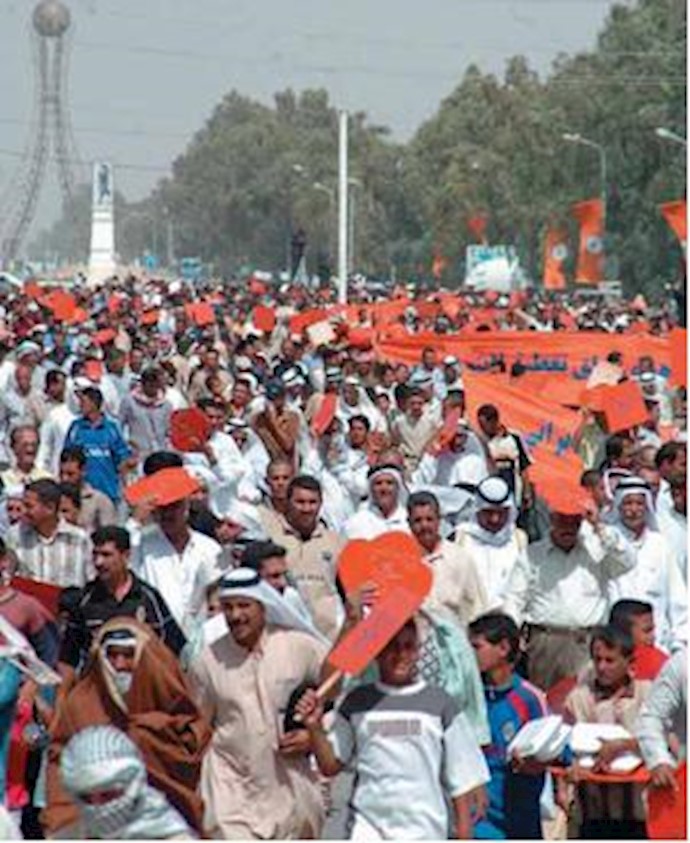
In June 2006, 5.2 million Iraqis of all religion and ethnic backgrounds signed a petition warning against the dangers of the Iranian regime in Iraq and supporting the People’s Mojahedin of Iran (PMOI). On 14 June 2008, delegations from southern provinces of the country presented to Sedigheh Hosseini, the secretary-general of PMOI, a statement signed by 3 million Iraqi Shiites, saying: “Believing in the true Islam, the PMOI, which is opposed to fundamentalism and extremism and that is the alternative to this regime and its counterweight, is a barrier and a powerful obstacle to the interference of the regime and stands with the Iraqi people.”
Today Tehran’s meddling in Iraq, viewed by the Iraqi people as a second occupation, is a devastating phenomenon. Iraq has always been the candidate of choice for the gateway to the Arab world for export of revolution by mullahs. Taking advantage of the ignorance of the Americans at the end of the war, Iran infiltrated to Iraq 32,000 of its agents, including the famous Badr Brigade, which belonged to Abdul Aziz al-Hakim, formed from a special unit of the Pasdaran (Revolutionary Guards). This force not only served many death squads that have mostly targeted the Iraqi civilian population, but also penetrated in different spheres of power.
One objective of Iran is the destruction of Ashraf, which symbolizes a bastion of resistance to the ayatollahs. Ashraf therefore suffered direct pressure from Tehran and its Iraqi agents. Sabotage of its water supply, attacks with surface-to-surface missiles manufactured in Iran, attacks against Iraqi workers and killing hundreds of Iraqi personalities supporting the resistance has been the price for its defense.
Avert a new Sabra and Shatila
Today Tehran is conspiring to transfer the protection of Ashraf to Iraqi security forces. Amnesty International, International Federation of Human Rights (FIDH) and all international organizations warn against a terrible tragedy that is being prepared, even a scenario of Sabra and Shatila. Given the extent of infiltration into Iraq of the Revolutionary Guards, the transfer of the protection of Ashraf would invite a humanitarian disaster. The statement by the Iraqi Cabinet in June, prohibiting any contact with the people of Ashraf and demanding “full control” of the PMOI “until its expulsion from Iraq” reinforces the concern. The Iraqi Minister of Justice even threatened Ashraf of “destruction”. A strong mobilization is necessary to prevent the Americans who bombed and disarmed Mujahideen of Ashraf from contributing to a tragedy. But any observer is struck by the calm and discipline that prevail in this land of peace, while it sits in the eye of a storm. Ashraf may be the key and the solution of crucial issues in the region.