WASHINGTON—The Obama administration is buying 32 tons of heavy water, a key component in atomic-weapons development, from Iran in an effort to safeguard its landmark nuclear agreement with the country, according to senior American officials.
The Department of Energy’s impending purchase was driven by U.S. concerns that Iran doesn’t have the capacity yet to quickly reduce its stockpile of the material as required under the July nuclear deal, according to these officials.
Under the accord, Iran must keep its load of heavy water to below 130 tons during the initial years of the deal, and under 90 tons later. But U.S. officials said Iran has been struggling to find buyers for the material on the international market and that its stockpile is at risk of rising above that level.
The U.S. hopes its initial purchase will give other countries the confidence to purchase Iran’s heavy water in the coming years.
The deal, estimated at $8.6 million, is expected to be formally signed by U.S. and Iranian officials Friday morning in Vienna.
“The idea is: Okay, we tested it, it’s perfectly good heavy water. It meets spec. We’ll buy a little of this,” U.S. Energy Secretary Ernest Moniz said in an interview with The Wall Street Journal. “That will be a statement to the world: ‘You want to buy heavy water from Iran, you can buy heavy water from Iran. It’s been done. Even the United States did it.’”
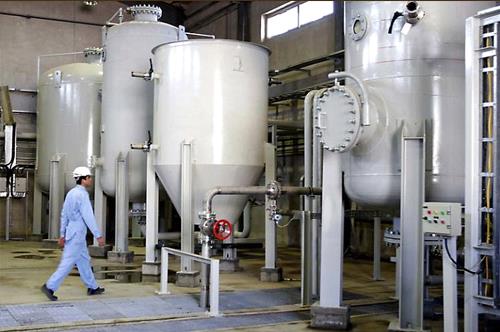
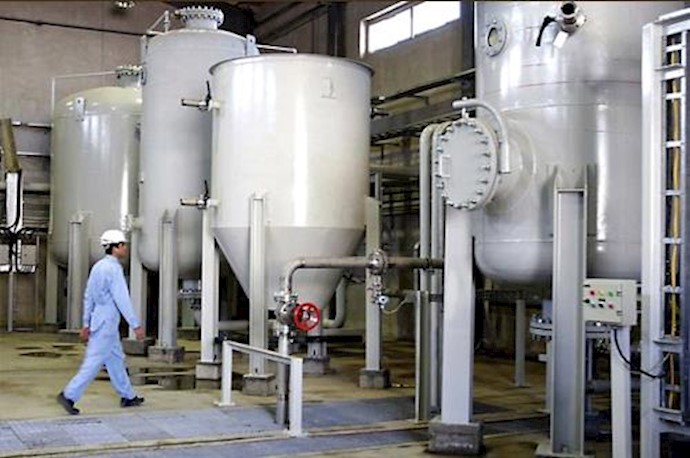
An Interior view, in October 2004, of Iran’s Arak heavy-water production facility.
Heavy water is a close chemical relative of water whose distinctive properties make it a critical component in the production of nuclear weapons and energy.
U.S. officials said the 32 tons of heavy water will be shipped by the Atomic Energy Organization of Iran to the Oak Ridge National Laboratory in Tennessee in the coming weeks. There, it will be used in a research facility that utilizes neutrons to study the makeup of a range of scientific materials.
Some of the heavy water also could be sold to private companies that use it for commercial applications, such as the production of semiconductors and fiber optic equipment.
Concerns about the heavy-water purchase
Critics of the Obama administration’s nuclear agreement, including on Capitol Hill, have raised concerns about the heavy-water purchase.
The chairman of the House Foreign Relations Committee, Rep. Ed Royce (R., Calif.), wrote Mr. Moniz on April 18 to seek clarity on the terms of the deal. He specifically asked how the U.S. would pay for the heavy water and what guarantees the administration had that the funds wouldn’t be used by Tehran to fund its military or terrorist groups.
“What assurances can you provide that U.S. taxpayer funds that Iran receives through this purchase will not be used to fund Iran’s nuclear program…or Tehran’s destabilizing activities in Iraq, Syria Lebanon and elsewhere?” Mr. Royce wrote.
In the interview, Mr. Moniz said he saw the U.S. government making only one purchase of the heavy water, which can be used to stimulate fissile reactions inside nuclear reactors.
Iran has complained that it hasn’t been able to repatriate billions of dollars of oil revenues that had been frozen due to U.S. sanctions.
U.S. law still bans Iran from entering the American financial system or conducting business in dollars. The Obama administration is deliberating ways to help Iran conduct dollarized trade without allowing it to directly access the U.S. system, according to U.S. officials.
U.S. officials wouldn’t specify how the Department of Energy would pay Iran for the heavy water.
Iranian officials have hinted at the heavy-water sale to the U.S. and praised it as an early step in support of the country’s ambitions to export its nuclear-related and scientific products.
“On the heavy water, we are among the very few developing countries which is able to produce its own heavy water and now we have entered the international market,” the head of the Atomic Energy Organization of Iran, Ali Akbar Salehi, told Iranian state media this month. “We have been able to sell more than 30 tons of heavy water just recently and this has put us on par with other countries.”
Some nuclear experts said the U.S. move comes close to subsidizing Iran’s nuclear program in a bid to keep the agreement alive. They said Tehran’s production of heavy water will remain a concern, especially when the constraints on its nuclear program are lifted after 10 to 15 years as part of the agreement.
“We shouldn’t be paying them for something they shouldn’t be producing in the first place,” said David Albright, head of the Institute for Science and International Security, a Washington think tank.
The U.S. doesn’t produce heavy water domestically, and largely has been purchasing the material from Canada and other foreign countries in recent years. It imports around 75 tons of heavy water annually, according to Department of Energy officials.
Thom Mason, head of the Oak Ridge National Laboratory, said one of his research facilities, called the Spallation Neutron Source, was being converted to use heavy water instead of light water. He said Iran emerged as a good supplier after plans to buy heavy water elsewhere fell through.
“Heavy water isn’t made in the U.S.,” Mr. Mason said in an interview. “It was fortuitous in terms of timing.”
The U.S.’s desire to constrain Iran’s heavy-water reactor in the city of Arak was one of the major issues in nearly two years of negotiations between global powers and Tehran, which culminated in last July’s agreement.
The Arak reactor was seen as largely designed to produce weapons-usable plutonium and had only limited commercial and scientific uses. Iran secretly built a heavy-water production plant in Arak in the early 2000s to feed the operations of the reactor.
Under the nuclear deal, Iran is converting the Arak facility, with China’s help, into a modified reactor that is seen as posing a much reduced nuclear-proliferation threat. Iran also is committed to limiting its production of heavy water for the reactor for 15 years.
“People have already forgotten that it wasn’t that many years ago that the big threat was considered to be the Arak reactor,” Mr. Moniz said. “We had to take care of that. That has gotten taken care of, in spades.”
Source: Wall Street Journal, 22 April 2016