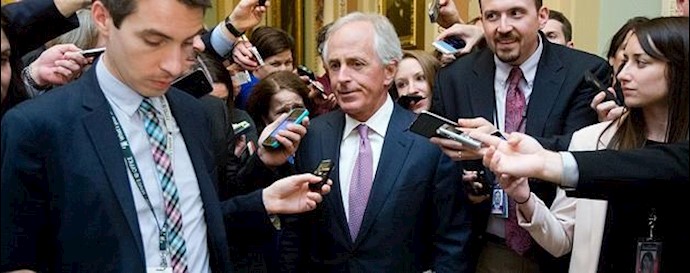
The Hill – April 29,2015 – Approximately 60 amendments have been put forward to the important bill on Iran so far, with almost half of Senate Republicans seeking to challenge President Obama’s handling of the controversial nuclear negotiations with Iran.
While the legislation crafted by Sens. Bob Corker (R-Tenn.) and Ben Cardin (D-Md.) has been endorsed by the White House, Democrats are warning that all bets are off if controversial amendments are attached.
“Amendments that undermine the administration’s negotiations or structurally alter this careful bipartisan compromise should be rejected by the Senate,” said Sen. Jeanne Shaheen (D-N.H.), who voted for the legislation during a Foreign Relations Committee markup earlier this month.
Under the Corker-Cardin agreement, lawmakers would have 30 days to pass a resolution of disapproval of any final deal. If a disapproval resolution were to become law, Obama would not be able to waive some congressional sanctions on Iran.
Corker said Tuesday that the legislation, in its current form, has the 67 votes needed to override a presidential veto.
Still, Senate Republicans are worried the bill doesn’t go far enough and want to tie the nuclear pact to a range of other issues, including Iran’s support of terrorism, the release of American prisoners and Israel’s right to exist.
Raising the stakes, the push for those changes is coming from several of the GOP’s presidential hopefuls, Sens. Marco Rubio (Fla.), Ted Cruz (Texas) and Rand Paul (Ky.)
Voting against the amendments could be politically perilous, and Democrats insist they should not have to bear the burden alone.
“It shouldn’t be up to Democrats to kill these amendments,” Sen. Minority Leader Harry Reid (D-Nev.) said. “We should get some help from our Republican colleagues.”
Sen. John Thune (R-S.D.) acknowledged Democrats are facing “hard votes” on the Iran bill but said Majority Leader Mitch McConnell (R-Ky.) is committed to letting the process play out.
“I don’t think the leader has any intention of shutting things down until everybody has an opportunity to exhaust their opportunity to talk about the issues that are important to them,” Thune said.
“Some of these amendments are going to be hard votes — whether or not they get attached to this remains to be seen.”
McConnell, who is expected to huddle with Corker and Cardin about which amendments will be considered on the floor, said on Tuesday said the Senate “ought to have a full and open and robust amendment process, and I believe that’s what we’ll have.”
Senators began voting on the amendments early Tuesday evening.
Democrats are pressing Republicans to limit the focus of their amendments to Iran’s nuclear program.
“The purpose of this undertaking, the negotiating with Iran, is to stop that nation from acquiring nuclear weapons that would threaten Israel’s right to exist,” Sen. Dick Durbin (D-Ill.) said.
Defense hawks, including Sens. Lindsey Graham (R-S.C.) and John McCain (R-Ariz.), have said they will back the legislation without amendments.
Sen. Dan Coats (R-Ind.) stressed that passing the legislation is “absolutely essential.”
“Its passage will send a message more important than any amendments, no matter how correct or well conceived if those amendments would doom the bill,” he said. “If this bill is defeated … Congress will have become a spent force. Iran will see that Congress is no longer a concern for them.”
But many of the Republicans aren’t giving up their push for amendments.
Sen. Ron Johnson (R-Wis.), who is up for reelection in 2016, is pushing for the Iran deal to either be considered as a treaty or to require a majority vote in both chambers for ratification.
Corker dismissed Johnson’s amendment as unrealistic, and it was rejected Tuesday night in a 39-57 vote.