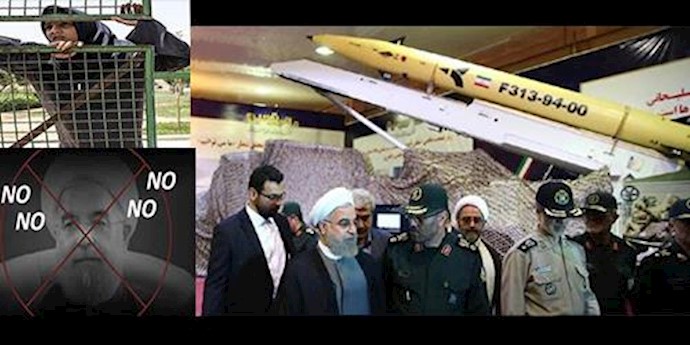
A farfetched idea that there are principal differences between the two ruling factions in Iran has prompted some to believe that they can work with one side against the other and that the so called ’moderates’ or ’reformists’ would eventually gain the upper hand among the country’s elite. But facts on the ground speak quite differently.
Not only the economic situation in Iran has not improved since the signing of the nuclear deal late last year, the Rouhani government has resorted to cutting subsidies on people’s everyday basic needs to cover for part of the deficit in the budget.
Based on government’s own statistics, there are more than 1,000,000 unemployed college graduates and the number in on rise.
Rouhani’s own spokesperson has admitted that the government is unable to complete more than half of its infrastructural projects due to lack of money.
An article published recently by Amir Basiri, an Iranian human rights activist and supporter of democratic regime change in Iran assesses the political and accountability coordinate of the so-called moderates in Iran.
The article is titled “Did ’Moderates’ win Iran’s ’Elections’?” and has been published in the number of prominent websites.
The following is extract from the article:
Iran held “elections” late last month. Headlines across the Western media loudly declared a victory for “moderate” electoral forces, with the implicit strapline that there is no longer an ethical case against doing business in Iran. This is music to the ears of would-be profiteers — and their would-be partners in Tehran — who are keen to get their teeth into the Iranian market.
The truth remains, however, that Iran is ruled by one of the world’s most evil regimes, and these “elections” do nothing to alter that fact. From day one of the “Islamic Revolution” in 1979, various factions of Western political elites have practiced willful self-delusion when it comes to Iran, insisting that “moderates” or “reformists” exist and are only an election cycle away from fundamentally changing everything. But this has always been a lie, and one which becomes more transparent and more farcical every time it is told.
Why “Elections” in Scare Quotes?
There were ballot papers, of course. But who was on them, and how did they get there?
The answer to that question tells you everything you need to know about democracy, Iran-style. Every single candidate running in these “elections” was vetted and pre-approved by a committee of six clerics and six sharia judges, all of whom are appointed by Supreme Leader Ali Khamenei.
When more than half of the initial 12,000-plus parliamentary hopefuls are disqualified for insufficiently zealous loyalty to the regime, and when over 600 of the 800 candidates running for the 88-seat Assembly of Experts are purged for the same reason, the term “election” seems inappropriate in this context.
Why “Moderates” in Scare Quotes?
We already know that two former intelligence ministers, Ghorbanali Dorri-Najafabadi and Mohammad Mohammadi Reyshahri, ran for the Assembly of Experts on a list supported by Iran’s “moderate” president, Hassan Rouhani.
Iran’s democratic opposition, the National Council of Resistance of Iran, has repeatedly accused both of orchestrating the murder of political dissidents.
These are just two examples.
Former Iranian president Akbar Hashemi Rafsanjani, now the putative leader of Iran’s “moderate” faction, is wanted for questioning over his role in the 1994 Buenos Aires Jewish community center bombing that left 85 dead and hundreds wounded.
Ali Fallahian, another ex-spy chief who unsuccessfully attempted to gain a seat alongside his fellow “moderates” in the Assembly of Experts, is notorious among Iranians for stage-managing the horrific “chain murders” of the late 1990s. If these are the moderates, imagine what the “hardliners” are?
What Does the Future Hold?
The Islamic Republic of Iran’s history is one of tyranny and terror, and its future holds more of the same in store. In the absence of genuine, free, and fair elections, anyone forecasting a brighter tomorrow is guilty of wishful thinking to say at least. Iranians are crying out for change – fundamental change, regime change — but their “elected” representatives will continue to ignore them; their loyalty to the status quo has already been tested, and is assured. Even if by the most elusive imagination one would think that there are some loyalty to people, Iran’s parliament, the Majles-e Showra-ye Eslami (translation: Islamic Consultative Assembly), has no real authority. As its name suggests, its role is that of an advisory council; a rubber stamp, in other words. So expect nothing new or different from Iran’s fundamentally unreformable regime.
Rather, expect it to continue its proxy wars against the United States and its Middle Eastern allies, using the windfall of billions of dollars from sanctions relief to purchase even more — and more advanced — weapons. Expect it to take further dangerous steps in defying non-nuclear-related restrictions, like the ballistic missile tests we saw after the nuclear agreement was sealed. And expect the appeasers in Washington to go on turning a blind eye to it all, waxing lyrical about the “moderates” that don’t exist, and the “reforms” that never change anything.