
Fars is one of the thirty-one provinces of Iran and known as the cultural capital of Iran. It is in the south of the country, in Iran’s Region 2, and its administrative center is Shiraz. It has an area of 122,400 km². In 2006, this province had a population of 4.57 million people, of which 61.2% were registered as urban dwellers (urban/suburbs), 38.1% villagers (small town/rural), and 0.7% nomad tribes. The etymology of the word “Persian” (From Latin Persia, from Ancient Greek Περσίς (Persis)), found in many ancient names associated with Iran, is derived from the historical importance of this region.
Fârs, or known in Old Persian as Pârsâ, is the original homeland of the ancient Persians. The native name of the Persian language is Pârsi. Persia and Persian both derive from the Hellenized form Πέρσις Persis of the root word Pârs. The Old Persian word was Pârsâ. Fârs is the Arabized version of Pârs, as Arabic has no [p] phoneme.
History
Persis/Pars
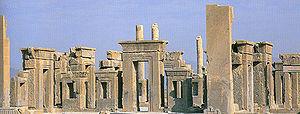
The ruins of Persepolis
The ancient Persians were present in the region from about the 10th century BC, and became the rulers of the largest empire the world had yet seen under the Achaemenid dynasty which was established in the late 6th century BCE, at its peak stretching from Thrace and Macedonia in the west, to the Indus Valley in its far east. The ruins of Persepolis and Pasargadae, two of their four capitals, are located in Fars.
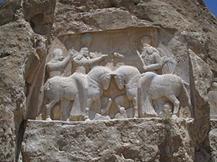
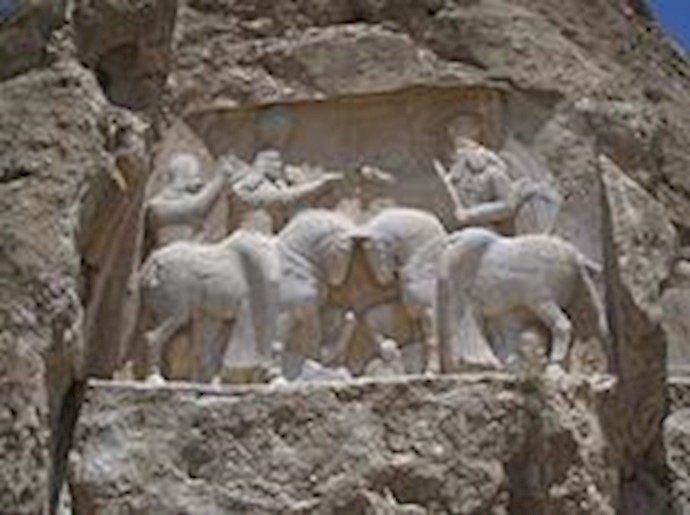
Alexander III of Macedon defeated the Achaemenid Empire in 333 BCE, incorporating most of its vast territory. Shortly after this the Seleucid Empire was established. However, it never extended its power beyond the main trade routes in Fars, and by reign of Antiochus I or possibly later Persis emerged as an independent state under the Parthians who minted their own coins. In 224 BCE Pathians were defeated by Ardashir I, who established a new dynasty. He was crowned at Ctesiphonas as the sole ruler of Persia, bringing the 400-year-old Parthian Empire to an end, and starting the virtually equally long rule of the Sassanian Empire. The Sassanid ruled over an even larger territory, once again making Persia a leading power in the
known world, only this time along its arch rival, the Byzantine Empire.
The Sassanids ruled for 425 years, until the Muslim armies conquered the empire. Afterward the Persians started to convert to Islam. This made it a lot easier for the new Muslim empire to continue the expansion of Islam.
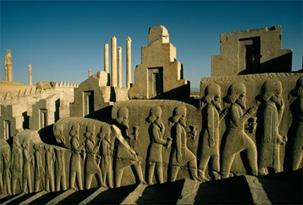
Persis then passed hand to hand through numerous dynasties, leaving behind numerous historical and ancient monuments; each of which has its own values as a world heritage, reflecting the history of the province, Iran, and West Asia. The ruins of Bishapur, Persepolis, and Firouzabad are all reminders of this.
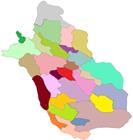
Administrative divisions
The province is divided into 27 counties. They are Abadeh, Eghlid, Khorrmbid, Rostam, Mamasani, Speidan,
Bavanat, Pasargad, Marvdasht, Shiraz, Kazerun, Kharameh, Nayriz, Estahban, Sarvestan, Kavar, Firuzabad,
Jahrom, Fasa, Farashband, Qir and Karzin, Zarrin Dasht, Khonj, Mohr, Gerash, Larestan, Lamerd.
Climate and wildlife
Agriculture is of great importance in Fars. The major products include cereal (wheat and barley), citrus fruits, dates, sugar beets and cotton. Fars has major petrochemical facilities, along with an oil refinery, a factory for producing tires, a large electronics industry, and a sugar mill. Tourism is also a large industry in the province. UNESCO has designated an area in the province, called Arjan (known as Dasht e Arjan) as a biosphere reserve. Shiraz, provincial capital of Fars, is the namesake of Shirazi wine. A large number of wine factories existed in the city.
Demographics
The main ethnic group in the province constitutes of Persians (including Larestani people), while Lurs, Qashqai, Kurds, Arabs, Georgians, and Circassians constitute minorities.
Due to the geographical characteristics of Fars and its proximity to the Persian Gulf, Fars has long been a residing area for various peoples and rulers of Iran. However, the tribes of Fars including Qashqai Turks, Mamasani Lurs, Khamseh and Kohkiluyeh have kept their native and unique cultures and lifestyles which constitute part of the cultural heritage of Iran attracting many tourists. The province has a population of 4.4 million approximately.
Higher education
The main universities of the province include Shiraz University of Medical Sciences, Shiraz University, Shiraz University of Technology and Islamic Azad University of Shiraz.
Notables from Fars
• Mansur Hallaj Persian Mystician, killed in 8th century AC.
• Salman the Persian was born in Kazerun.
• Saadi, writer, poet, born and died in Shiraz.
• Hafiz Shirazi, poet, born and died in Shiraz.
• Mulla Sadra was born in Shiraz.
• Qotb al-Din Kazeruni was born in Kazerun.
• Sibawayh, one of the founders of Arabic grammar, died in Shiraz.
• Karim Khan, founder of the Zand dynasty.
• Lotf Ali Khan, the last ruler of the Zand dynasty.
• Ibn Muqaffa, or Ruzbeh Dadwayh, Persian writer and translator in 8th century AC.
• Zahra Kazemi, photographer, born in Shiraz and killed by present government agents while visiting Iran
• Khwaju Kermani, buried in Shiraz.
• Ibn Khafif, a 9th-century sage, is buried in Shiraz.
• Meulana Shahin Shirazi, Persian Jewish poet and wiseman.
• Junayd Shirazi
Shiraz
is the fifth most populous city of Iran and the capital of Fars Province. In 2009 the population of the city was 1,455,073. Shiraz is located in the southwest of Iran on the Rood khaneye Khoshk (Dry river) seasonal river. It has a moderate climate and has been a regional trade center for over a thousand years. It is regarded as one of the oldest cities of ancient Persia.
The earliest reference to the city, as Tiraziš, is on Elamite clay tablets dated to 2000 BC. In the 13th century, Shiraz became a leading center of the arts and letters, due to the encouragement of its ruler and the presence of many Persian scholars and artists. It was the capital of Persia during the Zand dynasty from 1750 until 1781, as well as briefly during the Saffarid period. Two famous poets of Iran, Hafez and Saadi, are from Shiraz.
Shiraz is known as the city of poets, literature, wine and flowers. It is also considered by many Iranians to be the city of gardens, due to the many gardens and fruit trees that can be seen in the city. Shiraz has had major Jewish and Christian communities. The crafts of Shiraz consist of inlaid mosaic work of triangular design; silver-ware; pile carpet-weaving and weaving of kilim, called gilim and jajim in the villages and among the tribes. In Shiraz, industries such as cement production, sugar, fertilizers, textile products, wood products, metalwork and rugs dominate. Shirāz also has a major oil refinery and is also a major center for Iran’s electronic industries: 53% of Iran’s electronic investment has been centered in Shiraz. Shiraz is home to Iran’s first solar power plant. Recently the city’s first wind turbine has been installed above Babakoohi mountain near the city..
History
Shiraz is most likely more than 4,000 years old. The name Shiraz is mentioned in cuneiform inscriptions from around 2000 BCE found in south western corner of the Shiraz city.
The city became a provincial capital in 693, after the Arab invaders conquered Istakhr, the nearby Sassanian capital. As Istakhr fell into decline, Shiraz grew in importance under the Arabs and several local dynasties. The Buwayhid empire (945–1055) made it their capital, building mosques, palaces, a library and an extended city wall. It was also ruled by the Seljuks and the Khwarezmians before the Mongol conquest.
The city was spared destruction by the invading Mongols, when its local ruler offered tributes and submission to Genghis Khan. Shiraz was again spared by Tamerlane, when in 1382 the local monarch, Shah Shoja agreed to submit to the invader. In the 13th century, Shiraz became a leading center of the arts and letters, thanks to the encouragement of its ruler and the presence of many Persian scholars and artists. For this reason the city was named by classical geographers Dar al-‘Elm, the House of Knowledge.[17] Among the Iranian poets, mystics and philosophers born in Shiraz were the poets Sa’di and Hafiz, the mystic Roozbehan, and the philosopher Mulla Sadra. Thus Shiraz has been nicknamed “The Athens of Iran”.
As early as the 11th century, several hundred thousand people inhabited Shiraz. In the 14th century Shiraz had sixty thousand inhabitants. During the 16th century it had a population of 200,000 people, which by the mid-18th century had decreased to only 50,000. In 1504, Shiraz was captured by the forces of Ismail I, the founder of the Safavid dynasty. Throughout the Safavid empire (1501–1722) Shiraz remained a provincial capital and Emam Qoli Khan, the governor of Fars under Shah Abbas I, constructed many palaces and ornate buildings in the same style as those built during the same period in Isfahan, the capital of the Empire. After the fall of the Safavids, Shiraz suffered a period of decline, worsened by the raids of the Afghans and the rebellion of its governor against Nader Shah; the latter sent troops to suppress the revolt. The city was besieged for many months and eventually sacked. At the time of Nader Shah’s murder in 1747, most of the historical buildings of the city were damaged or ruined, and its population fell to 50,000, one-quarter of that during the 16th century.
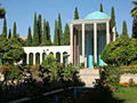
Shiraz soon returned to prosperity under the rule of Karim Khan Zand, who made it his capital in 1762. Employing more than 12,000 workers, he constructed a royal district with a fortress, many administrative buildings, a mosque and one of the finest covered bazaars in Iran. He had a moat built around the city, constructed an irrigation and drainage system, and rebuilt the city walls. However, Karim Khan’s heirs failed to secure his gains. When Agha Mohammad Khan, the founder of the Qajar dynasty, eventually came to power, he wreaked his revenge on Shiraz by destroying the city’s fortifications and moving the national capital to Tehran. Although lowered to the rank of a provincial capital, Shiraz maintained a level of prosperity as a result of the continuing importance of the trade route to the Persian Gulf. Its governorship was a royal prerogative throughout the Qajar dynasty. Many of the famous gardens, buildings and residences built during this time contribute to the city’s present skyline.
The city’s role in trade greatly diminished with the opening of the trans-Iranian railway in the 1930s, as trade routes shifted to the ports in Khuzestan. Much of the architectural inheritance of Shiraz, and especially the royal district of the Zands, was either neglected or destroyed as a result of irresponsible town planning under the Pahlavi dynasty. Lacking any great industrial, religious or strategic importance, Shiraz became an administrative center, although its population has nevertheless grown considerably since the 1979 revolution.
Climate
Shiraz’s climate has distinct seasons, and is overall classed as a hot semi-arid climate, though it is only a little short of a hot-summer Mediterranean climate. Summers are hot, with a July average high of 37.8 °C (100.0 °F). Winters are cool, with average low temperatures below freezing in December and January. Shiraz contains a considerable number of gardens. Due to population growth in the city, many of these gardens may be lost to give way to new developments. Although some measures have been taken by the Municipality to preserve these gardens, many illegal developments still endangers them.
Economy
Shiraz is the economic center of southern Iran. The second half of the 19th century witnessed certain economic developments that greatly changed the economy of Shiraz. The opening of the Suez Canal in 1869 allowed the extensive import into southern Iran of inexpensive European factory-made goods, either directly from Europe or via India. Farmers in unprecedented numbers began planting cash crops such as opium poppy, tobacco, and cotton.
Shiraz’s economic base is in its provincial products, which include grapes, citrus fruits, cotton and rice. Industries such as cement production, sugar, fertilizers, textile products, wood products, metalwork and rugs dominate. Shirāz also has a major oil refinery and is also a major center for Iran’s electronic industries. 53% of Iran’s electronic investment has been centered in Shiraz.
Culture
Shiraz is known as the city of poets, gardens, wine, nightingales and flowers. The crafts of Shiraz consist of inlaid mosaic work of triangular design; silver-ware; carpet-weaving, and the making of the rugs called gilim (Shiraz Kilim) and “jajim” in the villages and among the tribes.
The garden is an important part of Iranian culture. There are many old gardens in Shiraz such as the Eram garden and the Afifabad garden.
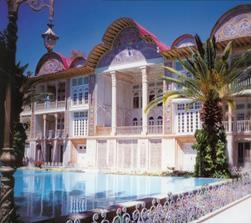
Shiraz is a center for Iranian culture and has produced a number of famous poets. Saadi, a 12th and 13th-century poet was born in Shiraz. Hafiz, another famous poet and mystic, was also born in Shiraz. A number of scientists also originate from Shiraz including Qutb al-Din al-Shirazi, a 13th-century astronomer, mathematician, physician, physicist and scientist. In his The Limit of Accomplishment concerning Knowledge of the Heavens, he also discussed the possibility of heliocentrism.