

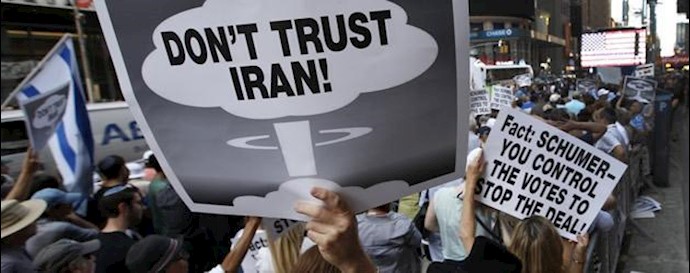
American opinions agreement have grown sharply polarized along party lines regarding the Iran nuclear, The Washington Post reported on Tuesday, September 1st citing to a new poll.
Democrats and Republicans are polar opposites in their view of the accord.
Nearly 7 in 10 Democrats support the deal. An identical share of Republicans are opposed.
The poll helps explain the White House strategy of focusing on Democratic support in Congress in advance of a vote on whether to “disapprove” the agreement reached between Iran and six world powers, including the United States. Virtually all Republicans have said they will vote against the deal.
The unique, detailed survey, which gave respondents a briefing on the issue vetted by congressional staffers and outlined core arguments for and against the agreement, shows Democratic support largely unchanged from similar in-depth surveys before the final deal was reached in July. But Republican backing has eroded dramatically, swinging from majority support to overwhelming opposition. A similar survey in February found that more than 6 in 10 people overall backed the broad outlines of a deal, with majorities among both Democrats and Republicans.
The new survey and other polls suggest that a massive campaign to stop the deal has gained traction with the public. Other recent polls, providing few details or specifics of the deal, have generally found Americans tenuous about the agreement and tilting toward opposition.
For example, 55 percent of voters opposed the deal in a Quinnipiac University poll released Monday — more than double the 25 percent who supported it.
A mid-August CNN-ORC poll found 56 percent saying Congress should reject the deal, though in a separate question, 50 percent supported the broad framework.
Some Americans have found their attitudes shifting as the debate has ground on, morphing from an initial hopefulness to wariness about Iran’s willingness to comply to outright opposition.
“I had hoped this would be a good deal,” said Diane Kugler, 61, a retired schoolteacher from Appleton, Wis., who considers herself an independent voter. “But the more I’ve read and heard, I really feel this is not a good deal.
“I feel history is repeating itself. It’s Neville Chamberlain trying to make a deal with Hitler. I think we’re running into the same situation here, because they’re still saying ‘Death to America.”
With two weeks remaining before Congress votes on Sept. 17, the surveys suggest attitudes toward the complex, nuanced agreement are malleable and could turn against the deal.
One in 5 in the Quinnipiac poll offered no opinion. In some other surveys, at least a third to more than half had no opinion. Despite wide coverage of the deal’s announcement and Obama’s news conferences, many Americans have not paid close attention to the issue. An August Kaiser Family Foundation survey found 28 percent of respondents saying they followed news about the deal “very closely.”
Nearly 8 in 10 said the decision to provide negotiated access to any suspicious, undeclared sites instead of “anytime, anywhere” inspections throughout Iran was a convincing reason to reject the deal.
Almost as many said another compelling reason was the estimated $100 billion Iran will receive of its own money currently frozen in accounts under sanctions. Critics call the money’s release a windfall and say it will fuel Iran’s expansionist ambitions throughout the region.
Those worries mirror a strong vein of distrust toward Iran captured in polls before and after the deal was announced. Most Americans lack confidence that the agreement will stop Iran from developing a nuclear weapon and expect it to cheat.
Republicans in particular fault the Obama administration for failing to negotiate a more favorable deal.
“I think that we negotiated from a position of weakness,” said Fred Morris, 72, a retired insurance executive from DeSoto, Tex., in suburban Dallas, and a Republican. “We acquiesced every time the Iranians said they wanted something, and they gave up nothing in return, as far as I can tell. The only thing Mr. Obama and others who support the treaty seem to think is talking is better than fighting. I’m not sure that’s a reasonable position.”