
The Wall Street Journal, Baghdad, 16 August 2015
A struggle among Iraq’s rival Shiite power-brokers poses a threat to Prime Minister Haider al-Abadi’s ambitious government overhaul, Iraqi and Western officials said.
The power struggle, which involves Iran-backed militias, had paralyzed Mr. Abadi and prompted a rare intervention by the top Shiite religious authority, Grand Ayatollah Ali al-Sistani. He endorsed Mr. Abadi’s overhaul plan, which was intended in part to defuse the challenge to the government, Iraqi officials said.
Mr. Sistani’s support has, at least for now, tamped down the surging tensions among Shiite groups and rallied Iraqis broadly behind Mr. Abadi’s plan.
“Iraq was like a barrel full of gas, ready to explode,” a Western diplomat in Baghdad said of the political tensions. “Something had to be done.”
But there is lingering concern this conflict could add a new layer to the country’s multiple crises as it tries to contain extremist group Islamic State and keep sectarian tensions among Sunnis, Shiites and Kurds from tearing Iraq apart.
At the root of the latest divide is the Popular Mobilization Forces—a mostly Shiite paramilitary group that came together last year to battle the extremist group Islamic State.
Some factions within the force who are more closely guided, funded, and trained by regional Shiite patron Iran have become an increasing threat to Iraq’s Shiite prime minister, Iraqi, Arab, and U.S. officials say.
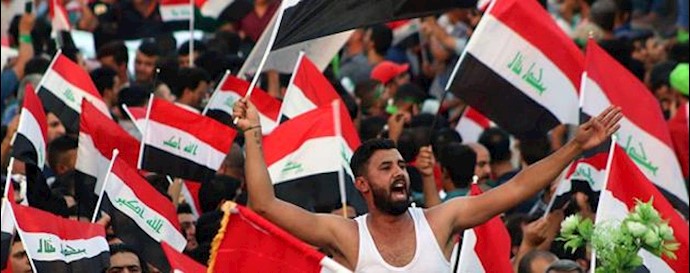
For a month now, Iraqis have taken to the streets weekly to vent frustration at power shortages that left people sweltering in summer’s peak heat—a long-standing grievance seen as a symbol of government failings and mismanagement here. The protests began in Iraq’s Shiite heartland in the south, then spread to the capital.
As Shiite militias and political parties joined the demonstrations in full force on Friday, the protests became a forum for surging tensions within the country’s majority sect.
The leader of a pro-Iran Shiite militia, Asa’ib Ahl al-Haq, earlier this month called publicly for Mr. Abadi to resign if he is unable to control “circumstances that are bigger than you.”
In response to the protests, Mr. Abadi introduced a raft of measures to revamp government and combat official corruption. The measures are supposed to end sect- and party-based quotas, something that could upend a political system that has put Shiite blocs in power since 2003, when a U.S.-led invasion toppled the Sunni-dominated regime of Saddam Hussein.
The prospect rattled the country’s Shiite political establishment.
Prime Minister Abadi has moved boldly against officials used to acting with impunity and political rivals, including Maliki, who is set to lose his post as first vice president under the reforms. Critics accuse Maliki of trying to undermine the government.
The prime minister took his first major steps to streamline government after his proposals were endorsed. First he cut 11 cabinet posts, including three deputy prime ministers, and merged eight ministries into four.
Mr. Abadi’s Shiite rivals gave their support for the overhaul after it was endorsed by Mr. Sistani, the most revered spiritual authority for Shiites, whose seat is in the southern city of Najaf.
“The scene was headed toward Shiite-Shiite conflict” before Mr. Sistani intervened, a senior Shiite official said.
The Popular Mobilization Forces came together after Mr. Sistani’s call to arms to fight Islamic State. But the group’s quick military ascension and growing political aspirations had become problematic for the ayatollah, according to some Iraqi officials and Western diplomats.
A senior Shiite official said Mr. Sistani intervened after a round of protests in which “the groups close to Iran tried to steal the movement.”
Sajad Jiyad, an Iraqi analyst, said Mr. Sistani’s recent moves were partly a genuine show of solidarity with people demanding change and partly spurred by seeing the prime minister in a deadlock.
“And part of it was the issue of the militias coming out and raising their political profile,” Mr. Jiyad said, adding that one possible outcome could have been that “they could destabilize the government, get a vote of no confidence on the prime minister.”
A parliamentary panel submitted to the parliament speaker an investigation into how the northern city of Mosul, Iraq’s second largest, fell to Islamic State last year. The report will refer dozens of senior officials to court for their role in the defeat, lawmakers said. That could result in an indictment for senior officials including Maliki, lawmakers said.
Mr. Abadi earlier paved the way for the military prosecution of senior commanders for the fall of another city, Ramadi. Islamic State seized Ramadi, the provincial capital of Anbar province, in May in what was a major setback for the government in its fight against Islamic State.
How quickly the prime minister acted to investigate the military’s shortcomings in Ramadi, versus the nearly yearlong investigation on Mosul, appeared to show new resolve, lawmakers said.
Maliki, who initially gave a statement of support for the government overhaul, has since appeared to appose some of the measures. In local television interviews, he called the moves to eliminate the vice presidency posts and a call to allow the prime minister to replace local governors “unconstitutional.”
Protester Mohammad al-Qas, holding an Iraqi flag at a rally on Friday in Baghdad, said he was no longer just marching to demand basic services or a better government.
“There are too many external influences playing in Iraq, and Iran is at the head of that,” said Mr. Qas, 48. “Abadi has to get rid of Iran.”