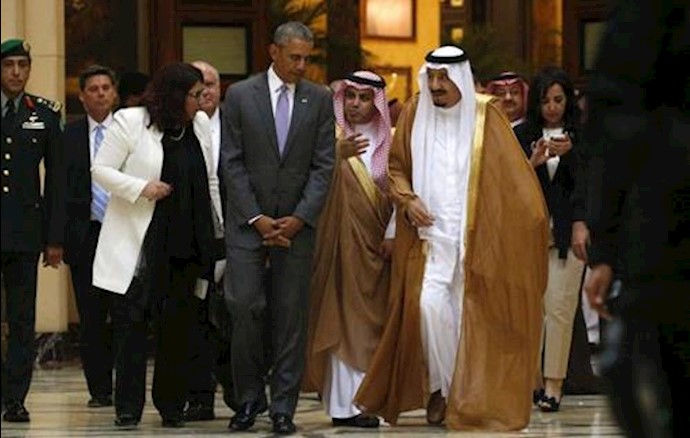
RIYADH – U.S. President Barack Obama met Saudi Arabia’s King Salman on Wednesday to seek joint action on security threats including Iran and ISIS.
Obama’s fourth and likely last visit to the world’s top oil exporter has been overshadowed by Gulf Arab exasperation with his approach to the region, and doubts about Washington’s commitment to their security.
Most of the Gulf Arab monarchies have in private been sorely disappointed by Obama’s presidency, regarding it as a period in which the United States has pulled back from the region, giving more space to their arch rival Iran to expand its influence.
Obama met for two hours with Salman and a group of top princes and officials at the opulent Erga palace.
The White House said the leaders exchanged views on a series of regional conflicts where the allies disagree.
“The two leaders reaffirmed the historic friendship and deep strategic partnership between the United States and Saudi Arabia,” the White House said in a statement.
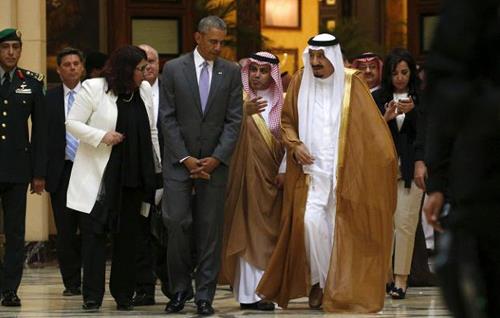
U.S. President Barack Obama and Saudi King Salman walk together following their meeting at Erga Palace in Riyadh, Saudi Arabia April 20, 2016.
“More broadly, the president and King discussed the challenges posed by Iran’s provocative activities in the region, agreeing on the importance of an inclusive approach to de-escalating regional conflicts,” the White House said.
Obama praised the king’s pledge of humanitarian aid to Yemen after a Saudi-led military campaign against the Iran-backed Houthi group.
They also talked about the need to reinforce a cessation of hostilities between Syrian government and opposition forces, and their support for a political transition in the war-torn country, the White House said.
LOW-KEY ARRIVAL
Obama arrived too late for the pomp of a televised official welcome for Gulf rulers at the airport, making a low-key entrance before being whisked off by helicopter to the palace.
He later met privately at his hotel with Abu Dhabi’s crown prince Sheikh Mohammed bin Zayed al-Nahayan and discussed the need to find a political settlement for the Yemen conflict, and to head off the “actions of potential spoilers” for Libya’s nascent government.
Earlier, U.S. Defense Secretary Ash Carter had talks with his Gulf Arab counterparts on ways of countering Iranian influence and fighting the Islamic State group.
They agreed on joint cooperation towards improving Gulf missile defense, special forces and maritime security, but no new deals were announced.
The GCC secretary general said the bloc and the United States would stage joint maritime patrols to stop weapons smuggling to Iran. American officials said these were already taking place and did not represent a new step.
On Thursday, Obama will attend a summit of the Gulf Cooperation Council (GCC), a group of monarchies comprising Saudi Arabia, Kuwait, Qatar, Bahrain, the United Arab Emirates and Oman.
Apart from Oman, they are ruled by Sunni Muslim dynasties who see Iran as a threat to their security and say its involvement in Iraq, Syria, Lebanon and Yemen has fueled conflict and deepened sectarian divisions.
That tension surfaced again on Wednesday when Iran’s Supreme Leader Ali Khamanei attacked Riyadh’s attempts to isolate its ally, Lebanon’s Hezbollah movement, in a series of fiery Tweets.
The White House shares the view of Gulf Arab states that Tehran plays a destabilizing role, but its push for the nuclear deal Iran agreed with world powers last year caused fears in Riyadh that Washington was not listening to their concerns.
Source: REUTERS, April 21