Iranian regime has widespread influence in Iraq
Syrian regime will weaken Tehran and its supporters throughout the region
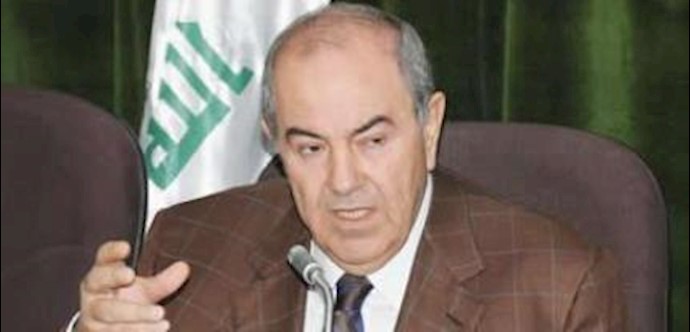
The Asharq al-Awsat daily published an extensive interview with former Iraqi Prime Minister and current Iraqiya Coalition leader Dr. Ayad Allawi.
This article is as follows:
Ayad Allawi and his coalition won Iraq’s last elections in 2010, however, the Iranian regime prevented them from forming government. Allawi agreed to back down on the condition of implementing political reforms and establishing a true national participation government based on the Arbil agreement.
Currently, Allawi and along with him Kurdistan Regional Government President Massud Barzani, Sadrists leader Moqtada Sadr and Iraqiya leaders have entered a new struggle: the fight to correct the political situation through impeaching the prime minister by the parliament.
In an interview with Asharq al-Awsat, Allawi, leader of the Iraqiya Coalition and former Iraqi prime minister, explains his efforts for a no-confidence vote against Maliki and the status of the region and Iraq which is currently in the ‘mouth of a dragon’. He is calling for quick change in conditions in Syria to prevent more bloodshed for the Syrian people.
“Our efforts to impeach Maliki remain on track. The dossiers that will be raised during the impeachment are ready…
“Muqtada al-Sadr is with us and he says if you obtain 124 votes, the 40 votes of my party in the parliament is ready to complete the legal quorum. In addition to him, KRG President Massud Barzani remains very much committed to his position.
“The Iranian regime interfered in this issue full speed and threatened many parties on a widespread basis to break the will of the impeachment issue. The US government did not have any interest in this issue gaining success because it is involved in its own presidential elections. There were many parties who agreed with our position, even inside the State of Law coalition, however they were other parties inside the government who played a major role in obstructing the efforts, and of course they were alongside the Iranian regime…
“Today, the Iranian regime has strong and widespread influence in Iraq, and it is the Iranian regime that makes the political decisions in Iraq and this is something that we felt quite obviously after the last elections and formation of the government. What took place regarding Maliki’s premiership was that he remained in his post through the pressures of the Iranian regime and the US, and everyone knows this is an enormous and flagrant aggression against the election merit because the Iraqiya Coalition won the elections yet it was not permitted to establish government.”
On the issue of the crisis between Maliki’s government and the KRG, Allawi explains, “The problem is not just between him and the KRG, in fact it is with all Iraqi provinces. And this is something that has directed most of the provinces to this position to take measures aimed at becoming a state… because they have had setbacks in many fields, including the country’s investments. Nobody takes risks over his capital in Iraq. Many people, among whom are friends who I know, are seeking to invest but there are no clear laws in this regard. Every day the government wages war against the Central Bank. In addition to this there is corruption and bribery. Therefore, this dilemma between the KRG and the central government is part of a large unrest that has engulfed the entire country due to the central government’s policies.”
Allawi also mentioned violations of the Iraqi Constitution by Maliki and said, “For someone who fires ministers however way he wants to, attacks the deputy Prime Minister or accuses the Vice President, he is the one who is violating the Constitution. We are those who have referred to the Constitution and through it we are defending the rights of all Iraqi people, including Kurds, Arabs and all minorities. The one who violates the Constitution is the one who has power in his hand and does not implement the law. Who specifies the Council of Ministers’ internal precept? Who specifies and implements the oil and gas and elections and party laws? We? Or the person who has the powers at his disposal?
“Currently, there are enormous aggressions against the Constitution, topping all of them the lack of an internal precept for the Council of Ministers. The truth is that in the Constitution there is no such post as the ‘prime minister’. He is head of the Council of Ministers. An article of the Constitution states the Council of Ministers must have a precept and currently there is no such thing. In addition to his previous term, it has been nearly two years since Maliki has been in power and the Council of Ministers continues to work without an internal precept. On appointing people to various posts, based on the Constitution the appointment of ministers, deputy ministers, advisors, director generals, military division commanders and heads of security organs must be carried out through voting in the parliament, and this has not been fulfilled. This is yet another aggression to the Constitution. Another subject is human rights that have been completely threatened.”
On Iraq’s deteriorating security conditions, Allawi said, “Currently, there are hideous security aggressions taking place. Specifically, the head of the Council of Ministers must accept responsibility for these measures, because he is the commander-in-chief, and commanders of all security organs responsible for fighting terrorism, such as the 56th Brigade and the Department of the Fight against Terrorism and Drugs, and the intelligence and special forces and many other organs act under the command of the commander-in-chief. All these are responsible for innocent Iraqi blood being wasted.
“The Iraqi Parliament must summon and impeach them for the people to know what is going on. Every day we hear remarks from the government based on establishing security and they said when US forces leave Iraq don’t be afraid of the security situation…Now that they have left what do they have to answer?”
The Iraqiya leader said on assassination attempts taking place against him, “There are prepared plans for my assassination, of which many countries have warned us about, and the first party who warned me about such plans was the Multi-National Forces, and they did so through an official report that is still at our disposal.”
On the fact that who are behind these plots Allawi said, “I know there are governments who don’t want me with the Iranian regime being the main one. It has been against me and will remain against me. It goes the same about the ruling government in Baghdad, it cannot be trusted.”
About taking part in Maliki’s conference, Allawi said, “I will not take part in any conference or meeting. If they want to talk about reforms, reforms are obvious and the Arbil agreement had two aspects. One being the national participation which was not fulfilled and they will not implement it. The other aspect is political and economic reform of which the documents are available and they must implement it. Therefore, what is the need for a national conference and meetings and more talks? At a time when the country is bleeding? The country is destroyed and today Iraq is in the mouth of a dragon. Killings continue and services have completely stopped. The political situation has been overturned and the security situation has been completely thrashed. Unemployment is on the rise and prices are soaring. Everything is heading for the worst.
“What is more strange is that one person names this conference as the National Congress, another says it is named the National Meeting, and another suggests it should be named the National Visit. All of this means nothing but laughing at each other’s’ faces.
I don’t think they are serious in implementing true reforms. There is one legal alternative that we have relied on: impeachment in the Parliament.”
The Iraqiya Coalition leader added: “I have not contacted Maliki and I have nothing to do with him… then why should I meet him again?”
On the situation in Syria and the popular uprising in this country, Dr. Ayad Allawi told Asharq al-Awsat: “In my opinion the Syrian regime cannot continue, the Syrian people doesn’t want it and they will not allow this regime to remain in power. The world will also take measures against him.
“The Syrian government must come to an end and this regime must go as soon as possible to prevent more dangers. The amount of bloodshed in Syria is very serious. There were Arab leaders who had revolutions against them and they preferred to step aside, like Tunisia and Egypt. However, in Syria the regime prefers to fight against the people and cause bloodshed. This will have its effect on Lebanon, Jordan and Iraq. Regime change in Syria will weaken the role of the Iranian regime and all those in the region that support it.”
On the Arab League summit in Baghdad, the Non-Aligned Movement in Tehran and Maliki’s foreign policy, Allawi said, “The Iraqi government has no clear foreign policy and its relations with most countries across the world – with the exception of the Iranian regime – is bad. They tried very hard with US support to hold the Arab leaders conference in Baghdad, and this conference ended in a serious defeat. The foreign minister is not responsible for this; in fact it is related to the policy of the government and the prime minister.
“Regarding the Non-Aligned Movement in my opinion thee countries are of no importance today. This organization was important during the Cold War when there were great figures in the world such as Abdol-Nosser, Tito and Nahro. Today, however, it has no importance. Instead, the conference of Islamic Cooperation leaders held in Mecca was very important because the Islamic World is passing through a very serious turning point, from Afghanistan and North Africa to Somalia. Unfortunately, today the blood of Muslims is being spilled at a very low price. It was necessary for Iraq’s representative to take part in this conference, regardless of who headed the Iraqi delegation. However, this did not take place.”