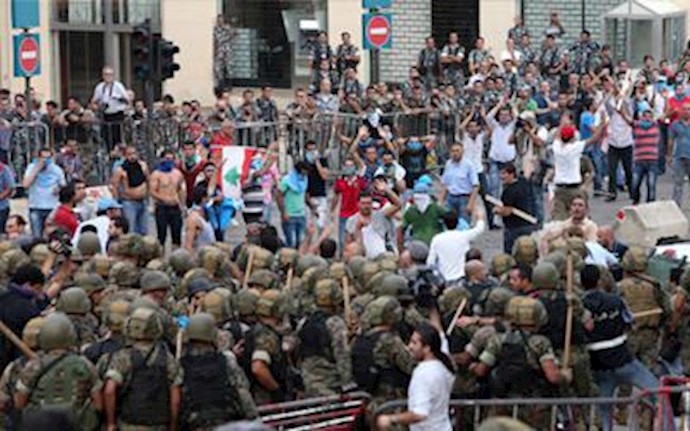
CNN, Beirut, 21 Oct 2012 – Anti-government rage erupted in central Beirut Sunday as protesters clashed with security forces after a funeral for the nation’s intelligence chief.
A mob pushed toward the prime minister’s office, hurling sticks, stones and flags and calling for his dismissal. Gunfire could be heard as police used tear gas to turn away crowds. A number of injuries were reported, Lebanon’s National News Agency said.
A smaller, peaceful demonstration continued later Sunday as government figures called for calm. But deep-rooted political and sectarian tensions still simmered.
Protesters, many of them allied with Sunni coalitions that have long been sharply critical of the Lebanese government’s perceived closeness to relationship with the Syrian regime, blamed Prime Minister Najib Mitaki for not preventing Friday’s deadly car bomb blast that killed Brig. Gen. Wissam al-Hassan.
Many anti-Syrian politicians in Lebanon blamed Syria for the assassination.
The attack — in broad daylight, at one of the capital’s busiest areas — left a crater more than a meter deep and also killed al-Hassan’s bodyguard and a bystander.
The intelligence chief’s death brought a sense of deja vu to Lebanese, recalling the 2005 assassination of former Prime Minister Rafik Hariri, which triggered the end of Syria’s occupation of Lebanon, and the turmoil that followed.
Mikati, a billionaire supported by Syrian ally Hezbollah, announced Saturday that he planned to stay in power, despite having offered his resignation to appease those who claimed Syrian President Bashar al-Assad was behind Friday’s car bombing that killed al-Hassan.
“To hold me personally responsible for the assassination is unfair,” he told reporters Saturday. “I have always respected and admired al-Hassan, who has done great things for Lebanon.”
Al-Hassan had spearheaded investigations of Hariri’s death and a series of killings that targeted major anti-Syrian political figures.
Sunday’s violence came after a series of political speeches given to the crowd gathered in Beirut’s central square for al-Hassan’s funeral.
“This government is responsible for the assassination of martyr (al-Hassan) and his companion martyrs, therefore, this government must leave,” former Prime Minister Fouad Siniora told the crowd.
A mob surged from the central square toward the prime minister’s office, growing in number and in intensity. Dozens rushed toward police lines.
Some politicians had called for a day of rage Sunday, as accusations over who’s responsible for the most high-profile assassination in Lebanon in more than seven years homed in on al-Assad’s government. Others, including speakers at the funeral, had urged crowds to remain peaceful.
Syria condemned the blast very quickly after it happened on Friday.
But al-Hassan’s work would have earned him a number of enemies, particularly among pro-Syrian elements in Lebanon and in Damascus.
He was aligned with the March 14 movement, the anti-Syrian regime coalition that emerged after Hariri’s assassination in 2005. That movement was key in forcing the withdrawal of Syrian troops, which had long occupied neighboring Lebanon and pulled out months after Hariri was killed.
He had worked closely with the U.N. Special Tribunal for Lebanon investigating the Hariri assassination. He had survived two assassination attempts, including one that killed an official getting evidence in Hariri’s killing.