PYONGYANG, North Korea, AP, 31 May 2017 — Early one winter morning, Kim Jong Un stood at a remote observation post overlooking a valley of rice paddies near the Chinese border.
The North Korean leader beamed with delight as he watched four extended range Scud missiles roar off their mobile launchers, comparing the sight to a team of acrobats performing in unison. Minutes later the projectiles splashed into the sea off the Japanese coast, 1,000 kilometers (620 miles) from where he was standing.
It was an unprecedented event. North Korea had just run its first simulated nuclear attack on an American military base.
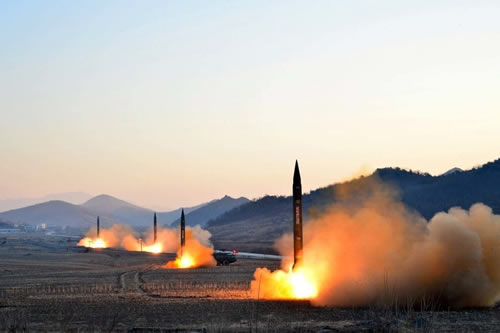
In this March 6, 2017, photo distributed by the North Korean government, four extended range Scud missiles lift off from their mobile launchers in Tongchang-ri in North Pyongan Province, North Korea. The four Scuds fell into the ocean 300 to 350 kilometers (185 to 220 miles) from the coast of Japan. The ruling party’s newspaper stated it was not a test to see if the missiles would work but rather a “drill” to train the troops who will “strike the bases of the U.S. imperialist aggressor forces in Japan in a contingency.” Independent journalists were not given access to cover the event depicted in this photo.
This scene from March 6, described in government propaganda, shows how the North’s seemingly crazy, suicidal nuclear program is neither crazy nor suicidal. Rather, this is North Korea’s very deliberate strategy to ensure the survival of its ruling regime.
Back in the days of Kim Il Sung, North Korea’s “eternal president” and Kim Jong Un’s grandfather, the ruling regime decided it needed two things to survive: reliable, long-range missiles and small, but potent, nuclear warheads. For a small and relatively poor country, that was, indeed, a distant and ambitious goal. But it detonated its first nuclear device on Oct. 9, 2006.
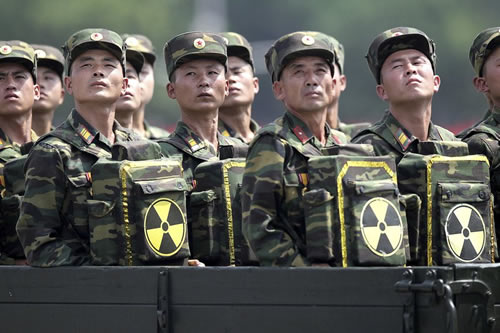
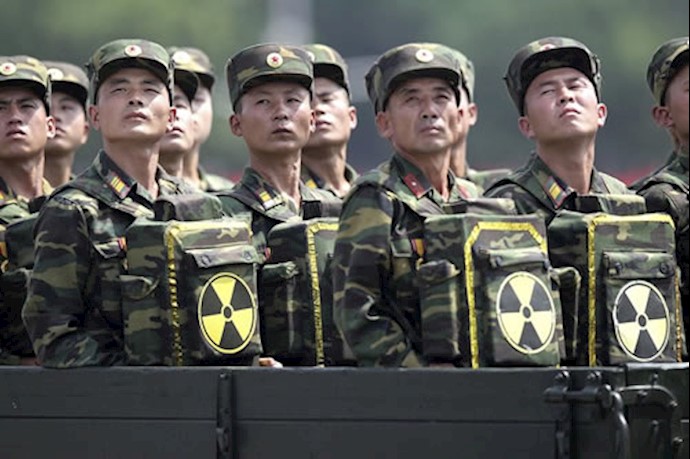
North Korean soldiers with nuclear symbol packs.
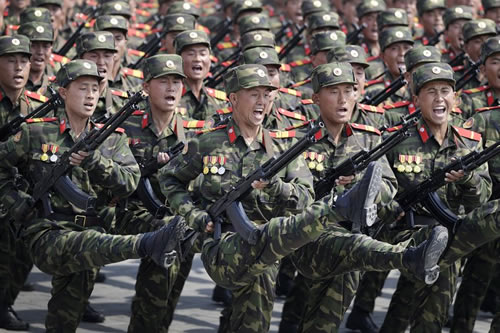
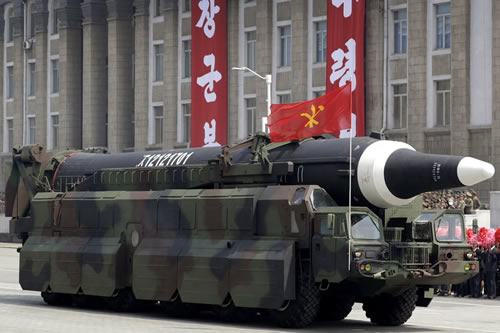
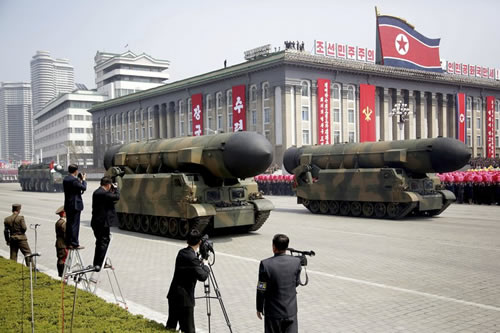
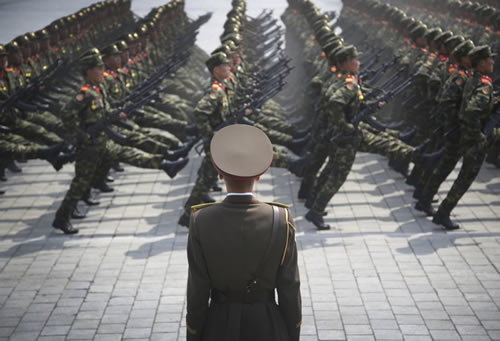
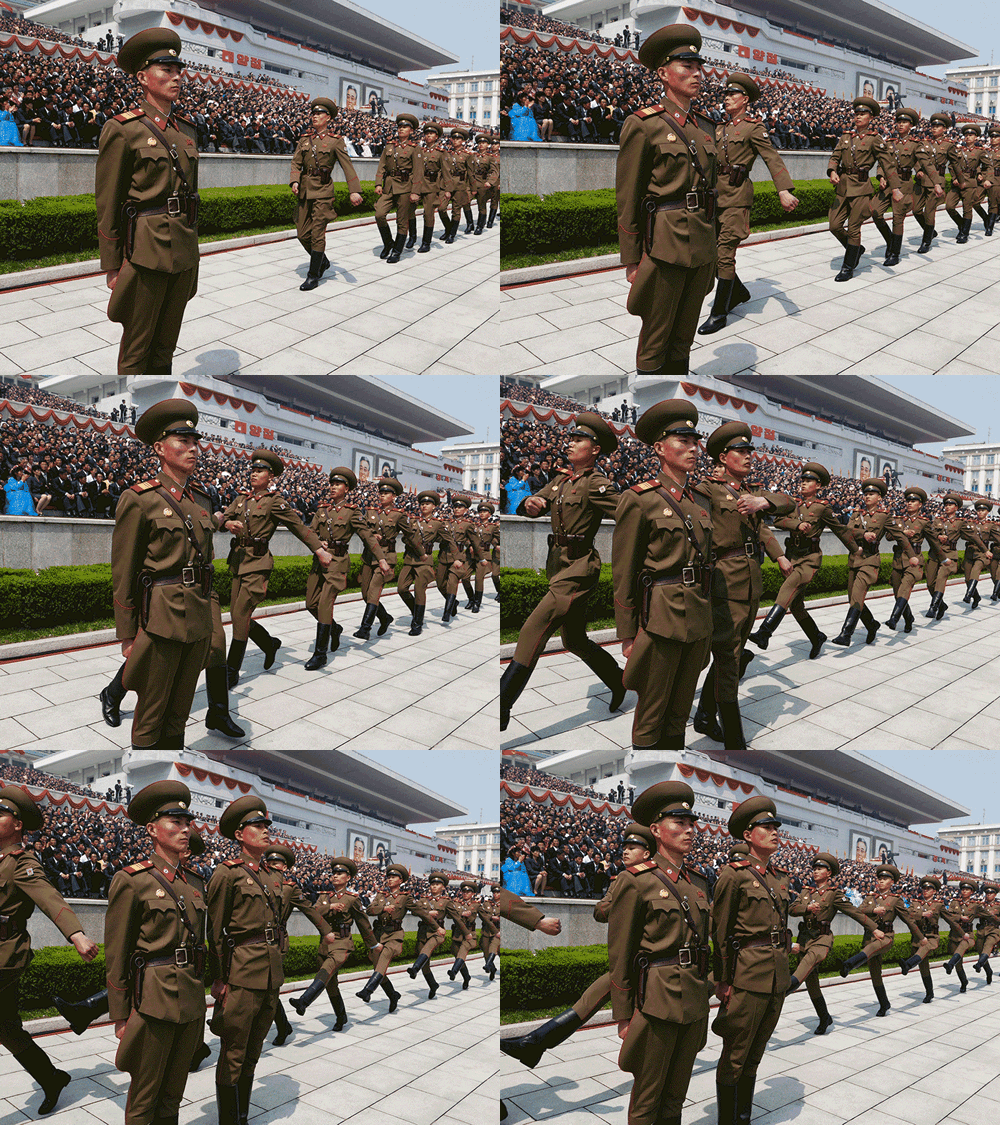
Today, North Korea is testing advanced ballistic missiles faster than ever — a record 24 last year and three in just the past month. With each missile and each nuclear device, it becomes a better equipped, better trained and better prepared adversary. Some experts believe it might be able to build a missile advanced enough to reach the United States’ mainland with a nuclear warhead in two to three years.
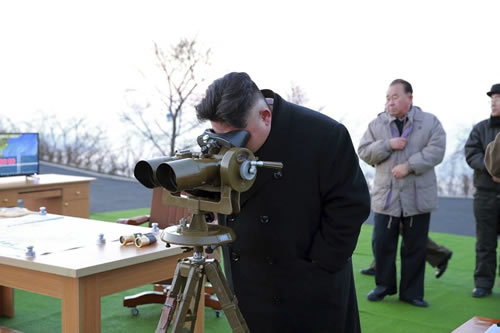
In this March 6, 2017, photo distributed by the North Korean government, leader Kim Jong Un looks through a scope at an observation point to watch the launching of Scud missiles in Tongchang-ri in North Pyongan Province, North Korea. The ruling party’s newspaper stated it was not a test to see if the missiles would work but rather a “drill” to train the troops who will “strike the bases of the U.S. imperialist aggressor forces in Japan in a contingency.” Independent journalists were not given access to cover the event depicted in this photo.
So forget, for the moment, how erratic Kim Jong Un and his generals may seem. North Korea conducted two nuclear tests last year; one was of the strongest nuclear device it has ever detonated and the other, Pyongyang claims, of its first H-bomb. The U.S. for its part is also escalating — in an explicit warning to Pyongyang, it successfully shot a target ICBM launched from a Pacific island out of the sky with a California-based interceptor missile on Tuesday.
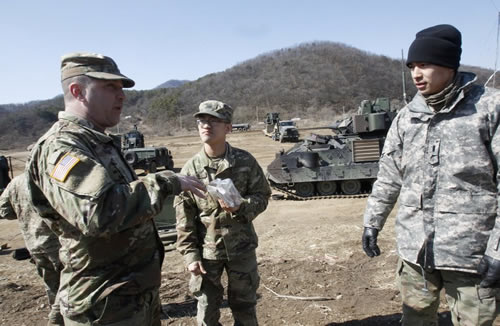
FILE – In this March 6, 2017, file photo, U.S. Army soldiers prepare for military exercises in Paju, South Korea, near the border with North Korea. According to foreign analysts, as U.S. and South Korea were having their military drills on the Korean peninsula, North Korea practiced their strike plans by launching four extended range Scud missiles.
The question is this: if war breaks out and North Korea launches a pre-emptive nuclear strike on an American military base in Japan — for real — would the U.S. recoil and retreat? Would it strike back, and risk losing Washington DC in a second wave of nuclear attacks?
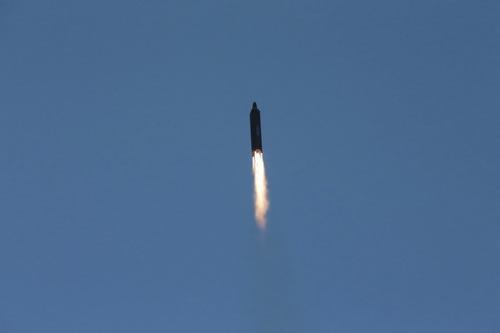
This May 14, 2017, photo distributed by the North Korean government shows the Hwasong 12, a new type of ballistic missile, as it is launched from an undisclosed location in North Korea. Many analysts believe the missile could be a stepping stone to the ICBM North Korea needs to attack the U.S. mainland. Independent journalists were not given access to cover the event depicted in this photo.
For Pyongyang, forcing Washington to seriously weigh that calamity is a win. And it may become a real-world possibility on President Donald Trump’s watch.