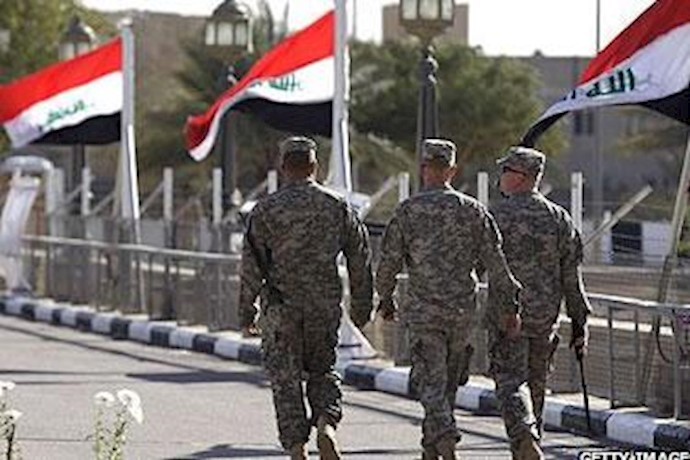
BBC News, Baghdad, 10 Dec 2011 – As the USA’s nine-year military intervention in Iraq comes to an end, opinions are sharply divided about what exactly the departure of US troops will mean for the country.
We had not been on the square long when a skinny man came up to talk to us.
He was wearing a suit jacket that was several sizes too large for him and dark aviator-style shades, despite the fact that the winter sunshine was not terribly bright.
Perhaps he wanted to remain anonymous, I thought. But he was pretty distinctive-looking anyway, with his long, black hair scraped back into a ponytail.
He glanced nervously up towards a balcony across the road. We were being watched.
Intimidation
His name was Dhirgham al-Zaidi and you might say that dissent runs in his family.
In 2008, his brother Muntadar had famously thrown both his shoes at then-president George W Bush.
Dhirgham and his dwindling band of fellow demonstrators are protesting against the Iraqi government.
It may be democratically elected, they say, but its performance is dismal. The country is plagued by violence and rampant corruption, and there is a lack of jobs and even basic services.
He and most of his friends have been arrested for speaking their minds. Some have disappeared for days into prison cells and been savagely beaten. Many have given up in the face of such intimidation.
But Dhirgham keeps on coming back.
He has been on Baghdad’s Tahrir Square almost every Friday since February. Back then, they had gathered here in their thousands.
Their central grievance was much the same as that of the crowds on the streets of Cairo, Tunis and Benghazi – the sense that somehow a small elite had monopolised their country’s resources.
In Iraq, too, the protests were initially met with violence.
Baton-wielding security forces cleared the square with water-cannon and live rounds. Around 20 protesters were killed. But that was not the remarkable fact.
The remarkable fact was that no suicide bomber had blown himself up in the crowd. The remarkable fact was that the death toll was so low.
And so, the Prime Minister, Nouri al-Maliki, congratulated the security services on a successful operation, and the wider world ignored the matter altogether.
Iraq is yesterday’s story.
Or is it?
Here are some figures. According to official statistics, 187 Iraqis were killed last month in what may be termed terrorists acts – bombings, mostly, but shootings too.
Actually, a further 55 people were also killed, those described as terrorists themselves. That figure was significantly lower than October’s total of 258 dead (not including the terrorists), a figure that was itself at the lower end of average for the year.