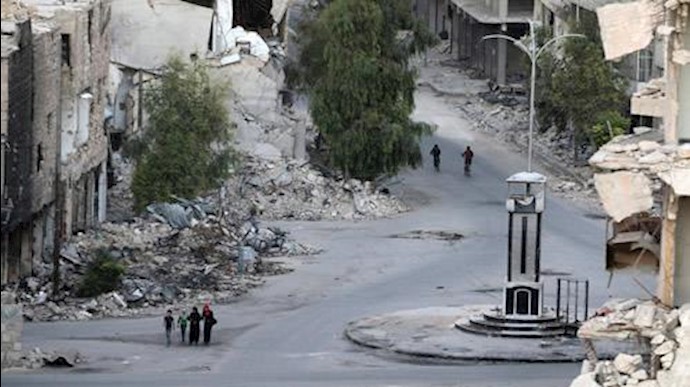
UN Special Envoy for Syria Staffan de Mistura warned on Thursday that the eastern part of Aleppo may be “totally destroyed” by the year’s end, vowing that the international body will not allow the Syrian city to be another Rwanda or Srebrenica.
In what is known as the Rwandan genocide, an estimated 500,000–1,000,000 Rwandans were killed in 1994. The Srebrenica massacre, meanwhile, witnessed the killing of more than 8,000 Muslim Bosnians, mainly men and boys, in and around the town of Srebrenia during the Bosnian War in 1995.
De Mistura said if Syria and Russia do not accept offer to end fighting in Aleppo, history will judge their use of terrorists as an “alibi” to destroy the city.
Meanwhile, UN humanitarian advisor Jan Egeland said at least 376 were killed and 1,266 wounded in the past two weeks in eastern Aleppo, and there is still no greenlight from the Syrian government to send aid convoys anywhere in the country in October.
De Mistura says total number of opposition fighters in eastern Aleppo is maximum is 8,000.
The United States on Monday suspended talks with Russia on a ceasefire in Syria in protest at Moscow stepping up its bombing campaign.
Russia launched its military operation in Syria last September to back up long-time ally Bashar al-Assad to Western ire, helping to shore up the regime’s embattled forces.
Russia’s military has been accused repeatedly that it has struck civilian targets in the country during its year-long bombing campaign.
Moscow has used Syria as a testing-ground for a range of new weaponry including long-range missiles fired from ships, submarines and warplanes.
Those include the X-101 rocket that has a range of 4,500 kilometers (2,800 miles) and was fired from bombers that took off from bases in Russia, Shoigu said.
Built on the foundations of its Soviet-era predecessor, Russia’s arms industry is a key source of income for the country and brought in some $14.5 billion (13 billion euros) in 2015.
Source: Agencies, 6 October 2016