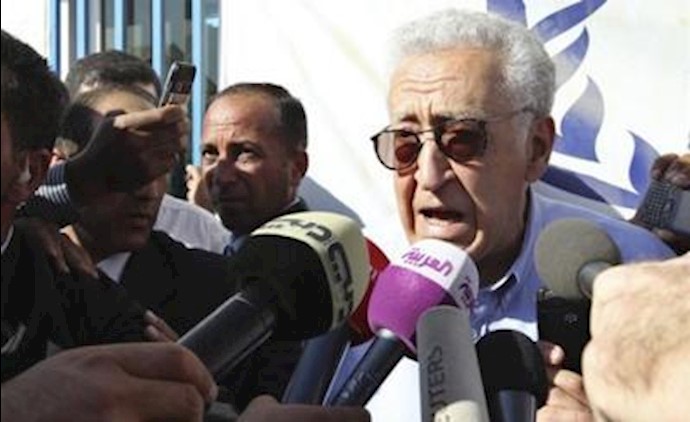
Al Arabiya , 24 October 2012 – U.N. Security Council backed on Wednesday a call by its envoy to Syria for a ceasefire during this week’s Muslim holiday of Eid al-Adha, and Russia said it had “indications” that the regime in Damascus will accept Lakhdar Brahimi’s proposal.
Earlier, Syria’s military command announced it was still studying Brahimi’s call contradicting his announcement that Damascus had agreed to a truce.
The Russian ambassador to the United Nations said his country hopes the “ceasefire in Syria will continue after Eid.”
The prominent Farooq Brigade, which operates out of the battered city of Homs, said it would cease fire. The Islamist militant Al Nusra Front rejected the truce, saying it is not a group “who accepts to play such dirty games.”
A previous ceasefire arrangement in April collapsed within days, with both sides accusing the other of breaking it.
Brahimi, the joint U.N.-Arab League special envoy, had crisscrossed the Middle East to push the warring factions and their international backers to agree to a truce during the upcoming Muslim holiday of Eid al-Adha – a mission that included talks with Assad in Damascus at the weekend.
“After the visit I made to Damascus, there is agreement from the Syrian government for a ceasefire during the Eid,” Brahimi told a news conference at the Arab League in Cairo.
Within an hour, Syria’s Foreign Ministry said the proposal was still being studied by the military commanders. “The final position on this issue will be announced tomorrow,” a ministry statement said. Brahimi later told the United Nations Security Council that Assad himself accepted the truce.
The holiday starts on Thursday and lasts three or four days. Brahimi did not specify the precise time period for a truce.
Nor did the initiative include plans for international observers, and rebel sources had earlier told Reuters there was little point if it could not be monitored or enforced.
Assad’s forces and rebels are now locked in a battle with huge potential ramifications in the northwest.
Syrian warplanes carried out bombing raids on Wednesday on the strategic northern town of Maarat al-Numan and nearby villages while rebels surrounded an army base to its east, an activist monitor said.
Five people from one family, including a child and a woman, were killed in the air strikes, according to Rami Abdelrahman, head of the British-based Syrian Observatory for Human Rights.
Maarat al-Numan has fallen to the rebels, effectively cutting the main north-south highway, a strategic route for Assad to move troops from the capital Damascus to Aleppo, Syria’s largest city where the insurgents have taken a foothold.
But without control of the nearby Wadi al-Daif military base, their grip over the road is tenuous and the rebels say the ferocity of counter-attacks by government forces shows how important holding the base is to Assad’s military strategy.
Children knifed
More than 32,000 people have been killed in the conflict, which began with peaceful pro-democracy demonstrations in March 2011 and then mushroomed into civil war as repression increased.
On Wednesday, opposition activists and Syrian state media traded blame for the killing of at least 25 people, including women and children, in the town of Douma near Damascus.
“People now are scared and very angry. Some of the martyrs were killed with knives, others were shot,” Mahmoud Doumany, an activist living in Douma, told Reuters.
Syrian state television said 25 people had been killed by “terrorist members of the so-called ‘Liwa al-Islam.’”
Opposition video showed the bodies of women and children, one of whom had a hole in his head.
“God is great,” said a man off screen, his voice trembling as he walked around the house, filming bodies on several floors of a residential building.
In contrast to the Libya crisis last year, the West has shown little appetite to arm the Syrian rebels, worried that weapons would fall into the hands of Islamic militants.
Russia, which has backed Assad through the conflict, sold his government $1 billion worth of weapons last year and has made clear it would oppose an arms embargo in the U.N. Security Council.