By the CNN Wire Staff
CNN, October 8, 2012 — Turkish President Abdullah Gul said Monday that “worst case scenarios” are becoming a reality in neighboring Syria over its 19-month civil war — which has spilled over into border clashes between the two nations — and that it “absolutely cannot” continue.
“The Syrian people are suffering and as you can see it is having an effect on us, too, from time to time,” he told reporters.
After days of Syrian shells flying across the border into Turkey, tensions — and carnage — are mounting on both sides of the border.
The stray shelling has prompted Turkey to respond with threats and weapons fire, fueling concerns that the Syrian civil war will bleed into a greater regional battle.
Early Monday morning, Turkish authorities reported exchanges of fire in a southern central region of Turkey that borders Syria.
A mortar shell launched from the Syrian side landed in Turkey’s Altinozu District, though no casualties were reported, authorities said in a written statement.
Turkish forces fired “retaliatory shots” into Syria, saying they believed the initial strike was launched by Syrian Security forces, the statement said.
Here are additional developments in the 19-month Syrian crisis:
Deaths add up amid continuing violence
A large explosion rocked Damascus on Monday, followed by heavy gunfire near a government checkpoint, though it is not clear if there are casualties resulting from the detonation and ensuing exchange.
“This is the largest blast I have ever felt since the uprising began,” said Omar al Khani, an opposition activist. “One of my windows is blown out and neighbors’ plates were knocked down from the table to the ground.”
Less than half an hour, al Khani said another smaller explosion could be heard followed by intermittent gunfire as a thick plume of smoke unfurled across the Syrian capital.
The Syrian Observatory for Human Rights, an opposition group, said the initial blast occurred in the Damascus suburb of Harasta, which is also home to an Air Force security building
Earlier, the opposition Local Coordination Committees of Syria said 76 people were killed across Syria. They included 33 killed in Daraa, 14 in Homs, 11 in Idlib, 10 in Aleppo, four in Damascus and its suburbs, three in DeirEzzor, and one in Hama, the LCC said.
The deaths in Daraa came as Al-Kark Al-Sharqi was pummeled by Syrian government shelling, it said.
CNN is unable to independently confirm reports of casualties or violence because the Syrian government has restricted access by international journalists
Turkish foreign minister: Syria’s vice president could lead a transitional government
Syrian rebels are open to the idea of the country’s vice president leading an interim government, as proposed by Turkey’s foreign minister, Turkish media reported Monday.
But Bessam Dade, political adviser to the rebel Free Syrian Army, said the dissidents would approve of such a plan only if Syrian President Bashar al-Assad is not granted immunity from prosecution, Turkey’s TRT news agency said.
Turkish Foreign Minister AhmetDavutoglu pitched the idea, saying the Syrian vice president is not to blame for the mass bloodshed in the country.
“Farouq al-Sharaa, with a reasonable and conscientious approach, was not a part of recent events and did not partake in the massacres. And perhaps there is no one that knows the system better than Farouq al-Sharaa,” Davutoglu told TRT, according to the Turkish Anadolu Agency.
George Sabra, a spokesman for the Syrian National Council, said members of the opposition group will meet in Qatar later this month and will discuss whether the Syrian opposition would accept the proposal.
“But first we need to know what will be the road map that such a transition will be based on,” Sabra told CNN. “Whether it is al-Sharaa or anyone else, we need to know first what will this person do, and how he or she will push to get Syria out of this quagmire.”
In August, a spokesman for the Free Syrian Army said that al-Sharaa had defected from the government and that rebels were trying to help him flee to Jordan. But al-Sharaa later resurfaced at an official meeting in Damascus.
He has not been seen publicly since, not even when al-Assad made a rare public appearance Saturday and was greeted by other Syrian officials.
On the ground: Rebels say they’re close to seizing a military camp
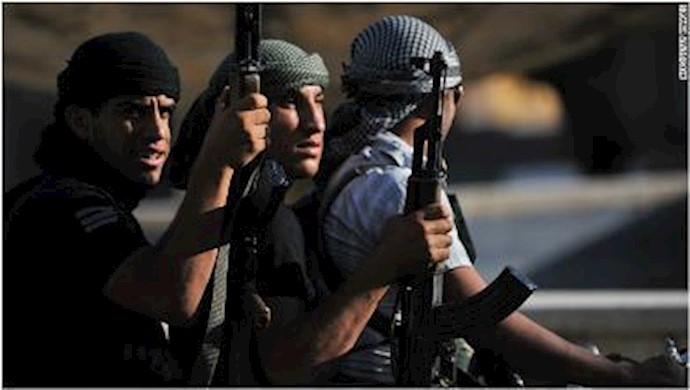
In their quest to wrest control of land near the Turkish border, Syrian rebels stationed outside a military camp in Tal Abyad said they had destroyed three tanks by Monday morning.
“We feel very strongly we will take (the camp) over in the next few hours,” rebel fighter Abu Abdallah told CNN.
Government forces have been shelling the surrounding area — and firing mortar rounds that fell into Turkey — from the Tal Abyad camp, said Abdallah and AyhamKhalaf, a witness and activist.
But Syrian state media reported that security forces had destroyed two vehicles and eliminated a number of terrorists during their attack.
If opposition fighters take over the military camp, Abdallah said, rebels will control an area that extends 45 kilometers (28 miles) south of the border of Turkey — a country that has been sympathetic to Syria’s opposition movement.
On Sunday, a Syrian shell landed near a Turkish government office in Akcakale — the same town where five Turks were killed last week in another cross-border incident.
Turkish Prime Minister RecepTayyipErdogan said the deadly incident in Akcakale was caused “by artillery fire belonging to the Syrian regime forces.” Turkey fired on Syrian government targets in response.
Witness SalihAydogan said no one was injured in the Sunday incident. As Aydogan spoke, the Turkish military fired two more shells at Syria.
“We heard (the Turkish military) fire back immediately. They retaliated with two shots,” Aydogan said. “We just got lucky this time.”
World reaction: U.S. presidential candidate supports arming rebels
U.S. Republican presidential candidate Mitt Romney is expected to announce his support of Syrian opposition members in a foreign policy speech Monday.
“In Syria, I will work with our partners to identify and organize those members of the opposition who share our values and ensure they obtain the arms they need to defeat Assad’s tanks, helicopters and fighter jets,” according to excerpts from Romney’s prepared speech. The remarks did not say whether the United States itself should arm the rebels.
“Iran is sending arms to Assad because they know his downfall would be a strategic defeat for them. We should be working no less vigorously with our international partners to support the many Syrians who would deliver that defeat to Iran — rather than sitting on the sidelines.”
Romney is running against President Barack Obama, who has not explicitly called for providing arms to Syrian rebels. The United States is helping Qatar and Saudi Arabia, which are arming the opposition, decide which rebels should receive weapons.
Obama’s administration has limited aid to nonlethal materials, like communication equipment, and officials have expressed concern about giving weapons to a disparate group of rebels of different levels of trustworthiness, saying they’re concerned that some weapons would fall into the hands of terrorists.
In a speech last month at the U.N. General Assembly, Obama pledged American support for those working for a “common good” for Syria — and sanctions against those causing harm.
“In Syria, the future must not belong to a dictator who massacres his people,” he said.
“If there is a cause that cries out for protest in the world today, it is a regime that tortures children and shoots rockets at apartment buildings. And we must remain engaged to assure that what began with citizens demanding their rights does not end in a cycle of sectarian violence.”