Almost every faction fighting in Syria has had its sights on Aleppo since the war began in 2011. No single faction has ever been able to take full control of Syria’s largest city and economic hub. The same goes for the region bordering Turkey. In these areas, the Assad regime has always been firmly in control. But now, several of Syria’s varied factions are once again racing reinforcements to Syria’s northern provinces and are headed for a collision in Aleppo that is creating new alliances.
With no group strong enough to take on the regime on its own and have a credible shot at capturing Aleppo, aligning with partners — sometimes unlikely ones — is the only chance at breaking the stalemate. Right now, the de facto alliances, experts say, is against both the Islamic State group and forces loyal to Bashar Assad. Syria’s Kurds are also active in Aleppo, as well as Iranian-backed forces loyal to the Syrian regime, such as Hezbollah.
“I think the lines are pretty well drawn,” said Jeff White, a defense fellow at the Washington Institute for Near East Policy. “Aleppo is just one of those places in Syria where it’s very difficult to achieve any kind of decisive change on the battlefield.”
After a string of strategic wins since the start of the year, rebel groups were in a very strong position to overrun regime forces in Aleppo and neighboring strongholds around the city of Idlib.
ISIS may be getting help from an unlikely source. Syrian President Bashar Assad’s air force pounded Aleppo on Thursday with barrel bombs, while the Islamic State group battled opposition forces on the ground. This suggests that the two, if not actually allied, are at least not targeting each other, despite officially being mortal enemies.
That alliance is taking the form of so-called “operations rooms,” or local coalitions of rebel forces that coordinate tactics on the ground. The most successful of those is Jaish al-Fatah, or Army of Conquest, a rebel coalition that has been instrumental in taking Idlib and includes some of the best-equipped opposition groups.
“The operations rooms have been around for a long time,” White said. “What has gotten better is their willingness to cooperate more effectively … and keep these fighting coalitions in existence over time.”
The unprecedented gains in Idlib province last month left rebels with several avenues for continued expansion, including a route to Aleppo and to the coastal regime stronghold of Latakia, a city of vast symbolic and strategic importance.
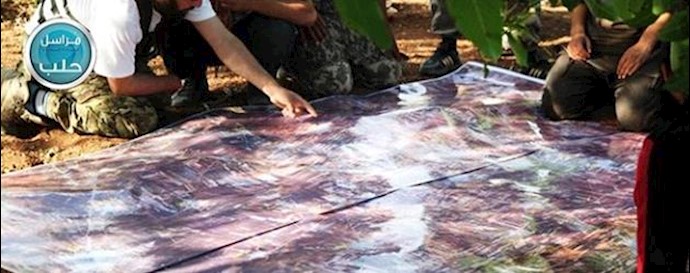
The operations room in charge of the rebel push on Syria’s economic hub bears a name that leaves little room for doubt about its objective: Fatah Halab, or “Conquest of Aleppo.” Having set aside all feuds among rebel groups, it’s now focused on the common enemies. “In regards to our operations, we are only against Daesh and the regime,” said Capt. Islam Alloush, a spokesman for the opposition group that is part of at least two operations rooms in the region.
While ISIS and the rebel coalitions battle in northern Aleppo, pro-regime forces have ramped up their presence around the city and in neighboring regime-held areas. The government reportedly formed a unit called Shield of Coast Brigade to protect Latakia, but the move may be a sign of desperation by a regime that’s losing its best fighters and foreign advisors.
“It’s a unit of very uncertain capability,” White said. “It’s one of these many, many schemes the regime has for generating forces and filling in these gaps in manpower. If there is an injection of Iranian forces that could change things.”
That manpower deficit has long been filled by Iran-backed forces, including Lebanese Hezbollah fighters. There have been various reports of an influx of these fighters to Syria in the past week, with numbers ranging from 1,000 to 15,000, many of whom would be deployed to Latakia.
In Aleppo, it is estimated that there are less than 150 Hezbollah fighters based in two major Shiite towns “who are in a position to assist ISIS but don’t appear to be doing very much,” White said.
On Thursday, the regime launched three rocket attacks that hit a highly populated area in Idlib, wounding at least 130 people, according to Doctors Without Borders.
That counterattack in Idlib threatens to spread opposition forces thin, but their leaders are vowing to hold on.
“The battle for Aleppo is continuing,” the commander of one of the largest groups in the Aleppo operations room said “As is the battle for Idlib.”