
U.N., opposition accuses Assad of deliberately seeking to divide country along sectarian lines
Sept. 13, 2016 – The Syrian regime is pressing a systematic effort to alter the country’s demographics and tighten President Bashar al-Assad’s grip on power, United Nations officials and opposition figures said.
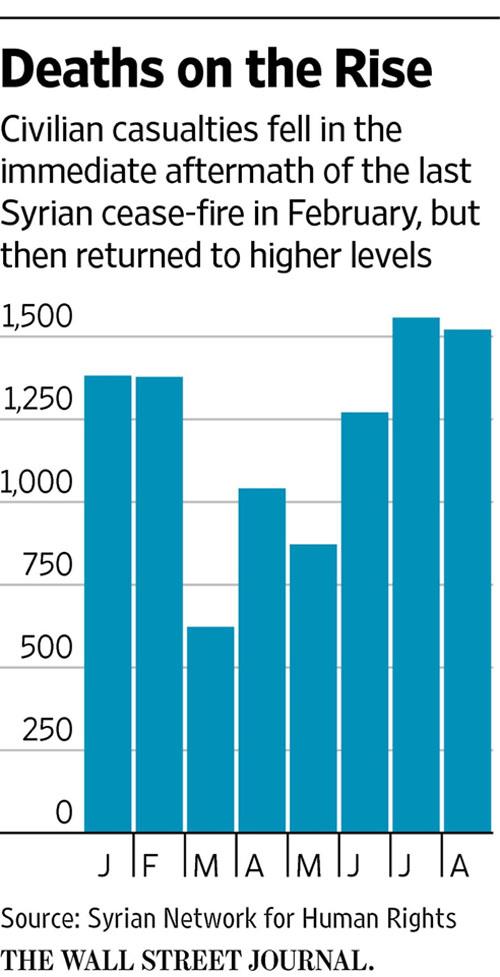
The government is pushing to seal deals for the surrender or evacuation of rebel strongholds despite the U.S.- and Russia-sponsored cease-fire, which began Monday and appeared to take firmer hold on its first full day Tuesday. Both sides traded accusations of violations, but residents and activists said battlefields were noticeably calmer than the day before.
The Assad regime has long used sieges—sometimes to the point of starvation—to force local populations to agree to cease-fires, surrender and evacuations, leading to the displacement of thousands of people. Now thousands more are at risk of being forced from their homes in deals the government seeks to push through in an opposition-held neighborhood of the city of Homs and at least one Damascus suburb.
The resulting transfers of population threaten to further partition the country between the opposition—dominated by Syria’s Sunni majority—and the government led by Alawites, adherents of an offshoot of Shiite Islam. Syria’s ethnic Kurdish minority has already carved out a sizable autonomous region in the north along the Turkish border.
“The Syrian regime, along with its Russian and Iranian allies, is relentlessly pursuing a malicious plan to orchestrate extensive demographic shifts across Syria,” said Riyad Hijab, a leader of the opposition’s main political body, the High Negotiations Committee.
“These changes will undermine the unity and integrity of Syrian territories and Syria’s demographic structure,” he added, saying they are “paving the way for ethnic and political cleansing on an unprecedented scale.”
U.N. Emergency Relief Coordinator Stephen O’Brien said recently that mass evacuations and prolonged sieges are violations of international humanitarian law. “All sieges, a medieval tactic, must be lifted,” he said. “This should not [occur] through any type of agreement which results in the forced displacement of the civilian population.”
Syria’s opposition has criticized previous truces, saying they favor the regime by letting it continue laying siege to opposition-controlled communities and targeting rebels they deem as extremists.
Hours before the truce took effect on Monday evening, Assad vowed to take back all rebel-controlled territory as he walked through the Damascus suburb of Daraya, which surrendered to the government late last month after a nearly four-year siege. Under the deal ending the siege, nearly 10,000 residents were forced to move immediately to other parts of the country—the largest-scale evacuation of the entire war.
Images of a confident Assad strolling through the ghost town ahead of the cease-fire left Syrian opposition groups fuming, saying the deal lacked enforcement measures to guarantee the government drops its “starve or submit” tactics.
The war’s first expulsion came in early 2012, when the government forced thousands of rebels and civilians out of the Homs neighborhood of Baba Amr after a month of scorched-earth attacks. Two years later, government forces starved out rebels in the old city of Homs.
Many of those displaced, both then and more recently, have relocated or been forced to resettle in the north of the country, where rebels have their main strongholds largely outside the government’s control.
After last month’s agreement to evacuate the population of Daraya, many evacuees went to the only remaining rebel-controlled province, Idlib, while some went to other Damascus suburbs.
Three days after the last resident left Daraya in late August, Syrian military commanders summoned opposition leaders in the neighboring Damascus suburb of Moadhamiya to a meeting, residents and local leaders said, adding they had expected the call.
Negotiators from the town, which has been besieged for nearly four years, said the regime urged them threatened them, saying they had to comply with new demands, including surrendering all weapons, or face dire consequences.
Two military officers from Russia—the Syrian government’s closest international ally—attended the meeting, according to town negotiators in attendance.
“They said if we reject their conditions, they are going to burn Moadhamiya over the heads of the residents,” one member of opposition-controlled town council said.
Rebels and local leaders in Waer, the last neighborhood under opposition control in the central city of Homs, said they faced similar demands from the regime recently.
“There is clearly a strategy at the moment to move from Daraya to al-Waer to Moadhamiya in a similar pattern,” U.N. envoy Staffan de Mistura said at a recently.
In Waer, rebels and local leaders said the government’s demands that rebel fighters leave were quickly followed by shelling, including attacks with incendiary weapons on the neighborhood of 75,000 people. The two sides struck an uneasy temporary truce this month that calls for 300 rebels to leave after the Muslim holiday Eid al-Adha, which began on Monday.
The provincial governor, Mr. Barazi, said rebel fighters could stay in Waer if they give up their weapons. But one resident said the government’s ultimate goal was to completely empty Waer. Similar fears reign in Moadhamiya, where many said they didn’t have enough leverage to prevent the regime’s attempts to carve out new demographic lines in Syria.
The regime’s heightened pace in striking these deals may be grounded in its desire to get the upper hand in the wake of the Turkish intervention in northern Syria and before the U.S. election, when a new administration could pursue a more interventionist policy, said Joshua Landis, director of the Center for Middle East Studies at the University of Oklahoma.
“Even though the regime has not articulated a policy of ethnic cleansing, what is unfolding is a policy of ethnic cleansing,” Mr. Landis said, clarifying that the divisions are actually on sectarian rather than ethnic grounds.
Olga Razumovskaya contributed to this article.