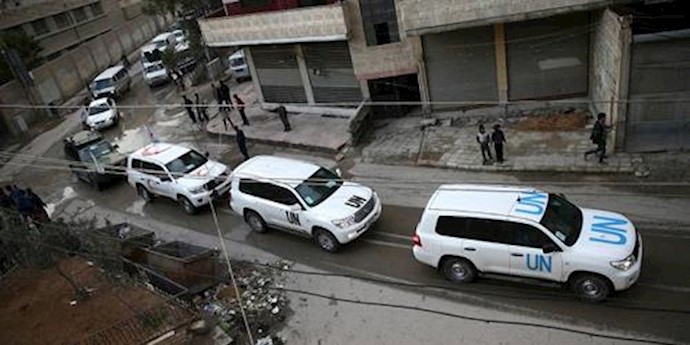
Beirut / United Nations – The opposition, which said Thursday that the cease-fire was close to collapse, has demanded immediate delivery of humanitarian relief as a key condition for participating in peace talks with the regime. The U.N. is trying to convene talks again next week, but those efforts could fail if the truce unravels and more aid deliveries fail to get through.
Riad Hijab, head of the opposition’s High Negotiations Committee, said there was evidence that the Syrian government and allied forces, including non-Syrian Shiite militias, were building up military reinforcements for large-scale operations in coming days.
“The reality is the regime and its allies continue to violate the truce and launch operations to gain more ground, and that has in fact happened,” Mr. Hijab said.
United Nations officials said they were on the verge of an agreement with the Syrian regime to get humanitarian relief flowing and to lift a ban on medical supplies to opposition-held areas, as Western powers raced to deliver aid while a shaky truce was still holding.
The six-day-old cease-fire brokered by the U.S. and Russia was supposed to provide a respite in violence that would allow for a ramp-up in aid deliveries mostly to rebel-held areas. A senior U.N. official in charge of the region’s aid operations said aid delivery has improved since the cease-fire began, although U.N. workers in Syria disagree.
Aid agencies say one of their biggest challenges is overcoming the regime’s obstruction. In particular, the regime’s security services and militias have long prevented medical aid from going to opposition-held areas. Vaccines for children, baby formula and surgical kits are among the items banned by the regime.
“There are huge unmet needs for lifesaving and trauma medicines such as antibiotics and analgesics—exactly those that were removed from the convoy by government security forces,” Elizabeth Hoff, the World Health Organization’s representative in Damascus, said this week about medical supplies removed Monday and again on Wednesday from U.N. trucks headed to Moadhamiya, a besieged opposition area on the edge of the capital.
Syrian government officials have made no secret of their policy of restricting or denying food and medicine to opposition-held areas to force them to surrender. In particular, they deny medical aid so that rebels wounded in battle can’t be treated.
Jan Egeland, an adviser to the U.N. special envoy to Syria, Staffan de Mistura, on Thursday described the lack of humanitarian access as a “symbol of the impotence of the international community.”
He told reporters in Geneva that efforts were under way to streamline procedures required by the regime to deliver aid and that this would include a green light for medical supplies prohibited so far.
“This could be the game-changer we’ve been waiting for a very long time,” he said.
The U.N. has been criticized by both opponents of President Bashar al-Assad as well as members of its own staff inside Syria and in neighboring countries for accommodating the regime.
“This is shameful,” said a U.N. staffer based in Jordan and dealing with Syria.
Some in the opposition accuse the U.N. of being complicit with Assad in preventing aid from reaching them.
Yousif al-Boustani, an activist in the rebel-held eastern suburbs of Damascus that have been under siege by the regime for more than three years, greeted a U.N. convoy that entered his area last week with a sign reading “U.N.=Assad.”
The convoy was delayed by the regime for days. What was eventually brought in was enough for 5% of the area’s estimated 200,000 civilians and excluded vaccines and urgently needed supplies for kidney dialysis services.
“The regime considers anything medical going to the opposition as bad as weapons,” said Mr. Boustani.
The U.N. said the accusations were unjustified and that in Syria, as in all war zones, it has to balance the need to gain access to millions of people against taking political stands.
“Our purpose in Syria is to deliver assistance to the people in need,” said Kevin Kennedy, the U.N.’s regional humanitarian coordinator for Syria. “Sometimes we make compromises we don’t like but our ultimate objective is to get food and water to families.”
Mr. Kennedy said his staff on the ground in Syria was under enormous pressure from the government. Officials say getting letters and paperwork for each aid truck can take up to a few weeks, while the ministry in some cases approves aid packages only for them to be thrown off trucks by soldiers manning checkpoints. At other times, a fluid security situation delayed deliveries. Delivering aid to destinations just 15 minutes outside Damascus can take over 48 hours because of government red tape, the U.N. said.
“Humanitarian operations cannot continue to be bogged down by unnecessary and unacceptable restrictions, obstructions and deliberate delays that are costing people their lives,” said U.N. Under-Secretary General for Emergency Relief Stephen O’Brien in a briefing to the Security Council on Syria last week.
On Sunday the U.N.’s top humanitarian chief in Syria, Yacoub El Hillo, said that various agencies were ready to deliver aid to 1.7 million people in besieged areas in Syria and that it would try to reach 154,000 this week.
The U.N. estimates there are about five million people in Syria in need of urgent humanitarian assistance, most of them living in opposition-held areas besieged by the regime or hard to reach because of the fightinge.
Source: Wall Street Journal, 4 March 2016