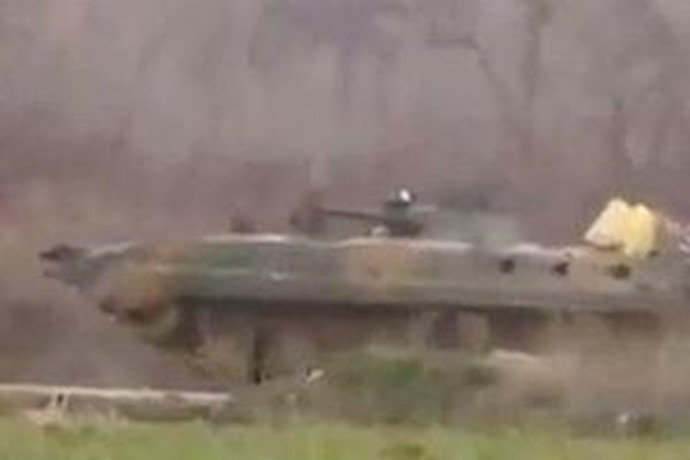
The New York Times, 20 Jan 2012 – After more than a week of fighting, Syrian army tanks have retreated from the small town of Zabadani, near the border with Lebanon. Our Observer in Zabadani tells us that a group of deserters armed with a handful of rifles managed to force the tanks to retreat. But, he warns, they may not be able to hold their ground much longer.
Zabadani is located on the mountain slopes 45 kilometres west of the capital, Damascus. For more than a week, it was the scene of deadly clashes between the army and deserters who had sought refuge there. Some had been hiding there for several months.
On Thursday night, Syrian activists announced that the army’s tanks and armoured vehicles had left Zabadani and were retreating to military outposts located ten kilometres away.
According to local residents, forces loyal to President Bashar al-Assad have only retained control of a few checkpoints around the city. This is the first time Assad’s forces have had to retreat from any city since the beginning of the uprising in March 2011. Activists now call Zabadani “Syria’s first liberated town”.
Due to severe restrictions on reporting in Syria, FRANCE 24 could not independently verify rebel claims that the army was pushed out and did not leave for other reasons.
This video, posted January 19 on YouTube, shows Syrian forces leaving the town of Zabadani.
“Our advantage is that the deserting soldiers are ready to die to defend their cause”
Mohammad Ali is one of the founders of Zabadani’s revolutionary council. We spoke to him as he was out in the street during a demonstration celebrating the army’s departure.
The fighting in the city was extremely violent. The army bombed several neighbourhoods. Some people have claimed that the troops’ withdrawal was the product of an agreement between the regular army and the Free Syrian Army [a rebel force formed by deserters], but that’s not the case. Our civilian fighters and deserters pushed them out by force.
Army deserters arrived in Zabadani in small groups, for the most part during the last two months. They chose to come to Zabadani because they know that nearly every person in this town owns a weapon, so we would be able to defend ourselves if we were attacked. Because the town is located only a few kilometres from the border with Lebanon, we got our hands on many weapons during the Israel-Lebanon war of 2006. However, we only have AK47s and shotguns, which is very little compared to what the regular army has. The other reason our fighters were able to push out the regular army is because we’re in a mountainous area with many forests. Deserters were able to hide out on the outskirts of town while they prepared counter-attacks. Town residents knew where they were hiding and brought them food and clothing.
“Without help from the international community, we won’t be able to hold out against the tanks for long”
We don’t have automatic machine guns or tanks, but our advantage is that the deserting soldiers are ready to die to defend their cause. In the regular army, many soldiers are just fighting because they know that if they desert, the army will take revenge by targeting their family. So they don’t have the same level of determination as those who are fighting for freedom.
Still, without help from the international community, we won’t be able to hold out against the tanks for long. Maybe a week, but not much longer than that. Bashar al-Assad’s troops are stationed not far from here. If they attack us again, we’ll quickly run out of ammunition and they’ll end up taking control of the town.
If the international community decided to create a no-fly zone over our heads, this would give some of the regular army soldiers a chance to defect and come to our side. I believe many would like to do so, but they know that if they join us in Zabadani, the regular army will start bombing the town. International support is our only hope.”
The six-nation group rejects Iran’s position, saying that the treaty contains no such “right” to anything except peaceful nuclear energy, that sanctions will not be removed as a condition for talks and that there is no point in talks unless they are about Iran’s nuclear program and its compliance with United Nations resolutions to freeze enrichment.
The importance of the European Union sanctions, which are still being negotiated, is both economic and political. The European Union buys about 18 percent of Iran’s oil exports, which are its main source of income.
France, Britain and Germany want the sanctions to come into effect within three months, while other countries more dependent on Iranian oil, like Greece, want a longer delay of up to eight months, European officials said. The question is when to phase out existing contracts, and how to replace Iranian oil with that from other countries, like Saudi Arabia, and whether to try to compensate countries that may need to pay more for replacement oil. If the delay is too long, some suggest, Iran will more easily find alternative customers.
The Europeans have agreed in general on sanctions on financial transactions with the Iranian Central Bank, which the United States has already imposed, but are discussing the scope, perhaps narrowing them to transactions supporting proliferation.
But Russia and China have made it clear to other partners that they will not accept any new round of Security Council sanctions on Iran. So further pressure must come from outside the United Nations, from countries willing to act, the French say.
The United States is also considered to be more willing than France to offer Tehran certain concessions in return for substantive talks, but nothing that would violate the Security Council resolutions, the officials said.
In Washington, Secretary of State Hillary Rodham Clinton said Friday that sanctions would continue until Iran showed a commitment to meaningful talks. “We all are seeking clarity about the meaning behind Iran’s public statements that they are willing to engage,” Mrs. Clinton said. “But we have to see a seriousness and a sincerity of purpose coming from them.”
A senior French official said: “We have to hold together, as the representatives of the world through the U.N. Security Council. And we have to be clear about what we are offering.”
Getting clear answers out of Tehran is another matter, the official said. “The inter-mullah process is much more complicated than even the inter-agency process” in the United States, he said.
“I’m convinced that if we fail,” the official said, “if the diplomatic process ends, then we’ll have terrible consequences — either military action versus Iranian sites or a collapse of the nonproliferation regime.”