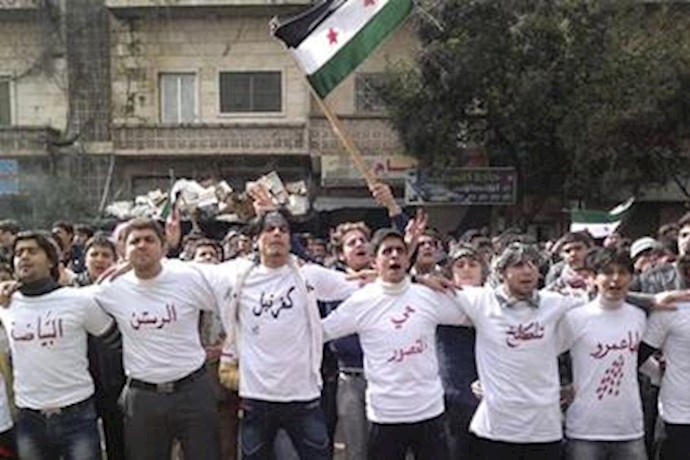
Al Arabiya, 10 Feb 2012 – The opposition Syrian National Council, an umbrella body grouping parties in revolt against Bashar al-Assad’s regime, said Friday it expects to be recognized within days by several Arab states.
Currently meeting in Qatar under its Paris-based leader Burhan Ghalioun, the SNC is hopeful that it will win a diplomatic breakthrough on Sunday at meetings of the Arab League and Gulf Cooperation Council in Cairo.
“There should be an official recognition of the SNC by several Gulf countries,” said Imad Hussari, a spokesman for the group and leader of the “Local Coordination Committees” which mobilizes protests inside Syria.
Another SNC figure, Istanbul-based Khaled Khoja, confirmed he expects recognition “by several Arab states in the coming days.”
Currently, only Libya’s post-revolutionary interim government recognizes the SNC as its sole legitimate Syrian interlocutor, but the Gulf states decided on Monday to expel Syrian ambassadors from their capitals.
The SNC groups parties from different backgrounds, including Islamists from the Muslim Brotherhood and liberal nationalists. Officials said it will meet in Cairo or Istanbul on February 15 to choose a new chairman.
EU agrees to tighten sanctions
Meanwhile, the European Union has reached an agreement in principle to tighten economic sanctions against Syria at the end of February to further cut funding for the regime, diplomats said Friday.
EU government representatives endorsed three new measures on Thursday, including an assets freeze against the central bank, a ban on Syrian phosphate exports and a prohibition on trading gold and gems, the diplomats said.
The 27-nation bloc accounts for 40 percent of Syrian phosphate exports.
The EU is aiming to give the final go-ahead for the sanctions at a meeting of foreign ministers on February 27.
Germany has also proposed a ban on commercial flights between Syria and Europe but such a measure “has little chance of being adopted,” a European diplomat said.
A flight ban could cause problems for the evacuation of EU citizens if the violence in Syria deteriorates.
More Syrians may also be added to a list of people facing an EU travel ban and assets freeze. Nearly 150 people and entities are under EU sanctions.
The EU has already imposed oil and arms embargos against Syria in response to a crackdown that has left more than 6,000 people dead, according to rights groups.
Assets of Assad’s cousin
Switzerland is unfreezing roughly 3 million euros ($4 million) held in a Geneva bank by a cousin of the Syrian president, according to a court ruling.
The money, held by Hafez Makhlouf, head of a branch of Syrian state security, was frozen in April when he was trying to conclude a property deal in Syria.
However, it was then unfrozen in September after he appealed in absentia because it predated sanctions imposed by the Swiss in May over the Syrian government’s crackdown on the uprising against the president, according to the Swiss court ruling.
This latest ruling, made public after a hearing in January, rejects a last-ditch effort by Swiss prosecutors to keep the funds frozen on grounds of suspected money-laundering.
The Swiss government declined to comment.
Makhlouf is a powerful figure in Assad’s inner circle. He is also the brother of billionaire businessman Rami Makhlouf, who was a target of protesters in the early days of the uprising because of allegations of corruption, which he denies.
He was not named in the court ruling, but identified by his title and his relationship to Assad.
The prosecutor was ordered to pay Makhlouf 1,800 Swiss francs ($2,000) to cover his costs.
Switzerland expanded the sanctions against Syria in May to include Assad and other senior officials in an attempt to raise pressure on his government to end the crackdown on protesters.
It said in December it had frozen 50 million Swiss francs ($55 million) of funds belonging to Assad and other top officials.
Switzerland has worked hard in recent years to improve its image as a haven for ill-gotten gains, seizing the assets of numerous deposed dictators and agreeing in 2009 to soften strict bank secrecy to help other countries catch tax cheats.
It has blocked assets of the former Tunisian and Egyptian leaders and their entourages as well as those of late Libyan leader Muammar Qaddafi and his family.