

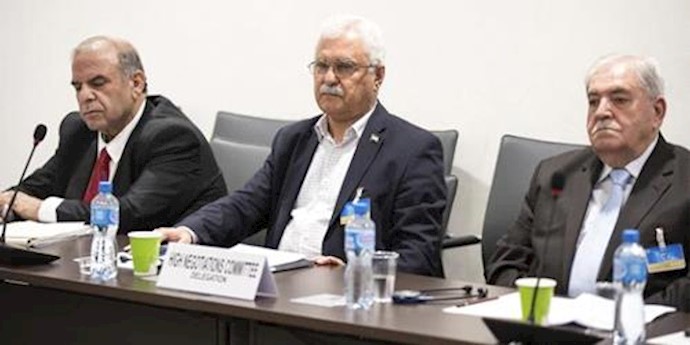
BEIRUT/GENEVA – Syrian peace talks came close to collapse on Monday, with the mainstream opposition announcing a pause in talks at the United Nations headquarters in Geneva, although it agreed to keep its negotiating team in the city.
The Western-backed opposition High Negotiations Committee (HNC) said in a letter to rebel fighters that government military advances meant a ceasefire was effectively over and it was calling a postponement in the talks.
Rebels, who accuse the government of breaking the ceasefire to try to recapture the northern city of Aleppo, announced an offensive of their own, launching an assault against government forces in Latakia province on the Mediterranean coast.
Opposition fighters made separate advances further east in Hama, while heavy government air strikes took place in Homs province to the south.
There was “no way” the opposition could resume formal talks amid a military escalation and a worsening humanitarian situation, senior opposition negotiator Mohammad Alloush told Reuters.
“We want real negotiations, not farcical ones,” he said, adding that the opposition had not decided whether it would continue to meet U.N. envoy Staffan de Mistura.
“When there are 70 airstrikes, and when there is mobilizing of troops, when Iran sends further armed men and Russia sends a large group of rockets and unmanned planes, all this tells us that there is no real will for a political solution that ensures the safety and stability in the country,” he said, naming countries that back Assad.
Nevertheless, de Mistura played down the decision by the opposition delegation to stay away from his headquarters, saying his team would continue to meet the delegates elsewhere as long as they were still in town.
He acknowledged that violence had become “worrisome”, particularly around Aleppo, and said he would call on Moscow and Washington to meet urgently if the situation did not improve.
The United States also urged Russia to use its influence to make the government stop its attacks immediately. These threatened not only the partial ceasefire but also the talks in Geneva, a U.S. State Department official said.
So far all sides have committed to some kind of political transition that would follow the war. But they still differ fundamentally on what that means, including whether it would require Assad to leave power.
Assad’s opponents say they cannot participate in talks as long as fighting goes on. But they are also under strong pressure not to quit altogether.
De Mistura said the opposition delegation had told him it would “postpone” its “formal participation” in negotiations at the U.N.’s headquarters, known as the Palais.
“It is one way for them to display their displeasure and concern for what they perceive to be a substantial deterioration of the humanitarian situation and a deterioration of the security environment, particularly in Aleppo,” he said.
“They told us however their intention to remain in Geneva, in their hotel, and possibly at my own suggestion, to pursue technical discussions with myself and my team.”
His team would continue to meet all sides “in the Palais or anywhere else”, he added, describing the format of proximity talks, in which the sides negotiate in separate rooms, as “very flexible”.
Both sides were “not yielding a comma” on their political demands, he acknowledged, but said that was normal in a negotiation. He would take stock of progress on Friday.
HALF-SOLUTIONS
A U.S. intelligence official speaking on condition of anonymity cited “credible reports” that Russia has been employing air strikes and long-range artillery.
“Despite holding back initially, Russian forces now seem to be directly engaging to support Assad’s violations,” said the U.S. intelligence official.
The opposition considers government attempts to recapture Aleppo as a violation of the ceasefire. The government says it is trying to capture areas held by Islamist militants who are not covered by the truce.
The opposition’s coordinator at the Geneva talks, Riad Hijab, also said it was unacceptable for talks to go on if the government and its allies pushed on with sieges and bombing civilian areas. Only three delegates met de Mistura for talks on Monday, instead of the usual 15.
One senior Western diplomat said de Mistura needed to reassure the opposition by criticizing the government for violating the truce.
“He needs to make a public statement putting pressure on the government. It’s in his interest to keep the talks alive. He needs to say that the regime isn’t listening.”
The Geneva talks aim to end a war that has killed more than 250,000 people, created the world’s worst refugee crisis, allowed for the rise of the Islamic State group and drawn in regional powers. Russia’s intervention in the conflict swayed the war in Assad’s favor.
Source: REUTERS, April 19