

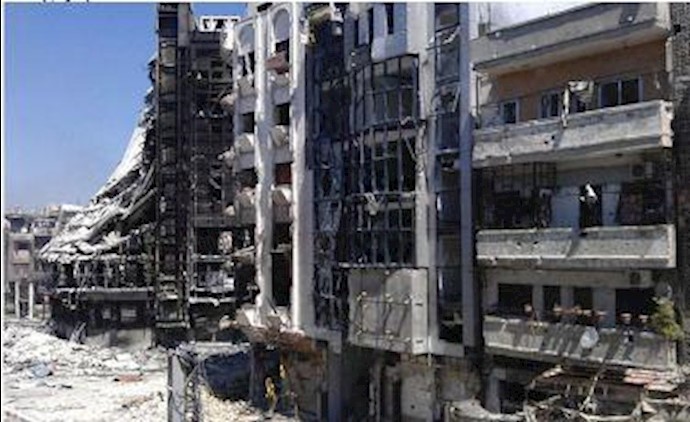
AL ARABIYA , 15 April 2012- Syrian regime forces heavily shelled the rebel Khaldiyeh neighborhood of the central city of Homs on Sunday, hours before the arrival in Damascus of an advance team of U.N. military observers, monitors said.
“The bombardment of Khaldiyeh intensified this morning with an average of three shells a minute,” the head of the Syrian Observatory for Human Rights, Rami Abdel Rahman, told AFP.
The rebel district of Bayada was also shelled, Abdel Rahman said, adding that it was the fiercest shelling of Homs since a U.N.-backed ceasefire went into force at dawn on Thursday.
The security forces now control some 70 percent of the flashpoint city, which has seen some of the biggest losses of life of the 13-month uprising in Syria.
Rebel fighters remain entrenched in several mainly Sunni Muslim neighborhoods of the Old City, Abdel Rahman said.
Three civilians died in shelling of Homs on Saturday, among 14 people killed nationwide ahead of a U.N. Security Council vote approving the dispatch of the observer mission to monitor the shaky truce.
With a cease-fire barely holding and the deployment of unarmed foreign observers expected to ease but not end months of violence, world powers are still struggling to find a longer-term strategy for Syria.
In theory, the world’s most powerful countries, the government of President Bashar al-Assad and much of the Syrian opposition have all signed up to a multipoint plan formulated by former U.N. chief Kofi Annan. But the reality remains much more complex.
While Moscow and Beijing have repeatedly said they want to avoid a Libya-style externally backed regime change, the United States, Britain and France still say they want Assad gone.
“The main focus at the moment is the… rapid deployment of monitors,,” said one Western official on condition of anonymity. “That’s a priority, but it’s not the only one… at the end of the day, do not see a future for Syria with Assad in charge. We are in this for the long haul.”
But officials concede they have few immediate tools with which to make that happen. Even a U.S. plan to provide “non-lethal” support to opposition fighters could end up being shelved, some suspect, largely because the rebels remain so disunited and ineffective.
U.S. pressure, insiders say, has already deterred Saudi Arabia and Qatar from making good on long-running talk they might provide weapons.
For now, Annan, Western powers and their Arab allies say Assad remains in breach of much of the peace plan. Privately, many Western diplomats worry his strategy may be to give just enough to drive a wedge between them and a much more reluctant Russia and China.
“The game for the weekend is watching whether the ceasefire holds and the monitors are approved,” said another Western official. “After that it gets more complicated.”
The most realistic immediate hope, officials say, would be that Assad’s forces cease use of heavy weaponry.
But if an earlier Arab league monitoring attempt in Syria — or other previous similar missions in Sri Lanka and Kosovo — are anything to go by, unarmed observers might struggle to stop killings, abductions and use of snipers.
Certainly, few believe Syria will genuinely follow through to withdraw troops from urban areas or allow peaceful protest. For world powers, the true challenge will come if the monitors report a fall in violence but accuse Syria of ignoring other areas of Annan’s plan.