Washington Post, February 10 ,2016 – Suddenly, after four years of brutal civil war, Syria this week became even more of an uncontrollable military, diplomatic and humanitarian disaster.
“We are not blind to what is happening,” Secretary of State John F. Kerry said Tuesday, as he prepared for a meeting in Munich of stakeholders from outside Syria. “We are all very, very aware of how critical this moment is.”
The Thursday gathering could well be the last gasp of a three-month, Kerry-orchestrated effort to bring together powerful countries on all sides of the conflict to try and forge a political solution that would allow them all to focus their efforts on defeating the Islamic State.
What seemed possible even two weeks ago, however, now seems all but hopeless. Failure of planned peace negotiations could lead President Obama finally to a decision he has long resisted — whether to more fully arm and back rebel groups whose cohesion and commitment to a democratic and secular Syria he mistrusts.
In recent days, Russian bombardment of opposition forces north of Aleppo, a rebel stronghold, has severed opposition supply lines and threatens to allow government-aligned forces to encircle the city. In a letter sent to the Obama administration this week, Russia proposed to stop the bombing on March 1, allowing it to continue for another three weeks.
The Russian blitz has allowed pro-government ground forces, mostly composed of Iranian-trained militias from Iraq, Iran and Lebanon’s Shiite Hezbollah, to push north to with 20 miles of the Turkish border. This is the same area where the United States and Turkey have planned to carve out an opposition-held zone to combat Islamic State forces approaching it from the east.
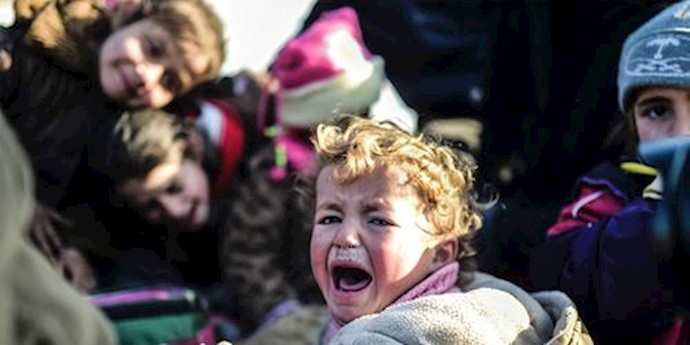
Tens of thousands of new refugees have fled Aleppo and its environs to the recently closed Turkish border. Mercy Corps, one of the few aid agencies in a position to help them, said Tuesday that its supplies will soon run out. For those who haven’t fled, the encirclement of Aleppo “would leave up to 300,000 people, still residing in the city, cut off from humanitarian aid unless cross-line access could be negotiated,” the United Nations said.
In Europe, where a flood of nearly a million migrants and refugees from the region, most of them Syrians, have already arrived, political and social tensions are threatening the foundation of European unity constructed over the past 70 years.
“There are fault lines emerging that we thought we had overcome,” said Peter Wittig, Germany’s ambassador to the United States, who described the situation as an existential threat to Europe.
“The United States has been slow to recognize this is a much bigger thing than anything else we’ve experienced since the beginning of the European Union,” Wittig said. “We didn’t see it earlier, we were totally unprepared. . . . We’re not blaming the United States. It takes time for this country to realize that it’s really that serious.”
Germany has taken in the bulk of the migrants and refugees, while some Eastern European members of the E.U. have closed their borders to them.
Negotiation ‘farce’
U.S. ties have become strained with partners closer to the conflict. These allies fear the Obama administration has been blinded to the threat from Russia and Iran by its desire to believe they can be swayed by diplomatic reason and appeals to shared worries about expansion of the Islamic State.
One senior official from a close partner nation described the negotiation track as a farce. The official said that it was unrealistic to expect the opposition to come to the table when its forces are being decimated on the ground and civilians are being starved by Russian bombing and the government gains it has enabled, in violation of United Nations resolutions that Moscow agreed to in order to get the talks started. The official, who said that U.S. leadership is still essential if the war is to end, did not want to be identified by name or nationality in order to speak candidly.
Talks between the Syrian government and opposition were suspended before they began this month after rebel representatives said they would not sit at the table until the government provided humanitarian access to besieged areas and released women and children it is holding prisoner. The Munich meeting, originally scheduled to monitor progress in the negotiations, became a final effort to get them started.
Near the Turkey-Syria border Tuesday, rebels said they fear they are being betrayed by the countries they thought were their allies — most notably the United States. Without significant new injections of arms and ammunition, they said, they will not survive the combined onslaught of intense Russian airstrikes and advances by pro-government ground forces.
“Russia is the second superpower in the world, and Russia is using all of its power against the rebels,” said Mohammed Adib, a political officer with Jabhat Shamiya, the main rebel group fighting in northern Aleppo province. “They’re using a scorched-earth policy, and they don’t care what the international community says.”
“The problem is the friends of the regime are really good friends and give lots of support, whereas our friends sometimes give support and sometimes not,” he said.
While they don’t expect they will receive anti-aircraft missiles, which would have a major impact on the balance of power, rebels said they still hope to receive upgraded weapons, including new-generation models of the TOW missiles that have proved effective at taking out the Syrian government’s aging battle tanks, though these are no match for newly supplied Russian T-90 tanks.
If the rebel fighters cannot rebound, Adib and other rebel spokesmen said, there is a risk that opposition fighters will join more radical organizations. “People will not surrender to [Assad] under any circumstances,” said Khaled Shihabeddine, a political adviser to the Noureddin al-Zinki rebel group. “If things stay as they are, with no support and no one stopping Russia, the rebels will be pushed into a corner and . . . all possibilities will be open.”