

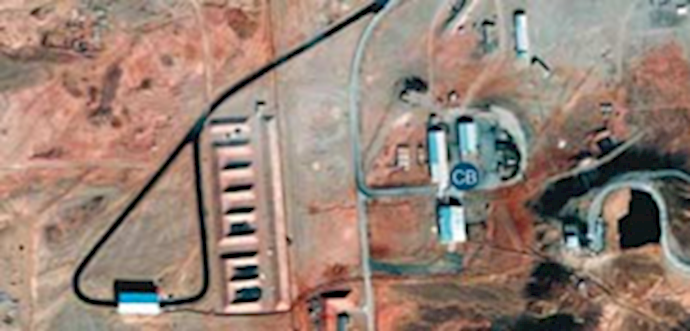
The photographs taken by the Digital Globe QuickBird satellite has revealed Iran is focusing its efforts on developing its long range ballistic missiles.
The Times, London daily on April 11, published the satellite imagery and wrote: the secret site where Iran is suspected of developing long-range ballistic missiles capable of reaching targets in Europe has been uncovered by new satellite photographs.
The imagery has pinpointed the facility from where the Iranians launched their Kavoshgar 1 “research rocket” on February 4, claiming that it was in connection with their space programme.
Analysis of the photographs taken by the Digital Globe QuickBird satellite four days after the launch has revealed a number of intriguing features that indicate to experts that it is the same site where Iran is focusing its efforts on developing a ballistic missile with a range of about 6,000km (4,000 miles).
A close examination of the photographs by a weapon analyst has indicated that the Iranians are following the same path as North Korea, pursuing a space programme that enables Tehran to acquire expertise in long-range missile technology.
He added that Iran was benefiting from the North Korean missile programme and following its designs. The Taepodong 1 consisted of a liquid-propellant Nodong (like the Shahab 3) first stage, a liquid-propellant Scud second stage and a solid-propellant third stage.
Geoffrey Forden, a research associate at the Massachusetts Institute of Technology, said that there was a recently constructed building on the site, about 40 metres in length, which was similar in form and size to the Taepodong long-range missile assembly facility in North Korea.
Avital Johanan, the editor of Jane’s Proliferation, said that the analysis of the Iranian site indicated that Tehran may be about five years away from developing a 6,000km ballistic missile. The Kavoshgar 1 rocket was based on the Shahab 3B missile, a version of the North Korean Nodong liquid-propellant missile.
Dr Forden said that the Kavoshgar launch did not demonstrate any significant advances in ballistic missile technology. “But it does reveal the likely future development of Iran’s missile programme,” he said.
However, according to Jane’s Intelligence Review, the satellite photographs prove that the Kavoshgar 1 rocket was not part of a civilian space centre project but was consistent with Iran’s clandestine programme to develop longer-range missiles.
The examination of the launch site revealed that it was part of a large and growing complex “with very high levels of security and recent construction activity”. It was clearly “an important strategic facility”, Dr Forden said.