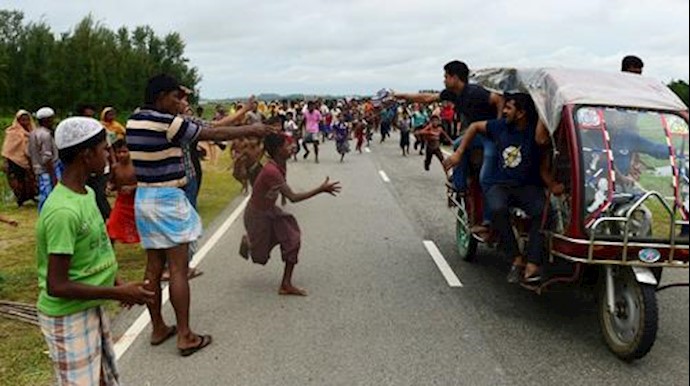
AFP, September 10, 2017 – Rohingya militants in Myanmar, whose raids sparked an army crackdown that has seen nearly 300,000 Muslim Rohingya flee to Bangladesh, on Sunday declared a unilateral ceasefire but the government declared it would not negotiate with “terrorists”.
The United Nations said 294,000 bedraggled and exhausted Rohingya refugees have arrived in Bangladesh since the militants’ attacks on Myanmar security forces in neighbouring Rakhine state on August 25 sparked a major military backlash.
Tens of thousands more are believed to be on the move inside Rakhine after more than a fortnight without shelter, food and water.
“The Arakan Rohingya Salvation Army (ARSA) hereby declares a temporary cessation of offensive military operations,” the group said in a statement on its Twitter account.
It urged “all humanitarian actors” to resume aid delivery to “all victims of humanitarian crisis irrespective of ethnic or religious background” during the one-month ceasefire until October 9.
In addition to Rohingya, some 27,000 ethnic Rakhine Buddhists as well as Hindus have also fled violence in the northern part of Rakhine state.
ARSA called on Myanmar to “reciprocate this humanitarian pause” in fighting.
Myanmar, which has previously labelled ARSA as “terrorists”, appeared to reject the overture.
“We have no policy to negotiate with terrorists,” Zaw Htay, a senior government spokesman, tweeted late Sunday.
Aung San Suu Kyi’s government has come in for strong international criticism over the military’s treatment of the Rohingya — including the alleged laying of mines along the border to prevent those who fled from returning.
Three Rohingya are reported to have been killed by a mine and others including children have been injured.
Mainly Buddhist Myanmar does not recognise its stateless Muslim Rohingya community, labelling them “Bengalis” — illegal immigrants from Bangladesh.
Rohingya refugees say the army operations against ARSA led to mass killing of civilians and the burning of hundreds of villages, sending them across the border.
International aid programmes in Rakhine have been severely curtailed, as the fighting tore through parts of the state.
– Food, shelter, safety –
India’s foreign ministry called for an immediate end to the violence, urging the situation “be handled with restraint and maturity”.
Thousands are arriving in Bangladesh each day, joining already overcrowded camps of Rohingya who have fled Myanmar over decades of troubles. The UN refugee agency UNHCR gave the latest figure of 294,000 for the new arrivals.
The UN has appealed for urgent donations of $77 million.
Bangladesh already hosts around 400,000 Rohingya from previous crises.
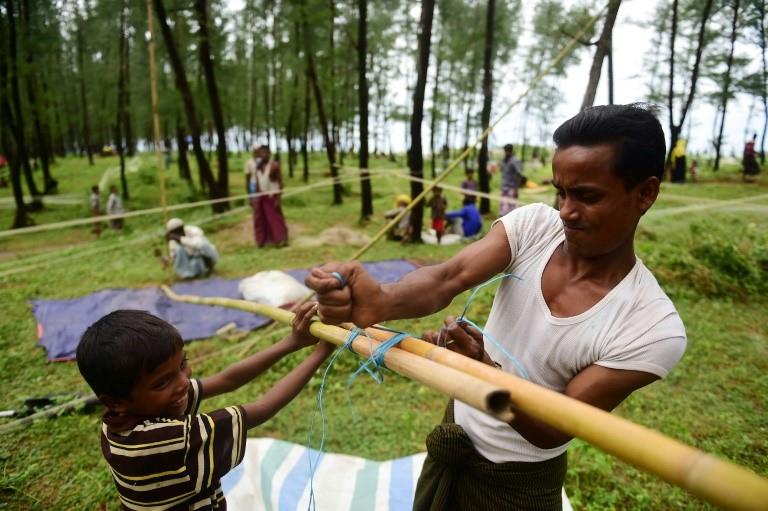
Rohingya Muslim refugees build temporary makeshift shelters, after crossing the border from Myanmar, in the Bangladeshi town of Teknaf on September 10, 2017
The Red Cross in Bangladesh welcomed the ceasefire pledge as aid agencies struggle to meet the needs of an “overwhelming crisis”, battling monsoon rains to deliver relief to people who have fled with few belongings.
“How can you handle such a big influx of people? They want shelter, they want a safe place,” Misada Saif, Prevention and Communication Coordinator of the ICRC Bangladesh delegation, told AFP.
Cradling her naked screaming infant, Rohingya refugee Zohra Begum was close to tears as several hundred people were ordered to leave a strip of forest alongside the beach near Shamlapur, where families were clearing land with hoes to build shelters.
“We went to all the camps but there was no place to stay. That’s why we came here,” she told AFP. “If we have to move from here, where will we go? We will die.”
Rohingya refugees in Bangladesh say ethnic Rakhine Buddhists joined Myanmar’s security forces in the indiscriminate killing of villagers.
But ethnic Rakhine villagers accuse militants of murdering civilians while the government says fleeing Rohingya set fire to their own homes to forment fear and anger against the authorities.
At the makeshift camp near Shamlapur, Rohingya refugees doubted a ceasefire would allow their return any time soon.
“They (Myanmar army) are saying ‘go away or we’ll burn all of you’. How can we believe a ceasefire will have any effect?” Hafez Ahmed, 60, told AFP.
But Hashem Ullah, a 33-year-old farmer from a village west of Maungdaw, said he would return “if I got compensation, and they accept us as Rohingya”.
How can we live like this here?” he added, gesturing to the swampy earth.
ARSA says it is fighting to defend the Rohingya from persecution in Myanmar.
But Myanmar labels them “extremist Bengali terrorists”.
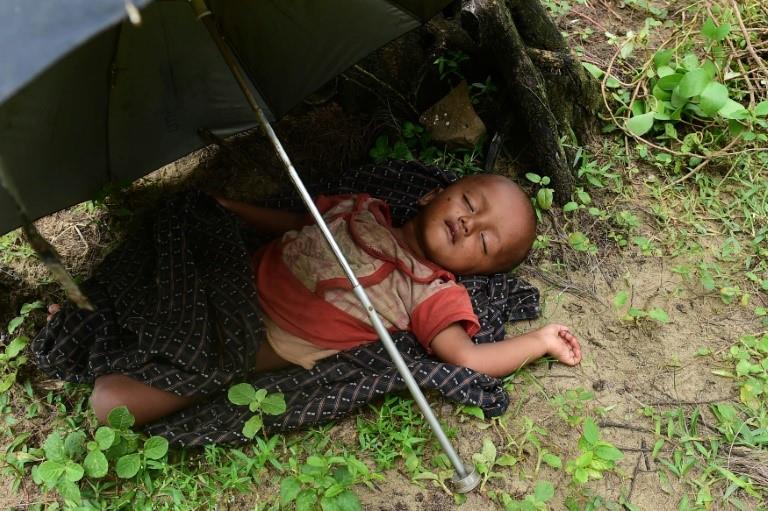
A Rohingya Muslim child sleeps after crossing the border from Myanmar
The army says it has killed nearly 400 militants so far, while some Rohingya refugees have complained they were forced to fight by ARSA.
The first ARSA attacks in October last year were less ambitious, but the subsequent military response by a security force notorious for its scorched-earth response to insurgency sent 90,000 Rohingya fleeing across the border.
That means over a third of the estimated 1.1 million Rohingya in Rakhine state have fled in less than a year.