

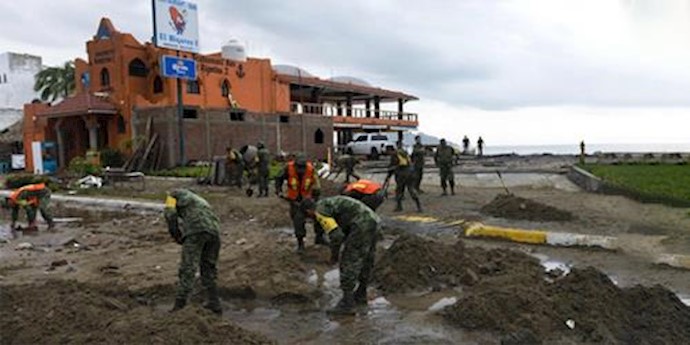
The remnants of Hurricane Patricia dropped heavy rain over central Mexico on Saturday, a day after pounding coastal luxury resorts and impoverished villages alike as a Category 5 storm that uprooted trees, toppled power lines and unleashed mudslides.
Patricia, the strongest hurricane ever recorded at sea, weakened slightly before striking southwestern Mexico’s coast Friday evening with crushing 165-mph sustained winds.
By late Saturday morning, Patricia had been downgraded to a tropical depression, sapped by mountainous terrain, with 35-mph sustained winds. It’s expected to dissipate Saturday night. There were no reports of fatalities or major damage.
Mexican officials had expressed cautious optimism overnight, with President Enrique Peña Nieto saying “damages have been minor to those corresponding to a hurricane of this magnitude.”
Airports had reopened in Manzanillo, Puerto Vallarta, Colima and Tepic on Saturday, according to Communications and Transport Minister Gerardo Ruíz Esparza. There was no major damage to regional ports. Schools are expected to reopen Monday.
“There are no victims, dead or hurt,” he said. “Prevention has saved lives.”
Officials said Patricia moved through a sparsely populated and mountainous stretch of the coast, avoiding the Puerto Vallarta resort and the port city of Manzanillo.
“We are fortunate the hurricane … went to the mountain areas,” Ruíz Esparza said. “The wind and water hit us but our infrastructure was able to withstand that hit. The worst went to the mountains.”
More than 10,000 people, including local residents and tourists, were evacuated to safe areas on Friday but most had returned, officials said.
More than 11 inches of rain had already fallen by early Saturday near the inland Nevado de Colima volcano in Jalisco state, Mexico’s meteorological agency said, and forecasters said 8 to 20 inches of rain could fall in several Mexican states through Saturday.