
BOLZANO (ITALY) (AFP) – 18 Sep. 2016- When police heard about the frozen corpse up in the Alps in September 1991, they opened a criminal probe. Murder it was, but the crime was rather old — and the ultimate cold case.
The dead man, found by hikers 25 years ago this week a snowball’s throw from the Austrian-Italian border and put in a wooden coffin at a nearby police station, turned out to have died more than 5,000 years ago.
Mummified in the ice, “Oetzi”, as he was later nicknamed, was a sensation, providing invaluable scientific insights that a quarter of a century later show no sign of abating.
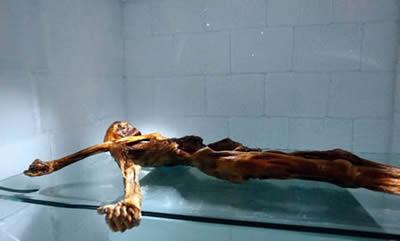
Mummified in the ice, Oetzi as he was later nicknamed, was a sensation, providing invaluable scientific insights that 25 years later show no sign of abating.
“The iceman is without doubt one of the most outstanding mummy discoveries in the history of mankind,” said Angelika Fleckinger, director of the museum in Bolzano, Italy, where the mummy is on display.
“It’s a unique window into the prehistoric era, and gives us an incredible amount of information,” she told AFP.
– Shot in the back –
To put it into perspective, when Oetzi died around 3,350-3,100 BC, Stonehenge in England and the first Egyptian pyramids were still hundreds of years from being built.
He lived during the Late Neolithic or Copper Age when mineral extraction and copper smelting, which spread to Europe from the Near East, was fundamentally transforming human society.
Perhaps the resulting upheaval explains his still mysterious death. That he came to a sticky end was confirmed by the arrowhead lodged in his shoulder, only found in 2001, showing he had been shot from behind.
He would have bled to death in minutes and was possibly finished off with a whack on the head. He had at least had a large meal including barbecued ibex around 12 hours earlier, the contents of his stomach showed.
And his untimely demise high in the mountains meant for scientists that he was incredibly well-preserved, allowing detailed studies.
Unlike other ancient mummies, Oetzi is “damp”, meaning there is still humidity in his cells and his body is untouched by funeral rites. Egyptian specimens are generally without brains and other organs.
The findings include that Oetzi was lactose intolerant and genetically predisposition to heart disease, as shown by his hardened arteries, something thought of before as a modern phenomenon.
The 30 types of pollen in his intestines and the isotopic composition of his tooth enamel suggest he lived just south of the Alps.
He was from a genetic subgroup now extremely rare in Europe but relatively common in Corsica and Sardinia, meaning that people there and Oetzi have common ancestors.
Albert Zink, director at the EURAC Institute for Mummies and the Iceman in Bolzano, said that studying the bacteria in his stomach could help advances in modern medicine.
For instance Oetzi’s intestine contains H. pylori, a bacteria present in 50 percent of humans’ guts today and which can lead to stomach ulcers or even cancer.
“Maybe this was a positive bacteria that helped with the digestion of raw meat and later turned into a pathogen,” Zink told AFP. “Clinicians are very interested (in our research).”
– Lean and tattooed –
Oetzi was around 46 when he died, a good age for his time. And with not an ounce of excess fat, he must have been fit. He had brown eyes, a beard, long hair — and 61 tattoos.
But these were not ornamental but medicinal. They were where there were signs of wear, and correspond to pressure points used in acupuncture today.
Before Oetzi was discovered, it was thought this technique originated 2,000 years later in Asia.
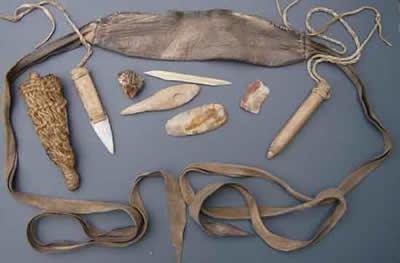
What he did have though was an axe with a copper blade, which would have been a coveted object — the iPhone 7 of his day — as well as a wealth of other equipment.
This included a quiver of arrows, a dagger, two types of tree fungus, one probably for lighting fires and another medicinal, and a pencil-like tool for sharpening arrows.
His clothing is also well preserved, including leggings and a coat made from goat hide, a hat of bear fur, shoes of tree bast netting, hay and deer skin, and even a backpack and possible cape.
All this, plus Oetzi himself inside a special air-conditioned container, can be seen in the South Tyrol Museum of Archaeology, which attracts 260,000 visitors a year from the world over and where queues are often long.
“We could say that Oetzi has put Bolzano/Bozen on the map,” said Roberta Agosti from the Bolzano tourism office. In fact a new, bigger museum is planned.
– Tip of the iceberg? –
And 25 years after his discovery, scientists continue to learn more things about Oetzi, helped by the advent of new technologies.
Indeed on Monday a major mummy congress begins in Bolzano revealing new findings including on the bacteria in Oetzi’s stomach and the circumstances surrounding his death.
And one upside to global warming is that more treasures may be discovered, like the snowshoe found nearby that was recently revealed to be 500 years older even than Oetzi.
“People are more aware now that there could be more mummies in the mountains, and the melting of the glaciers makes us hope or maybe believe there could be more,” Zink said.
Read More:
Otzi The Iceman
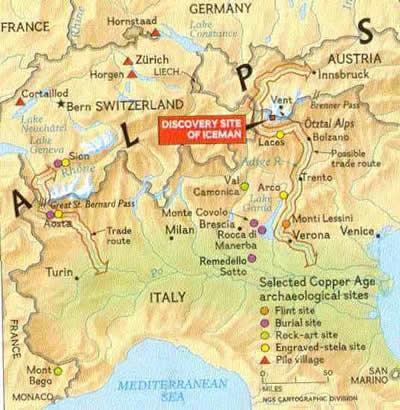
Otzi. also called Otzi the Iceman, the Similaun Man, the Man from Hauslabjoch, Homo tyrolensis, and the Hauslabjoch mummy, is a well-preserved natural mummy of a man who lived around 3,300 BCE. Otzi was discovered in Europe 1991 in the Otztal Alps on the Austrian-Italian border. He is Europe’s oldest known natural human mummy, and has offered an unprecedented view of Chalcolithic Europeans. His body and belongings are displayed in the South Tyrol Museum of Archaeology in Bolzano, South Tyrol, Italy.
Otzi was found by two German tourists, Helmut and Erika Simon, on September 19, 1991. The body was at first thought to be a modern corpse, like several others which had been recently found in the region. It was roughly recovered by the Austrian authorities and taken to Innsbruck, where its true age was finally discovered. Subsequent surveys showed that the body had been located a few meters inside Italian territory. It is now on display at the South Tyrol Museum of Archaeology in Bozen-Bolzano, Italy.
The body has been extensively examined, measured, x-rayed, and dated. Tissues and gut contents were examined microscopically, as was the pollen found on his gear. At the time of his death, Otzi was a 30-to-45-year old man, approximately 160 cm (5’3″) tall.
Facial Reconstruction
Using modern 3-D technology, a facial reconstruction has been created for the South Tyrol Museum of Archaeology in Bolzano, Italy. It shows Otzi looking old for his 45 years, with deep-set brown eyes, a beard, a furrowed face, and sunken cheeks. He is depicted looking tired and ungroomed.
Discovery – February 25, 2011
Brown-eyed, bearded, furrow faced, and tired: this is how Otzi the Iceman might have looked, according to the latest reconstruction based on 20 years of research and investigations. The model was produced with the latest in forensic mapping technology that uses three-dimensional images of the mummy’s skull as well as infrared and tomographic images. The new reconstruction shows a prematurely old man, with deep-set eyes, sunken cheeks, a furrowed face and ungroomed beard and hair. Although he looks tired, Otzi has vivid brown eyes. Indeed, recent research on the 5,300-year-old mummy has shown that the Stone Age man did not have blue eyes as previously thought. Believed to have died around the age of 45, Otzi was about 1.60 meters (5 foot, 3 inches) tall and weighed 50 kilograms (110 pounds).
Blood
In May 2012, scientists announced the discovery that Otzi still had intact blood cells. These are the oldest blood cells ever identified. In most bodies this old, the blood cells are either shrunken or mere remnants, but Otzi’s have the same dimensions as living red blood cells and resembled a modern-day sample.
Oetzi the Iceman’s blood is world’s oldest BBC – May 2, 2012
Researchers studying Oetzi, a 5,300-year-old body found frozen in the Italian Alps in 1991, have found red blood cells around his wounds. Blood cells tend to degrade quickly, and earlier scans for blood within Oetzi’s body turned up nothing.
Genetics
A recent DNA study conducted by Walther Parson of Innsbruck Medical University revealed Otzi has 19 living genetic relatives.
Scientists say Otzi the Iceman has living relatives, 5,300 years later NBC – October 15, 2013
A researcher examines the 5,300-year-old body of Otzi the Iceman in Bolzano, Italy. No next-of-kin was around to claim the frozen 5,300-year-old body of Otzi the Iceman when it was found in the Italian Alps in 1991, but researchers now report that there are at least 19 genetic relatives of Otzi living in Austria’s Tyrol region.
Link to Oetzi the Iceman found in living Austrians BBC – October 10, 2013
Austrian scientists have found that 19 Tyrolean men alive today are related to Oetzi the Iceman, whose 5,300-year-old frozen body was found in the Alps. Their relationship was established through DNA analysis by scientists from the Institute of Legal Medicine at Innsbruck Medical University. The men have not been told about their connection to Oetzi. The DNA tests were taken from blood donors in Tyrol.
New clues have emerged in what could be described as the world’s oldest murder case: that of Oetzi the “Iceman”, whose 5,300-year-old body was discovered frozen in the Italian Alps in 1991. Oetzi’s full genome has now been reported in Nature Communications. It reveals that he had brown eyes, “O” blood type, was lactose intolerant, and was predisposed to heart disease. They also show him to be the first documented case of infection by a Lyme disease bacterium. Analysis of series of anomalies in the Iceman’s DNA also revealed him to be more closely related to modern inhabitants of Corsica and Sardinia than to populations in the Alps, where he was unearthed.
Gene Map to Give Insight into 5,200-year-old Iceman Live Science – August 5, 2010
Iceman, the Neolithic mummy found accidentally in the Eastern Alps by German hikers in 1991, has offered researchers all sorts of clues to life 5,200 years ago, from his goat-hide coat to the meat and unleavened bread in his stomach to the arrow wound in his shoulder.
Travels
Analysis of pollen and dust grains and the isotopic composition of his teeth’s enamel indicate that he spent his childhood near the present village of Feldthurns, north of Bolzano, but later went to live in valleys about 50 km further north.
Deciphering the Origin, Travels of “Iceman” October 30, 2003 National Geographic
A 46-year-old man entombed by a glacier about 5,200 years ago high in the mountains that border Austria and Italy probably spent his entire life within a 37-mile (60-kilometer) range south of where he came to his final rest, according to a new study.
Health
Otzi apparently had whipworm (Trichuris trichiura), an intestinal parasite. During CT scans, it was observed that three or four of his right ribs had been cracked when he had been lying face down after death, or where the ice had crushed his body. One of his fingernails (of the two found) shows three Beau’s lines indicating he was sick three times in the six months before he died. The last incident, two months before he died, lasted about two weeks.
Also, it was found that his epidermis, the outer skin layer, was missing, a natural process from his mummification in ice. Otzi’s teeth showed considerable internal deterioration from cavities. These oral pathologies may have been brought about by his grain-heavy, high carbohydrate diet. DNA analysis in February 2012 revealed that Otzi was lactose intolerant, supporting the theory that lactose intolerance was still common at that time, despite the increasing spread of agriculture and dairying
Neolithic Iceman Otzi Had Bad Teeth Science Daily – April 10, 2013
Periodontitis, Tooth Decay, Accident-Related Dental Damage in Ice Mummy – The latest scientific findings provide interesting information on the dietary patterns of the Neolithic Iceman and on the evolution of medically significant oral pathologies.
Diet
Analysis of Otzi’s gut contents showed two meals, one of ibex meat, the second of red deer meat, both consumed with some grain. Pollen in the first meal showed that it had been consumed in a mid-altitude conifer forest.
Analysis of Otzi’s intestinal contents showed two meals (the last one consumed about eight hours before his death), one of chamois meat, the other of red deer and herb bread. Both were eaten with grain as well as roots and fruits. The grain from both meals was a highly processed einkorn wheat bran, quite possibly eaten in the form of bread. In the proximity of the body, and thus possibly originating from the Iceman’s provisions, chaff and grains of einkorn and barley, and seeds of flax and poppy were discovered, as well as kernels of sloes (small plumlike fruits of the blackthorn tree) and various seeds of berries growing in the wild. Hair analysis was used to examine his diet from several months before.
Pollen in the first meal showed that it had been consumed in a mid-altitude conifer forest, and other pollens indicated the presence of wheat and legumes, which may have been domesticated crops. Pollen grains of hop-hornbeam were also discovered. The pollen was very well preserved, with the cells inside remaining intact, indicating that it had been fresh (a few hours old) at the time of Otzi’s death, which places the event in the spring. Einkorn wheat is harvested in the late summer, and sloes in the autumn; these must have been stored from the previous year.
In 2009, a CAT scan revealed that the stomach had shifted upward to where his lower lung area would normally be. Analysis of the contents revealed the partly digested remains of ibex meat, confirmed by DNA analysis, suggesting he had a meal less than two hours before his death. Wheat grains were also found.
Daily Life
High levels of both copper particles and arsenic were found in Otzi’s hair. This, along with Otzi’s copper axe which is 99.7% pure copper, has led scientists to speculate that Otzi was involved in copper smelting. By examining the proportions of Otzi’s tibia, femur and pelvis, Christopher Ruff has determined that Otzi’s lifestyle included long walks over hilly terrain. This degree of mobility is not characteristic of other Copper Age Europeans. Ruff proposes that this may indicate that Otzi was a high-altitude shepherd.
Tattoos
Otzi had 57 tattoos, some of which were located on or near acupuncture points that coincide with the modern points that would be used to treat symptoms of diseases that Otzi seems to have suffered from, such as digestive parasites and osteoarthrosis. Some scientists believe that these tattoos indicate an early type of acupuncture.
Otzi had several carbon tattoos including groups of short, parallel, vertical lines to both sides of the lumbar spine, a cruciform mark behind the right knee, and various marks around both ankles. Radiological examination of his bones showed “age-conditioned or strain-induced degeneration” in these areas, including osteochondrosis and slight spondylosis in the lumbar spine and wear-and-tear degeneration in the knee and especially the ankle joints. It has been speculated that these tattoos may have been related to pain relief treatments similar to acupressure or acupuncture. If so, this is at least 2000 years before their previously known earliest use in China (c. 1000 BCE).
Otzi iceman’s tattoos came from fireplace MSNBC – July 17, 2009
The 57 tattoos sported by Otzi, the 5300-year-old Tyrolean iceman mummy, were made from fireplace soot that contained glittering, colorful precious stone crystals, according to an upcoming study in the Journal of Archaeological Science. The determination supports prior research that the tattoos were associated with acupuncture treatments for chronic ailments suffered by the iceman, whose frozen body was found remarkably well preserved in the Similaun Glacier of the Alps in 1991. The findings also suggest how prehistoric people were tattooed in the days before commercial inks and electric tattooing machines.
Clothing
His clothes, including a woven grass cloak
and leather vest and shoes, were quite sophisticated.
Otzi’s shoes were waterproof and wide, seemingly designed for walking across the snow; they were constructed using bearskin for the soles, deer hide for top panels, and a netting made of tree bark. Soft grass went around the foot and in the shoe and functioned like warm socks. The shoes have since been reproduced by experts and found to constitute such excellent footwear that there are plans for commercial production.
Clothes worn by Otzi the Iceman 5,300 years ago include (clockwise from top left): hay-stuffed shoes, goat- and sheepskin coat, goatskin leggings, bear fur hat, grass matting and sheepskin loincloth. Since the discovery of Otzi the Iceman in a European glacier in 1991, scientists have recovered a wealth of information from his 5,300-year-old mummified remains: The brown-eyed, gap-toothed, tattooed man most likely spent his 40-odd years farming and herding, and was probably suffering from a painful stomach ache at the time that he died a quick – albeit violent – death in the Oztal Alps.
Iceman Wore Cattle, Sheep Hides; May Have Been a Herder National Geographic – August 21, 2008 The clothes of the world’s oldest intact human mummy suggest the Iceman lived in a relatively advanced farming society and may even have been an Alpine herdsman, a new study says. More than 5,000 years ago, the Iceman – also called Otzi – donned a coat and leggings of Neolithic sheep hair, according to data from a new type of laser-assisted chemical analysis.
Weapons – Tools
Items found with the Iceman were a copper axe with a yew handle, a flint-bladed knife with an ash handle and a quiver of 14 arrows with viburnum and dogwood shafts. Two of the arrows, which were broken, were tipped with flint and had fletching (stabilizing fins), while the other 12 were unfinished and untipped. The arrows were found in a quiver with what is presumed to be a bow string, an unidentified tool, and an antler tool which might have been used for sharpening arrow points. There was also an unfinished yew longbow that was 1.82 metres (72 in) long.
In addition, among Otzi’s possessions were berries, two birch bark baskets, and two species of polypore mushrooms with leather strings through them. One of these, the birch fungus, is known to have antibacterial properties, and was probably used for medicinal purposes. The other was a type of tinder fungus, included with part of what appeared to be a complex firestarting kit. The kit featured pieces of over a dozen different plants, in addition to flint and pyrite for creating sparks.
Otzi’s copper axe was of particular interest. The axe’s haft is 60 centimetres (24 in) long and made from carefully worked yew with a right-angled crook at the shoulder, leading to the blade. The 9.5 centimetres (3.7 in) long axe head is made of almost pure copper, produced by a combination of casting, cold forging, polishing, and sharpening. It was let into the forked end of the crook and fixed there using birch-tar and tight leather lashing. The blade part of the head extends out of the lashing and shows clear signs of having been used to chop and cut. At the time, such an axe would have been a valuable possession, important both as a tool and as a status symbol for the bearer.
Among Otzi’s possessions were two species of polypore mushrooms. One of these (the birch fungus) is known to have antibacterial properties, and was likely used for medical purposes. The other was a type of tinder fungus, included with part of what appeared to be a complex firestarting kit. The kit featured pieces of over a dozen different plants, in addition to flint and pyrite for creating sparks.
Death
DNA analysis revealed traces of blood from four other people on his gear: one from his knife, two from the same arrowhead, and a fourth from his coat. A CAT scan revealed that Otzi had what appeared to be an arrowhead lodged in one shoulder when he died, matching a small tear on his coat. The arrow shaft had been removed, apparently by a companion. He also had bruises and cuts on his hands, wrists, and chest.
From such evidence, and an examination of his weapons, molecular biologist Thomas Loy from the University of Queensland believes that Otzi and one or two companions were hunters who engaged in a skirmish with a rival group. At some point, he may have carried (or been carried by) a companion. Weakened by blood loss, Otzi apparently put down his equipment neatly against a rock, lay down and expired.
Otzi the Iceman’s Dark Secrets: Protein Investigation Supports Brain Injury Theory Science Daily – June 10, 2013
Using just a pinhead-sized sample of brain tissue from the world-famous glacier corpse, the team was able to extract and analyze proteins to further support the theory that Otzi suffered some form of brain damage in the final moments of his life 5,300 years ago.
Head Trauma Contributed to Iceman’s Demise National Geographic – September 1, 2007
Severe head trauma likely contributed to the prehistoric man’s demise 5,300 years ago, according to new research. But even without a blow to the head, the 46-year-old man would have bled to death from the arrowhead wound in his shoulder, the scientists note.
Burial Theory
In May 2012, scientists announced the discovery that Otzi still had intact blood cells. These are the oldest blood cells ever identified. In most bodies this old, the blood cells are either shrunken or mere remnants, but Otzi’s have the same dimensions as living red blood cells and resembled a modern-day sample.
Otzi, the 5,000 year old “Iceman” found in the Italian Alps, may have been ceremonially buried, archaeologists say. An autopsy showed that Otzi had been murdered, dying of an arrow wound. While this is not disputed, a new study suggests that months after his death, OOtzi’s corpse was carried to the high mountain pass where it was found. The discovery site therefore may not be a murder scene after all, but a burial ground.
Source: http://www.crystalinks.com/otzi.html