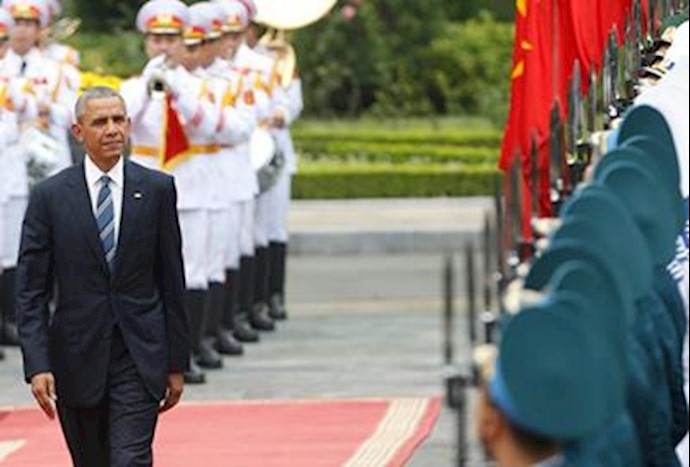
AFP, May 23, 2016 – US President Barack Obama on Monday scrapped a Cold War-era ban on weapons sales to Vietnam, as ties between the former foes grow closer thanks to trade and mutual fears of Chinese expansion in disputed seas.
The announcement, made at the start of Obama’s three-day visit to Vietnam, ends a decades-old embargo and risks irking Beijing, which has been increasingly assertive in its claims to contested areas of the South China Sea.
“Over the past century, our two nations have known cooperation and then conflict, painful separation, and a long reconciliation,” Obama said at a joint press conference alongside Vietnamese counterpart President Tran Dai Quang.
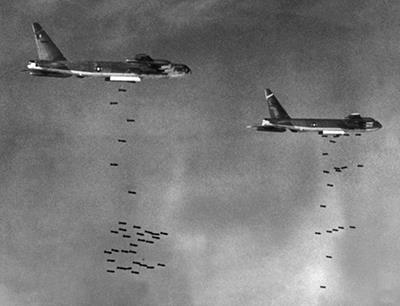
US planes drop bombs over a Viet Cong-controlled area in South Vietnam in August 1965
The move, Obama added, was not prompted by China’s regional manoeuvres, but came as the countries entered a “new moment” taking them towards a “normalisation” of ties.
Quang welcomed the rollback of the ban, hailing the shared “common concerns and interests” that now bind the two countries.
The Obama administration has pitched this week’s trip as an opportunity to push ties beyond the period of rapprochement, with Vietnam now a vital plank in America’s much vaunted pivot to the Asia-Pacific region.
The visit is Obama’s first to the country — and the third by a sitting president since the end of the Vietnam War in 1975. Direct US involvement in the conflict ended in 1973.
Obama said he was “moved” to see thousands of locals lining Hanoi’s streets, craning with smartphones in hand for a view of his motorcade.
The nations have experienced an astonishing turnaround in their relations, from bitter foes physically and psychologically scarred by a decade of war to regional allies.
– Human rights –
Until now Vietnam’s dismal human rights record has weighed against a full rollback of the arms embargo.
The one-party state still ruthlessly cracks down on protests, jails dissidents, bans trade unions and controls local media.
In a muted reference to its parlous rights situation, Obama said Washington “still had differences” with Vietnam on human rights but “modest progress” had been made.
That sentiment jarred with some of the country’s long-persecuted dissidents.
“They (Vietnam) have not changed anything in terms of basic core values when it comes to human rights,” blogger Huynh Ngoc Chenh told AFP, while noting he was glad the embargo was lifted.
Human Rights Watch said Obama had “jettisoned what remained of US leverage to improve human rights in Vietnam”.
Trade also dominated much of the first day of the unusually long trip.
A series of deals were unveiled worth $16 billion, including an agreement for VietJet, Vietnam’s privately-owned budget airline, to spend $11.3 billion on Boeing passenger jets.
Vietnam is a vital plank in America’s much vaunted pivot to the Asia-Pacific region
Both nations have long pushed for closer trade ties, with the US hoping to tap into the growing wealth of Vietnam’s burgeoning middle-classes.
Hanoi’s leaders crave continued growth to deflect opposition to their authoritarian rule.
Obama said he was confident Congress would ratify the 12-nation Trans-Pacific Partnership trade deal, which includes Vietnam and spans 40 percent of the global economy.
Quang welcomed the pact, committing Vietnam “to fully implementing” all of its clauses, which include recognition of workers’ rights.
– US star ascendant –
The visit comes at a time when America has rarely, if ever, been so popular among ordinary Vietnamese.
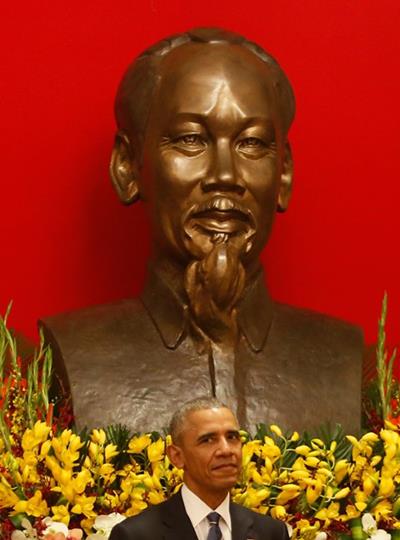
US President Barack Obama photographed under a statue of late Vietnamese revolutionary leader Ho Chi Minh at the Presidential Palace in Hanoi on May 23, 2016
A poll last year by the Pew Research Centre found 78 percent of Vietnamese have a favourable view of the United States, the third highest in Asia after the Philippines and South Korea.
The approval rate was even higher among young people in a nation where the median age is around 29.
“I like Obama as he seems moderate,” Nguyen Toan Thang, an office worker, told AFP. “This is a once in a lifetime chance to see the US president coming to Vietnam.”
Like most Vietnamese, 25-year-old Doan Quang Vinh from Hanoi was born long after the war.
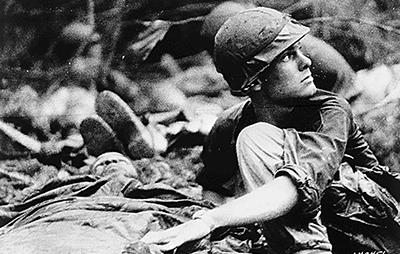
US President Barack Obama’s visit to Vietnam is the third by a sitting president since the end of the Vietnam War in 1975
“For me, the American war against Vietnam is a matter of the past, and though we must not forget the past, we should not dwell on it. We should look towards the future,” he told AFP.
Later Monday Obama will hold talks with Prime Minister Nguyen Xuan Phuc.
But the most important meeting will be afterwards with de facto leader Nguyen Phu Trong, the general secretary of the Communist Party.
Trong and Obama met last July, when he was given a prestigious Oval Office meeting.
On Tuesday afternoon Obama will fly to Ho Chi Minh City, the southern city formerly known as Saigon and the country’s thriving commercial heart, four decades after American troops beat a hasty retreat.
There he will meet tech entrepreneurs and hold one of his trademark town hall gatherings with young people.