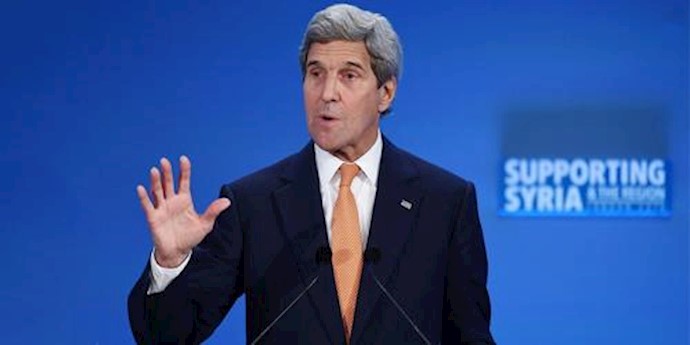
The Washington Post,February 10 – Secretary of State John F. Kerry said in an interview that the United States is nearing a final “crunch time” on Syria — in which it will either make progress toward a cease-fire or begin moving toward “Plan B” and new military actions.
For Kerry-watchers, it’s a familiar moment of brinkmanship: He’s making a last, desperate push for a diplomatic breakthrough with Russia and Iran at a meeting in Munich on Thursday, even as he warns that the United States has “other leverage” if diplomacy fails.
Kerry’s problem, skeptics would argue, is that his strategy has the same logical flaws that have scuttled three years of Syria diplomacy: Russia and Iran won’t compromise on their fundamental support for President Bashar al-Assad’s regime; and President Obama won’t approve military tactics that could actually shift the balance. So each diplomatic inflection point comes and goes — with greater misery for the Syrian people.
But Kerry presses on, doggedly and, some critics would say, unrealistically. In the interview Tuesday, he offered a frank, on-the-record explanation of his approach.
From the beginning, Kerry has hoped that Russia would decide that its interests are best served by a political transition in Syria. Here’s how Kerry put the dangers for Moscow if there’s no settlement: “the threat of implosion in Syria, and the threat of a very prolonged war that keeps Russia embroiled on the ground, and the threat of increased numbers of terrorists.”
But rather than seeing disaster ahead, Russia seems to think it is winning.
Kerry conceded that “ripeness” is crucial in negotiations. If one party thinks it’s winning, it makes demands that the losing side won’t accept — and the carnage continues. Kerry said it would be “diplomatic negligence of the worst order” not to make one last try for a cease-fire that could assist the thousands of civilians newly fleeing Aleppo.
“What we’re doing is testing [Russian and Iranian] seriousness,” he said. “And if they’re not serious, then there has to be consideration of a Plan B. . . . You can’t just sit there.”
Although Kerry wouldn’t discuss specific military options in Syria, he did offer some broad outlines. The aim, he said, would be “to lead a coalition against [the Islamic State], and also to support the opposition against Assad.” He said Obama has already directed the Pentagon and the intelligence community to move “harder and faster” against Islamic State extremists so that the terrorist group “is reined in and curbed and degraded and neutralized as fast as possible.”
Asked whether Obama would support more aggressive Special Operations forces tactics, Kerry responded that Obama has “already made the decision to put Special Forces in, and he’s made the decision to test the ‘proof of concept’ of how they are operating.” Impatient critics would argue that the proof of concept came 10 years ago in Iraq, and that Obama is temporizing.
Kerry said “sure” when asked if the administration would accept recent offers by Saudi Arabia and the United Arab Emirates to send ground troops into Syria, noting that Arab special forces “could augment significantly the capacity to . . . do greater damage to [the Islamic State]
much faster.”
“The hard-liners made Foreign Minister [Mohammad Javad] Zarif and President [Hassan] Rouhani’s life very difficult, just as hard-liners in the United States had a role in making — oppositionists, I wouldn’t call them hard-liners, I’d call them oppositionists . . . made it difficult for our negotiations,” Kerry said. But he sharply cautioned against any U.S. effort to support Rouhani’s camp in this month’s parliamentary elections: “The worst thing we could do is meddle.”
By David Ignatius Opinion writer