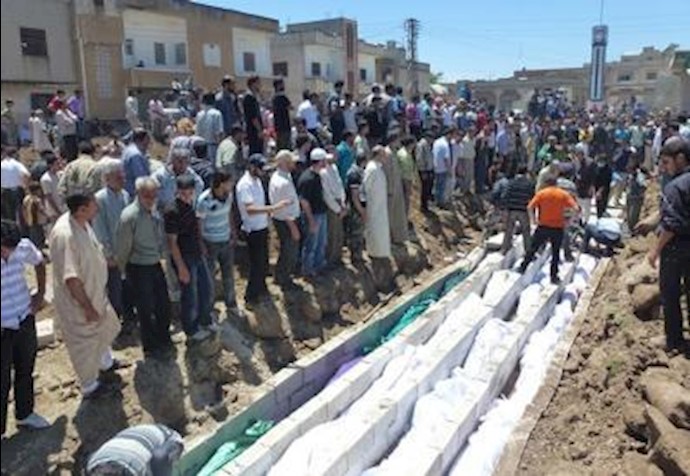
The Washington Post, Abu Dhabi, United Arab Emirates, May 30, 2012 — The men who stormed the Abdel Razzaks’ home while carrying out a massacre in the Houla district of Syria were dressed like soldiers except for one potentially crucial detail, said a 10-year-old family member: They wore white shoes.
Hidden in a nearby barn, the boy watched as the thugs left the house and shot dead his 13-year-old friend Shafiq, who was standing across the street.
Analysts say the white shoes are one of several indicators that the slaughter of more than 100 people in this central Syrian cluster of villages was more than just another killing spree by the army of President Bashar al-Assad.
Nadim Houry, of Human Rights Watch, said the running shoes were one of the details cited by witnesses as evidence the people carrying out the attacks were not soldiers but members of the shadowy and much-feared group of pro-government militiamen known as the shabiha, who are playing an expanding role in the country’s deepening conflict.
From their roots as a Mafia-style crime gang in the home region of the Assad dynasty that has ruled Syria for more than four decades, the shabiha have, say many observers, emerged as a increasingly deadly but deniable instrument in the government’s efforts to crush a 14-month-long uprising against its rule.
“With the regime basically relinquishing control over some rural areas, it’s easier to send in the shabiha than it is to send in the regular army,” said Emile Hokayem, an analyst at the International Institute of Strategic Studies. “They are a better tool for retribution — and you are going to see them operating in the country a lot more.”
While the world, including the Assad government and its allies in Moscow, has deplored the Houla killings, there are sharp divisions over who is responsible. The Syrian government blames armed gangs for the killings, the vast majority apparently carried out at close range and targeting victims who included 49 children.
However, the Syrian opposition, its international allies and rights groups say the atrocity was primarily the work of shabiha, who they say poured into the town after the military shelled it.
Most observers agree that the original shabiha were Alawite gang lords who ran drugs and hot money across the Lebanese border from the region of northwestern Syria around the coastal town of Latakia, the heartland of Assad’s minority Alawite religious sect.
But much else about the group remains murky, even down to its etymology: While many say the name shabiha has its roots in the Arabic word for ghost, others say “ghost” was actually the nickname not of the gang members, but of the stolen black Mercedes some used to drive.
In the 1990s, the group’s racketeering and extortion eventually caused sufficient anger that even Assad — with the approval of his father, Hafez al-Assad, who was president at the time — tried to curb its activities. But the popular uprising that began in March last year put the shabiha and, more significantly, the militia idea they represent firmly back in favor with the government.
Analysts say that the word shabiha has now become a catch-all term for irregular forces fighting on behalf of the government, ranging from hard-core loyalists bused in to trouble spots to poor farmers in central Syria who are given arms and told to defend themselves against the foreign-backed terrorists the government says are behind the revolt.
As the shabiha’s ranks and violence have grown and widened, groups have sprung up to counter them. Analysts say shabiha-style militias made up of the Sunni Muslims who represent the majority of the population have also started to emerge in regions such as Homs province, where Houla is located and where Sunni and Alawite communities sit side by side, increasing the potential for sectarian violence.
Wissam Tarif, a researcher with the anti-Assad campaign group Avaaz, said there have been tit-for-tat incidents of kidnapping and violence between religious communities in Homs city because of the presence of local shabiha. “That’s what made the sectarian cycle of violence in Homs higher,” Tarif said.
Analysts say the Houla massacre is one of the most horrific and best-documented of many signs that Syria’s conflict, like other civil wars, is increasingly becoming the domain of militiamen operating under political license but also with increasing autonomy.
Given rein to attack a civilian population and an opposition Free Syrian Army that is itself a loosely linked confection of local militarized groups, many observers see the likelihood of more and greater shabiha atrocities like the one in Houla.
“You are creating a monster here,” said Randa Slim, a researcher at the New America Foundation, a U.S.-based think tank. “We have a Frankenstein in the making.”