

Beirut (AFP) – Hopes for a quick political transition in war-ravaged Syria dimmed Thursday as embattled Bashar al-Assad threw cold water on an ambitious timetable agreed at international talks in Vienna.
At the same time, the US held firm to its calls for Assad’s departure, with President Barack Obama insisting the war could not end unless the Syrian leader steps down.
“I do not foresee a situation in which we can end the civil war in Syria while Assad remains in power,” said Obama.
Top diplomats from 17 countries met in Vienna Saturday to discuss a way out of Syria’s nearly five-year conflict, which has killed more than 250,000.
They produced a two-year timetable: a transitional government would be formed and a new constitution written within six months, to be followed by internationally monitored elections within 18 months after that.
But in a television interview with Italy’s Rai television, Assad said there could be no transition schedule for elections while swathes of Syria remained out of government control.
“This timetable starts after starting defeating terrorism. You cannot achieve anything politically while you have the terrorists taking over many areas in Syria,” he said.
“If we talk after that, one year and a half to two years is enough for any transition.”
Damascus refers to all opponents — fighters and activists alike — as terrorists.
’More realistic than Vienna’
Syrian regime has insisted that combatting “terrorist groups” including the Islamic State (IS) jihadist organization should come ahead of any political solution.
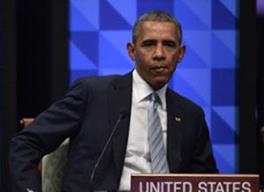
US President Barack Obama attends the Asia-Pacific Economic Cooperation (APEC) summit in Manila
Assad also rejected the idea of UN observers monitoring elections, saying the world body had “lost all credibility”.
In comments to French magazine Valleures Actuelles, the embattled leader said Syria could only accept observers from countries that “were not partisan during the crisis”.
Despite holding diametrically opposed views on the fate of Assad, Russia and France are set to begin coordinating military and security efforts in the anti-IS fight.
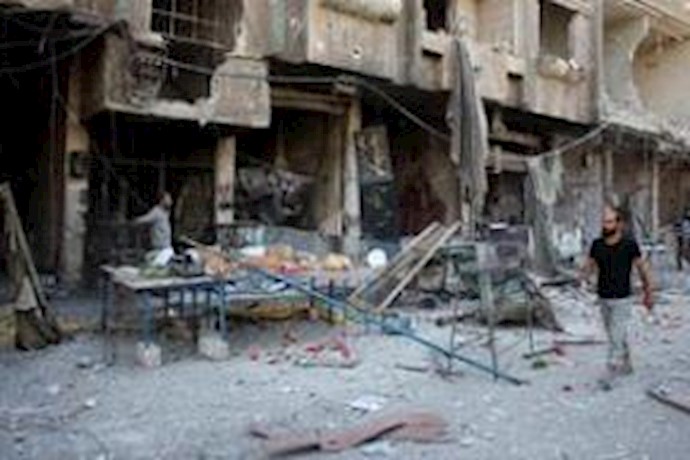
Debris in Ain Tarma in Eastern Ghouta following reported Syrian government forces airstrike
The remarks by world leaders have rolled back hopes a political solution was on the horizon.
On Tuesday, US Secretary of State John Kerry said Syria could be “weeks away” from a transition.
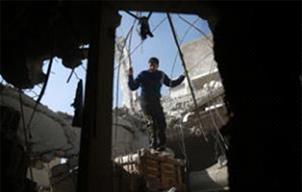
A man checks the destruction following a reported airstrike by Syrian regime forces in Duma
Truce talks under pressure
IS territory across eastern, central, and northern Syria is the target of a US-led air coalition as well as Russian strikes.
Air strikes on fuel trucks in IS’s de facto capital, Raqa, killed at least six civilians and wounded 20, said the Syrian Observatory for Human Rights.
Observatory head Rami Abdel Rahman said those killed were oil smugglers and their families, not jihadists.
Another eight people were killed and 20 wounded in government shelling of an olive press in Sheikh Maskin, in the southern province of Daraa, the Observatory said.
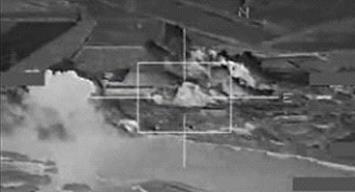
An image released on November 17, 2015 by French Defense Audiovisual Communication and Production
After hours of relative quiet Thursday morning, Syria’s armed forces resumed shelling Duma, killing 12 people and wounding 70, the Observatory said.
“The mediators are still at work,” but the situation was less hopeful than this morning, Abdel Rahman said.
A Syrian security source said “the window to reach an agreement has not ended, but we have yet to reach the results stage.”