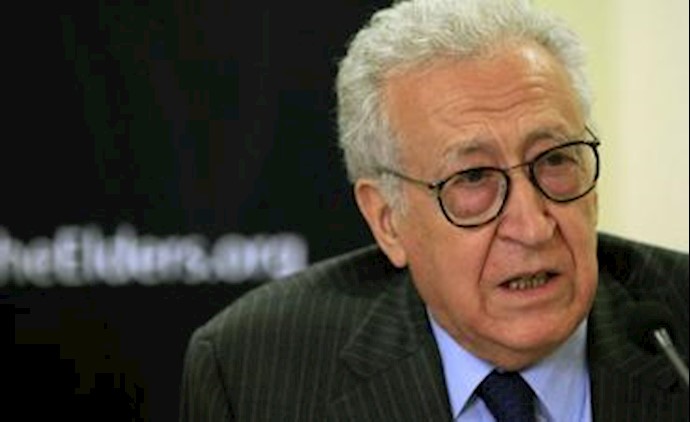
Al Arabiya, 10 August 2012 – Lakhdar Brahimi, a veteran diplomat and former Algerian foreign minister, is expected to be named as the new U.N.-Arab League envoy to Syria in place of Kofi Annan, diplomats said Thursday.
Negotiations are still going on over the envoy’s role and how the United Nations will operate in Syria amid the intensifying civil war. The mandate of the U.N. mission in the country ends on August 20.
An official announcement of the appointment of the 78-year-old Brahimi is expected to be made early next week, diplomats said, speaking on condition of anonymity as talks continue.
“We are certain it will be Brahimi,” said one U.N. diplomat.
“He is the choice of the U.N. secretary general and his name will be announced next week as long as he does not pull out,” added another.
Annan, a former U.N. secretary general, said he is leaving because of the lack of international support for his efforts to end the 17-month Syria conflict, in which rebels say more than 20,000 people have been killed.
He is to carry on working until August 31.
Brahimi was the U.N. envoy in Afghanistan after the September 11, 2001 attacks and in Iraq after the 2003 U.S.-led invasion.
Brahimi was Algerian foreign minister from 1991 to 1993, and he helped end Lebanon’s civil war in the late 1980s as an Arab League envoy.
With the failure of Annan’s six-month campaign to get Syrian President Bashar al-Assad to carry out his six-point peace plan, there is now debate among key players over the role of the new envoy.
Annan and U.N. Secretary General Ban Ki-moon have made it clear that they believe divisions among the major powers on the U.N. Security Council undermined the Annan plan.
“I think there are different models for what an envoy might look like, what kind of background, what kind of role,” U.S. ambassador Susan Rice told reporters on Thursday without mentioning who Annan’s replacement might be.
“We are open-minded about that. I think we have to be realistic that it is a very difficult job, and Kofi Annan did it admirably and found himself understandably frustrated at the end,” Rice added.
A U.N. diplomat, speaking on condition of anonymity, said the Security Council now has to decide whether to stick with Annan’s plan.
“For the moment it is all we have, but that does not mean that it cannot be reviewed. There are parts now that are redundant. There could be a new version with a new name,” the diplomat said.
“All these elements are now being discussed,” the diplomat added.
The badly divided Security Council powers are also discussing the future of the U.N. Supervision Mission in Syria (UNSMIS) — the unarmed observers who were meant to monitor the implementation of Annan’s peace plan.
A final decision is expected at a Security Council meeting next Thursday.
The original 300 military observers have been cut to less than 150 because of the worsening violence. They are still carrying out limited patrols but most of their work has now been suspended.
The Security Council gave it a “final” 30-day mandate in a resolution passed last month. Russia, Assad’s key ally, says it wants UNSMIS to remain. Western nations say it is too dangerous to keep the observers there.
Russia and China have vetoed three U.N. resolutions proposed by the Western powers hinting at or threatening sanctions against Assad, fearing that they could lead to a Libyan-style foreign military intervention in Syria.
U.S. ambassador Rice said the mission was unlikely to be extended in its current form.
“As we’ve said repeatedly, the conditions, particularly the extreme use of violence and heavy weapons by the government, do not permit the UNSMIS monitors — or any monitors at this point who are unarmed — to do the job they were sent to do,” she said.
“They are hunkered down and have been for many, many weeks,” she added.
“So that will not continue as far as we’re concerned. We would certainly be willing to entertain other conceptions of a U.N. presence. There will be a country team.
“There will be a humanitarian presence. Perhaps there will be recommendations that will be more political in nature that we can consider favorably,” Rice told reporters.
New prime minister
Assad, engaged in an all-consuming fight with his mostly Sunni opponents, appointed a Sunni as his new prime minister on Thursday after his predecessor fled on Monday in the highest-level defection so far in the uprising that began 17 months ago.
Wael al-Halki, from the southern province of Deraa where the revolt began, replaces Riyad Hijab, who had spent only two months in the job before making a dramatic escape across the border to Jordan.
Assad’s authority was already shaken by the assassination last month of four of his top security officials and by rebel gains in Damascus, Aleppo and swathes of rural Syria.
But he has persevered with a crackdown on opponents seeking to end half a century of Baathist rule and topple a system dominated by members of the president’s minority Alawite sect.
He has focused his fierce army counter-offensive on Syria’s two main cities, reasserting control over much of the capital Damascus before taking the fight to the northern commercial hub.
As the battle for Aleppo rages, Iran, Assad’s closest foreign backer, called for “serious and inclusive” negotiations between the Syrian government and opposition.
Assad has repeatedly said he is ready for dialogue, but he has vowed to crush the armed rebels he says are terrorists. His opponents say he must step aside before any talks, arguing negotiations would be meaningless while the bloodshed persists.
Iran made the call after gathering diplomats from like-minded states in Tehran for talks on the conflict not attended by Western and most Middle Eastern states, which have demanded Assad end his family’s 40-year rule.
The violence has already shown elements of a proxy war between Sunni and Shi’ite Islam.
“There will be no winner in Syria,” U.N. Secretary General Ban Ki-moon said in a statement read by a U.N. representative to the conference in Tehran.
“Now, we face the grim possibility of long-term civil war destroying Syria’s rich tapestry of interwoven communities.”