EU nations approved plans on Monday for an unprecedented naval mission starting next month to fight human traffickers responsible for a flood of migrants crossing the Mediterranean from Libya.
Launched after a series of deadly shipwrecks in which hundreds of people drowned, the military operation will involve European warships and surveillance aircraft being deployed off the North African coast.
But the EU is still waiting for a UN resolution that will allow it to destroy boats that belong to people smugglers in Libyan waters, the epicenter of the humanitarian disaster unfolding on Europe’s southern shores.
“Decision just taken to establish the EU naval operation to disrupt the business model of smugglers and traffickers networks,” EU diplomatic chief Federica Mogherini said on Twitter after a meeting of the bloc’s foreign and defence ministers.
The military operation is part of a bigger EU blueprint for a migrant crisis that has seen more than 1,800 people dying this year while trying to make the dangerous crossing in flimsy dinghies and fishing boats.
More than 5,000 people have died in the past 18 months.
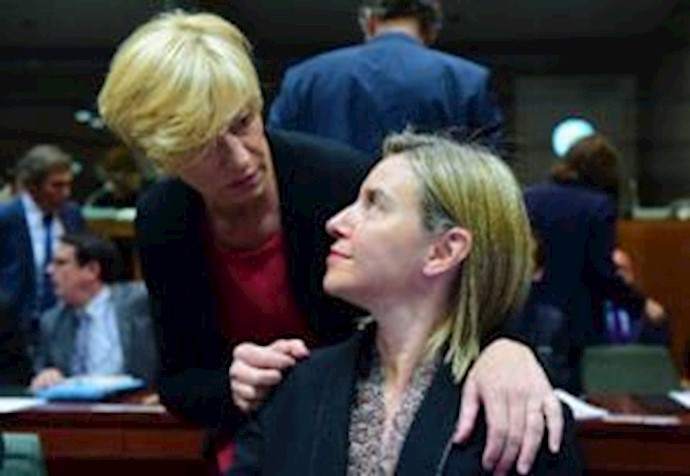
Italian Defense Minister Roberta Pinotti speaks with EU foreign policy chief Federica Mogherini
Mogherini later told a press conference that operational planning for the EU Navfor Med mission — to be based in Rome and led by Italian Rear Admiral Enrico Credendino — would start immediately.
The final phase of destroying smugglers’ boats in Libyan waters is the most controversial, with the organization Human Rights Watch describing it as “utter madness.”

Female migrants from sub-Saharan Africa wait at a detention center on May 17, 2015
Pressure has grown on governments to act after an overcrowded migrant boat sank in the Mediterranean last month, leaving more than 750 dead in a case that sparked international outrage.
NATO head Jens Stoltenberg, also attending the meeting in Brussels, said the US-led military alliance was ready to assist but the EU had not yet asked for help.
He also warned that “terrorists” from Islamic extremist groups could also be making the crossing by “trying to hide, trying to blend in among the migrants.”
Britain, France, Germany, Italy and Spain have already promised to deploy warships for the mission, a rare joint EU military venture for a bloc that was formed to promote peace after World War II.
Brussels wants to take the operation step-by-step, starting by collecting intelligence on the traffickers by using radar, satellite pictures and reconnaissance flights and raiding unflagged boats.
British Foreign Secretary Philip Hammond said ministers needed to put together a complete programme, with the current plan “an important first step”. He said cooperation with Libya was also key.
The EU has also pledged to boost funding for and step up non-military search and rescue efforts in the Mediterranean.