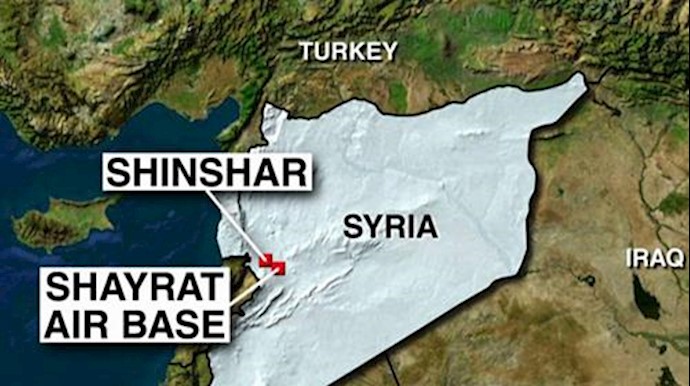
THE WEEKLY STANDARD, APR 08, 2017 – After the Trump administration’s strike on the Shayrat airfield Thursday, lawmakers, analysts, and the press are asking if the White House has a next move. Certainly it was important to signal that the use of chemical weapons is something the United States could not tolerate. As President Trump explained Thursday, it is a “vital national security of the United States to prevent and deter the spread and use of deadly chemical weapons.”
That is, the Trump administration enforced the redline against the use of chemical weapons that the previous White House ignored. Further, by citing the possible “spread” of those unconventional arms, Trump was alluding to the organization that is the likeliest recipient of Syria’s chemical weapons arsenal—Hezbollah, Iran’s praetorian guard in the eastern Mediterranean.
Thus the strike underscored that the Trump administration’s understanding of the Syrian conflict is broader than that of its predecessor. Where the Obama White House limited its focus in the Syrian arena to an anti-ISIS campaign, Trump struck a blow against the Iranian axis. Tehran and its allies are no longer dealing with an American president eager to strike a bargain with them. The new White House has put Iranian ally Bashar al-Assad on notice. However, the 59 tomahawk missiles launched at Shayrat is perhaps best understood as a message to Russia.
The White House acted less than 48 hours after receiving intelligence regarding Tuesday’s chemical weapons attack. The Trump White House knew immediately who was behind the attack and named names—Syrian government forces.
The Russians were putting out a different story. They claimed that Jabhat al-Nusra had a chemical weapons factory in Khan Shaykun and that a strike with attack helicopters created the plume that killed civilians on Tuesday.
“We know from our ability to monitor that this story was false,” a senior administration official told THE WEEKLY STANDARD. “The aircraft that flew from Shayrat airbase to Khan Shaykun were tracked. Furthermore, no group like Nusra has ever had the ability to make Sarin in Syria. To weaponize Sarin is quite a sophisticated thing. Opposition groups have not shown that they have that ability, but the Assad regime does.”
Presumably, the American government had access to the same intelligence resources when Assad previously used chemical weapons. However, the Obama administration’s standard response was to ignore intelligence regarding the use of Syria’s unconventional arsenal and avoid or downplay attribution of responsibility.
For instance, when Israeli intelligence showed in April 2013 who was responsible for gassing men, women, and children, a Pentagon official contended that “the use of chemical weapons in an environment like Syria is very difficult to confirm.” When Turkey’s Recep Tayyip Erdoğan visited Washington in May 2013 and brought evidence of the attacks and intelligence regarding who conducted and ordered them, President Obama said that he needed “specific information about what exactly is happening there.”
Thus, there should have been little surprise when Obama decided not to strike Assad regime targets in September 2013 to enforce the American redline against the use of chemical weapons. Obama had shown repeatedly that he resisted blaming Assad for deploying chemical weapons—punishing him for it was almost unimaginable.