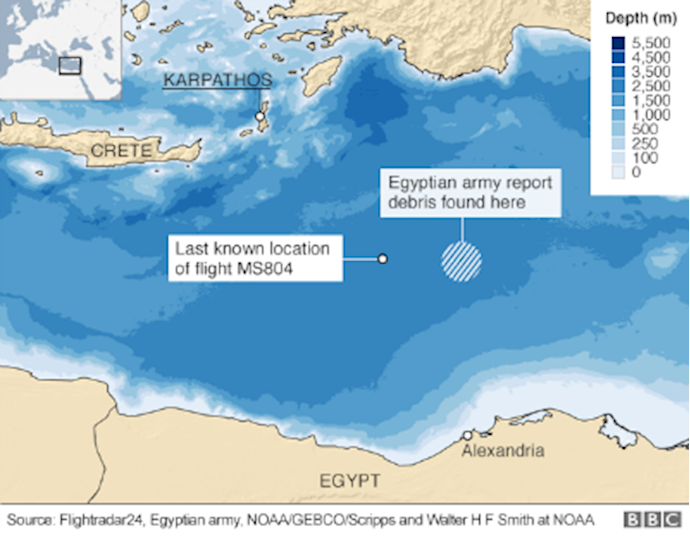
Wreckage of the Egypt Air flight that went missing over the Mediterranean last month has been found, Egyptian investigators say.
In a statement released late on Wednesday night, the investigation committee said that the John Lethbridge – one of two ships contracted by the Egyptians to hunt for the wreckage – had found “several main locations” on the sea floor between Crete and the Egyptian coast.
The committee said it had obtained images of the wreckage. These will allow search teams and investigators on board the vessel to draw an exact map of the location.
A second ship, the LaPlace, detected signals from MS804’s black box on 1 June, fueling hopes that investigators will find what caused the plane to crash. But the black box is only expected to emit signals for a further nine days.
Both the LaPlace and the John Lethbridge have been combing the sea off the Egyptian coast, searching for the wreckage in an area of the Mediterranean an estimated 10,000 feet deep.
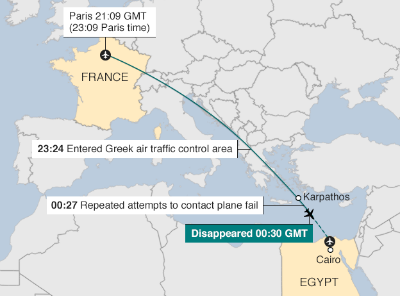
A deep sea search vessel had also sent back the first images of the wreckage, the statement added.
There were 66 people on board flight MS804 when it crashed on 19 May while flying from Paris to Cairo.
The Airbus A320 plane vanished from Greek and Egyptian radar screens, apparently without having sent a distress call.
The Egyptian investigation committee said that investigators on board the John Lethbridge search vessel, which has been contracted by the Egyptian government, would now draw up a map of the wreckage distribution.
Egypt Air Flight MS804 vanished over the eastern Mediterranean early on Thursday 19 May with 66 passengers and crew on board. Some surface debris was found 290km (180 miles) north of the Egyptian city of Alexandria. Signals from the plane indicated that smoke was detected in the toilet and in the avionics area below the cockpit.
Search area is one of deepest in the Mediterranean more than 3,000 metres (10,000ft) in some parts.
Earlier this month, search teams said signals from one of the “black box” flight recorders had been detected.
Signals emitted by the recorders are expected to expire by 24 June, experts have warned.
The cause of the crash remains a mystery. A terror attack has not been ruled out but no extremist group has claimed the downing of the plane.
Analysts say human or technical error is also a possibility. Satellite data revealed that smoke detectors went off in the toilet and the aircraft’s electrics, minutes before the plane’s signal was lost.
According to Greek investigators, the plane turned 90 degrees left and then 360 degrees to the right, dropping from 11,300m (37,000ft) to 4,600m (15,000ft) and then 3,000m (10,000ft) before it was lost from radar.
Source: BBC, Guardian, 16 June 2016