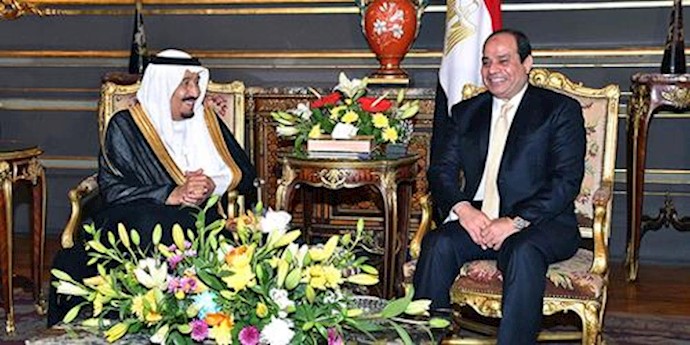
Egyptian President Abdel Fattah al-Sisi and Saudi King Salman agreed to set up a $16-billion investment fund Saturday and settled a long-standing maritime dispute as the monarch continued his rare visit to the country.
A day after Salman announced a plan to build a bridge over the Red Sea to Egypt, the heads of state met at the historic Abdeen Palace in Cairo to oversee the inking of a string of agreements Egypt hopes will help boost its battered economy. The 80-year-old Saudi monarch’s visit to Egypt has been seen as a clear show of support for Sisi.
In one of the most high-profile announcements, Saudi Arabia and Egypt have signed agreements to specify maritime borders, a cabinet statement said on Saturday, allowing both countries to benefit from maritime zones that were previously untapped. The technical drawing of the border include the Tiran and Sanafir islands as part of Saudi Arabia’s territory, the statement said.
In 1950, Saudi Arabia’s founder King Abdulaziz Al Saud had requested Egypt to protect those islands which has been the case since then. The islands bear strategic importance as they are located on the straits that connect the Red Sea with the Gulf of Aqaba, where Jordan’s only sea port of Aqaba and Israel’s only Red Sea port of Eliat are located.
Drawing up the maritime border for both countries had been in progress for over six years. “This enables both countries to benefit from the exclusive economic zone for each, with whatever resources and treasures they contain,” the statement said.
Since touching down on Thursday, Salman and his delegation have announced a slew of investments in Egypt. A live Egyptian state television broadcast on Saturday showed an official announcing the latest agreements, signed by a representative of each country. The two nations agreed “to set up a Saudi-Egyptian investment fund with a capital of 60 billion Saudi riyals ($16 billion),” the announcer said, giving no further details.
More than a dozen other accords, including a memorandum of understanding to set up an industrial zone in Egypt, were also announced.
Saudi Arabia has been a key backer of Sisi. Saudi has pumped billions of dollars in aid and investment into Egypt. Egyptian officials and media have heaped accolades on Salman, with state television welcoming him to what it called his “second country” — a country Riyadh views as a cornerstone in its ambitions to be a regional leader against Iran.
Earlier on Saturday, Salman paid a visit to the prestigious Al-Azhar mosque. He is due to address parliament on Sunday and receive an honorary doctorate from Cairo University on Monday.
An Egyptian government official had said the deals agreed with Saudi Arabia, excluding the investment fund, would amount to $1.7 billion.
On Friday, both leaders lavished praise on each other’s countries and their relationship. “This visit comes as a confirmation of the pledges of brotherhood and solidarity before the two brotherly countries,” Sisi said in a televised speech.
However, Saudi Arabia has played a key role in propping up Egypt’s economy, whose vital tourism industry has been devastated by years of political turmoil and terrorist attacks.
For Saudi Arabia, which is in competition with regional rival Iran, keeping Egypt under its aegis is crucial.
Source: DAILY SABAH , AFP, April 11