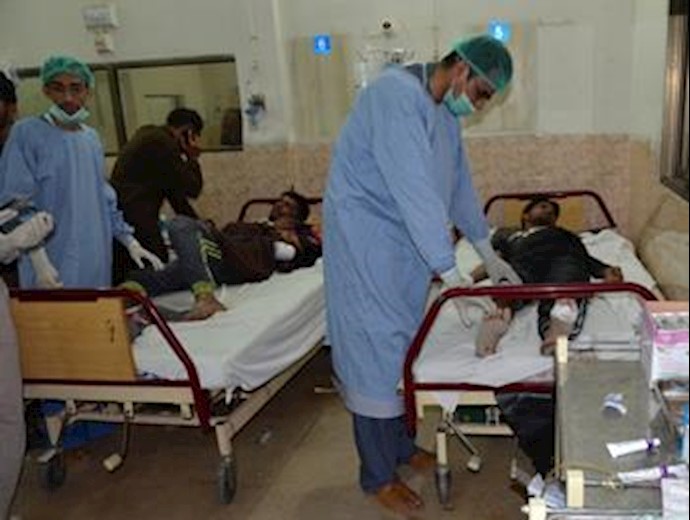
The Associated Press, 25 Oct. 2016- A Pakistani police official says the death toll from a brazen overnight militant attack on a police training centre in the southwestern city of Quetta has risen to 59 people, mostly police cadets and trainees.
Shahzada Farhat, spokesman for the police in Quetta, the capital of Baluchistan province, said on Tuesday that 117 were wounded in the attack.
He says most of the casualties were police cadets but some army personnel who responded to the assault were also among the casualties.
There are fears the death toll could rise further in what has been one of the deadliest attacks on Pakistan’s security forces in recent years.
Militants stormed the academy shortly before midnight, gunning down sleeping police recruits and waging a ferocious gunbattle for four hours before blowing themselves up.
There were disparate figures as to the number of attackers. Provincial police chief Ahsan Mahboob said there were four gunmen while a statement issued by the military put the number of attackers at up to six.
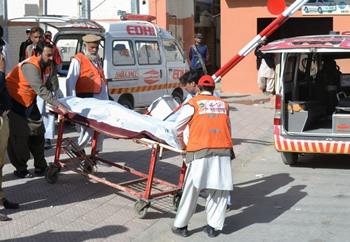
Pakistani rescue workers transport a body Tuesday from the attack in Quetta. (Banaras Khan/AFP/Getty Images)
Once inside the academy grounds, Pakistani media said the gunmen headed straight to the dorms housing the cadets and trainees and opened fire, shooting indiscriminately. Some of the cadets jumped off the rooftops and through windows to try to escape.
“They were rushing toward our building, firing,” one cadet told Pakistani Geo TV news channel. “We rushed for safety toward the roof and jumped down in the back of the building.”
Another recruit, his face covered in blood, told the station the gunmen shot at whoever they saw. “I ran away, just praying God might save me,” he said.
After hours of siege, the attack was over, said the home minister for Baluchistan, Sarfaraz Bugti. Pakistani forces tightened security around the academy and Quetta hospitals were the wounded were taken.
Some injured falling from roof, walls
Footage aired on local television stations showed ambulances rushing out of the main entrance of the academy as fire engines struggled to put out fires set off by the explosions from the attackers’ suicide vests. Most of those being treated at the city hospitals had gunshot wounds, although some sustained injuries jumping off the rooftop of the hostel housing the cadets to escape the gunmen.
“This war isn’t over,” said Pakistani Interior Minister Chaudhry Nisar Ali Khan. “The enemy is weakened, but not eliminated.”
Maj. Gen. Sher Afgan, head of the Pakistani paramilitary force which is primarily responsible for the province, claimed the attackers had received instructions from commanders in neighboring Afghanistan. He said they were most likely from the banned Lashker-e-Jhangvi Al-Almi militant group affiliated with al-Qaida and the Taliban.
PAKISTAN MILITANTS ATTACK
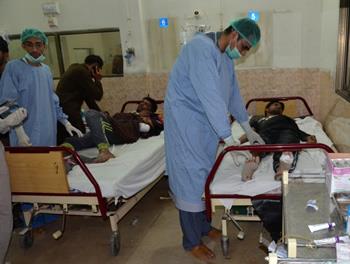
Most of those being treated at city hospitals had gunshot wounds, although some sustained injuries jumping off the roof of the hostel and climbing a wall to escape the gunmen. Nearly all of the wounded were police; two were paramilitary troops, authorities said. (Jamal Taraqai/EPA)
Afghanistan dismisses allegations
Afghanistan condemned the attack in Quetta and dismissed Pakistan’s allegations that the assault was planned from bases inside Afghanistan.
“Afghanistan is the biggest victim of terrorism and denounces all terrorist attacks,” said Mohammad Haroon Chakhansuri, spokesman for Afghan President Ashraf Ghani.
In a separate statement, Ghani also condemned the attack, saying that “terrorism is a threat throughout the region, which is reflected in the brutal act today in Quetta.”
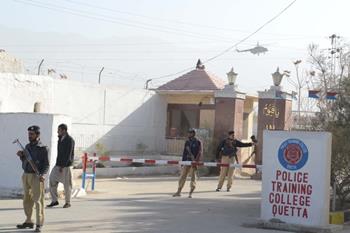
Pakistani security forces stand guard outside the Balochistan Police Training College in Quetta the day after militants attacked the training college. (Mazhar Chandio/Anadolu Agency/Getty Images)
Pakistan maintains that militants fleeing army operations in the tribal regions regularly escape across the border, finding safe havens inside Afghanistan. For his part, Ghani has been deeply critical of Pakistan, saying it has provided safe havens to the Taliban and in particular the violent Haqqani network.
For over a decade, Baluchistan has been the scene of a low-intensity insurgency by nationalist and separatist groups demanding a bigger share in the regional resources. Islamic militants and Sunni sectarian also have a presence in the province.
Pakistan has carried out several military operations against militants in country’s lawless tribal regions along Afghanistan border, including a major push that started mid 2014 in North Waziristan, a militant base.