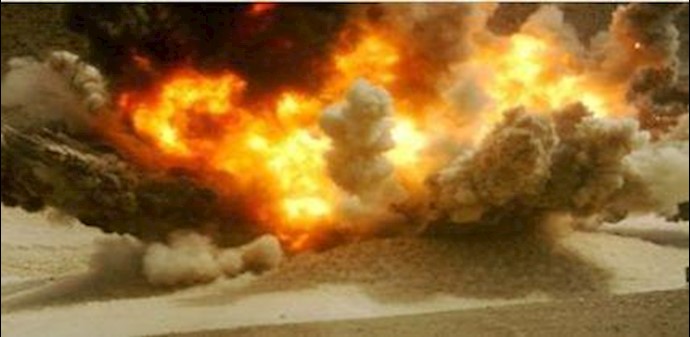
AL ARABIYA, 19 April 2012- A series of explosions, in an apparent coordinated attack on the Iraqi capital and four other cities mainly in the northern part of the country, killed at least 30 people early Thursday.
At least five explosions rocked mainly Shiite Muslim areas in Baghdad, leaving about 17 people dead, police said.
Other six explosions took off in the country’s north killing at least eight people and wounding 32, police and hospital sources said.
Bomb attacks in the northern province of Kirkuk left nine people dead, high-ranking police officers were quoted by AFP as saying.
Another two rocked Samarra killing three people; a roadside bomb exploded in Taji and a suicide bomber detonated his explosives in Baquba, the sources said, adding that security forces appeared to have been the targets.
Iraq’s security in shambles
Late March, Iraq invited Arab officials to attend the Arab Summit in Baghdad. There were no reported attacks occurring during the Arab meeting due to tight security measures that Iraqi citizens complained of. The security measures during the summit heavily exacerbated traffic jam in an already crowded Baghdad.
While violence has fallen sharply in Iraq compared to its peak in 2006 and 2007, amid a bloody sectarian war, militant groups including the Islamic State of Iraq, al-Qaeda’s front organization in the country, remain active, and attacks common.
“The main reason for the failure to eliminate violence completely and control the leaders of the terrorist organizations is the multiplicity of security services,” one high-ranking interior ministry officer in Baghdad told AFP.
“Each department operates in accordance with instructions … that are different from the other one, and that complicates cooperation among them,” said the officer, who spoke on condition of anonymity.
Iraq became a stronghold for a variety of militant groups, both Sunni and Shiite, following the 2003 U.S.-led invasion that toppled now-executed dictator Saddam Hussein.
The U.S. disbanded Iraq’s military following the invasion, creating a large pool of men who were unemployed, disgruntled and armed, and thus ripe for recruitment into the insurgency.
People also journeyed to Iraq from around the region to fight the U.S. “occupiers.”
But the worst violence was reserved for the Iraqis, tens of thousands of whom were killed in an orgy of bombings and death squad murders that erupted after the bombing of the Shiite Al-Askari shrine in Samarra in 2006.
A surge of US troops combined with the Sunni tribesmen turning against Qaeda reduced the violence, but it still continues, with 14 Iraqi security agencies now working to fight it.
Three of these services are directly linked to Prime Minister Nuri al-Maliki, six to the interior ministry, three to the defense ministry, one to the office of the national security advisor, and one to the intelligence service.
Each of the 14 services have their own detention facility.
“All these services lack close coordination with each other,” said Ali al-Haidari, an Iraqi security analyst.
“Some of the services were built without legal legislation because of the urgent need to confront terrorism,” including the “anti-terrorism force which is supervised directly by the prime minister,” Haidari said.
“If someone is stopped by the anti-terrorism force, for example, and (they) found he was wanted for other crimes being investigated by another service, they do not hand him over to the other service,” the interior ministry officer said.
The officer attributed the unwillingness to hand over detainees to the heads of various services and desire for personal acclaim sometimes hampering the overall effort against militants.
The officer also said that large numbers of detainees are affected by delays in investigations that leave their cases open for years.
“Investigations are not completed because the other security agencies do not cooperate and refuse to hand over detainee to other security services which have files related to his case,” the office said, adding that “each one of the security services is an independent state in itself.”
“One day, we were able to arrest three people who were preparing a car bomb inside a house in central Kirkuk, but it exploded because of a technical failure,” the officer said on condition of anonymity.
“Someone offered $300,000 to change a single paragraph in the investigation (to say) that the car exploded outside the home, not inside,” meaning they were not involved, he said.
“I strongly rejected it, but when they were tried, they succeeded in obtaining an order to release them after a person inside the court cooperated with them and changed some of the information in the investigation papers.”
Some critics blame infiltration of political parties by militants as reason. Some say warring political parties ally with militants to combat other competitor parties.