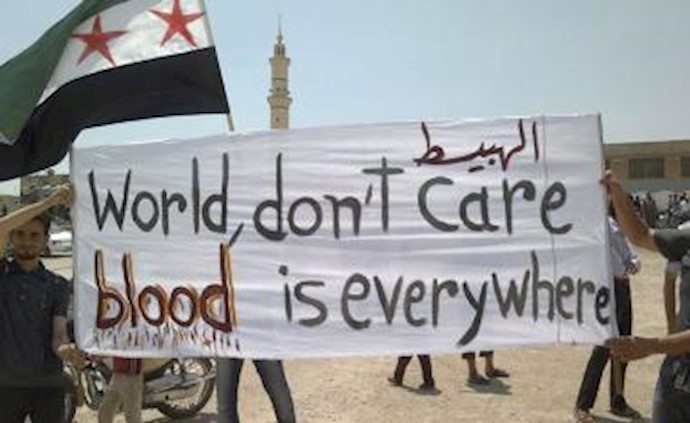
Al Arabiya , 30 June 2012 – World powers agreed Saturday to a plan for a transition in Syria that could include current regime members, but envoy Kofi Annan doubted if Syrians would pick leaders “with blood on their hands”.
U.S. Secretary of State Hillary Clinton made it clear that Washington did not see any role for President Bashar al-Assad in the new regime, even though there was no explicit call for him to cede power.
“Assad will still have to go. He will never pass the mutual consent test,” said Clinton.
While Annan did not name names and said it was up to the Syrians to decide who they want in a unity government, he added: “I would doubt that Syrians… would select people with blood on their hands to lead them.”
“It is for the people to come to a political agreement but time is running out,” Annan said in concluding remarks.
“We need rapid steps to reach agreement. The conflict must be resolved through peaceful dialogue and negotiations.”
The deal came despite initial pessimism from participants about the prospects of the Geneva talks due to deep divisions between the West and China and Russia on the future of Assad.
Russian Foreign Minister Sergei Lavrov said following the meeting that Moscow had convinced other parties to accept that the transition would be decided by Syrians and that no party should be excluded from the process.
“How exactly the work on a transition to a new stage is conducted will be decided by the Syrians themselves,” he said.
“There are no demands to exclude from this process any one group. This aspect had been present in many of our partners’ proposals. We have convinced them that this is unacceptable,” Lavrov said.
A long-time Syria ally, Russia is loath to cast Assad aside, even as relations between Moscow and Damascus have cooled.
British Foreign Secretary William Hague said Assad and his close associates could not lead any transition. Accountability for war crimes must be part of such a process, he added in his speech to the meeting.
Hague called for the U.N. Security Council to start drafting a resolution next week setting out sanctions against Syria, a move that he noted put him at odds with Russia.
As divisions threatened to scupper talks earlier Saturday, Annan had warned at the opening of the meeting that history “will judge us all harshly” if world powers failed to bridge their gaps on how to end the bloodshed in Syria and chart a transition.
A failure to unite also raised the specter that the conflict that has claimed 15,800 lives over 16 months in the strategic Middle East country could spill over to the region and expose the world to fresh threats, said the former U.N. chief.
“History is a somber judge — and it will judge us all harshly if we prove incapable of taking the right path today,” Annan told the five permanent Security Council members — the United States, Russia, Britain, China and France — as well as regional powers Qatar, Turkey, Kuwait and Iraq.
Situation on the ground deteriorates
Highlighting the deteriorating situation on the ground, Syrian government forces pushed their way into Douma on the outskirts of Damascus on Saturday
Rights monitors say at least 53 people, mostly civilians, were killed in violence across Syria on Saturday, and hundreds more were trapped in Douma as regime forces stormed the town in Damascus province after weeks of siege and shelling. Fleeing residents spoke of corpses lying in the streets.
State news agency SANA said security forces were raiding hideouts in Douma of “armed terrorist groups” and had killed, wounded or arrested scores.
Although the government routinely refers to its enemies as foreign-controlled terrorists, Assad himself conceded this week that the country was now in a state of war.
An explosion also rocked the Qaboon district of Damascus on Saturday and another blast hit the country’s second city Aleppo in the north. A further blast hit an oil pipeline in a rebel-held area of the eastern province of Deir Ezzor.
The latest violence came a day after 73 people were killed nationwide, among them 23 regime troops.
While the violence rages there is also mounting concern about the destabilizing impact it has on the region, in particular Jordan and Lebanon.
And the Turkish-Syrian border remains a potential flashpoint.
Turkey has sent tanks, troops and missile batteries toward the frontier, after Syria shot down a Turkish jet last Friday.
Meanwhile the head of the rebels’ Free Syrian Army told AFP that 2,500 Syrian soldiers were “massing 15 kilometers or slightly more (10 miles) from the Turkish border” on Friday.
Egypt’s President Mohamed Mursi — elected after a revolution with overthrew strongman Hosni Mubarak — announced on Saturday called for an end to bloodshed in Syria, in his inaugural address.
“We support the Syrian people. We want the bloodshed to stop,” he said.