
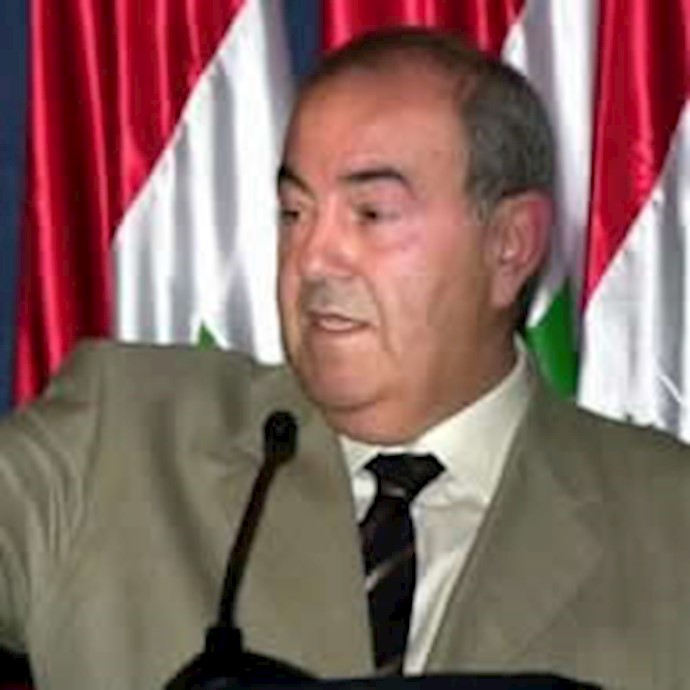
In an article in the New York Times, Dr. Ayad Allawi, former Iraqi Prime Minister, explained the flagrant meddling of the Iranian regime and its affiliated militias in 2005 elections and asked for formulating new elections law and holding it without sectarian apportionments.
This article reads: The paralysis that has afflicted the government in Baghdad, the sectarian disputes across the country and the failure to move toward reconciliation were all predictable outcomes of the senseless rush to hold national elections and put the Constitution in place. At the time, leaders from all major parties produced a memorandum calling for a delay of the elections, which I presented to Ghazi al-Yawer, then the interim president of Iraq. Yet due largely to political pressure from the international community, the elections went ahead in January 2005, under a misguided “closed party list” system.
Dr Allawi added: Rather than choosing a specific candidate, voters across the country chose from among rival lists of candidates backed and organized by political parties. This system was entirely unsuitable given the security situation, the lack of accurate census figures, heavy intimidation from ethnic and religious militias, gross interventions by Iran, dismantled state institutions, and the use of religious symbols by parties to influence voters.
Accordingly, the vast majority of the electorate based their choices on sectarian and ethnic affiliations, not on genuine political platforms. Because many electoral lists weren’t made public until just before the voting, the competing candidates were simply unknown to ordinary Iraqis. This gave rise to our sectarian Parliament, controlled by party leaders rather than by the genuine representatives of the people. They have assembled a government unaccountable and unanswerable to its people.
Allawi added: How to fix this mess and bring Iraqis together as a true nation? We must begin with a fundamental re-examination of the electoral laws and the Constitution. I propose that a new electoral law be devised to move Iraq toward a completely district-based electoral system, like the American Congress, or a “mixed party list” system like that in Germany, in which some representatives are directly elected and other seats are allotted based on the parties’ overall showing. In either case, the candidates must be announced well in advance of the election, and they must be chosen to represent the people in their locality.
Furthermore, a new law should ban the use of religious symbols and rhetoric by candidates and parties – these have no place in democratic elections. In order to prevent interference from militias and to ensure transparency, the United Nations
Allawi continued: Building democracy in Iraq will be a long-term process, established through the rule of law, a stable security environment, functioning state institutions and an emerging civil society. Success can be achieved if we act soon to bring about the fundamental reforms needed to provide for an Iraqi democracy with a parliament and government that are receptive to people’s needs. Only then can we build a country that will finally allow us to enjoy the freedom so many have paid for with their lives.
The alternative is continuing down the road we are headed, which leads directly to the disintegration of Iraq.