By Ma’ad Fayad
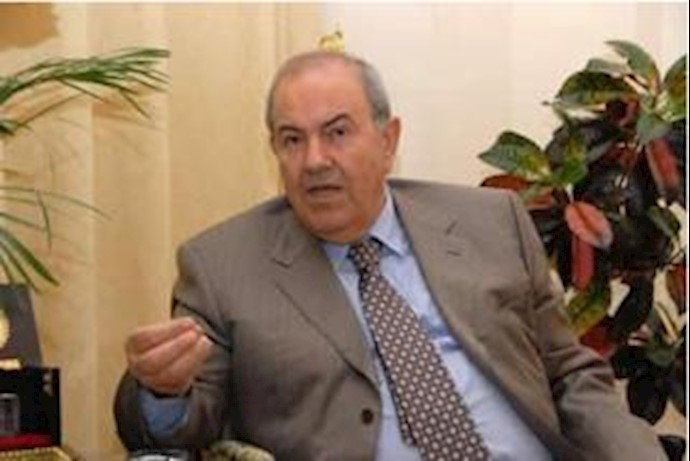
Asharq Al-Awsat, London, 18 Sept 2011- Iyad Allawi, the former Iraqi prime minister and leader of the Al-Iraqiya Bloc, is having more than one concern and is shouldering more than one responsibility. He is having the concern for Iraq and the Iraqis for whom he sacrificed and continues to do so to remove this concern from the hearts of its people and to lead them to a dignified life in accordance with programs that establish for building a modern democratic state. He is shouldering a responsibility toward those who elected him and gave him their votes to win and to form a government away from sectarianism and foreign interferences. Allawi, whose list, Al-Iraqiya, won in the latest elections, did not form the government due to what he considered “an Iranian and American interference.” In his interview with Asharq Al-Awsat while spending the Id holiday in London, he explained in detail the complications of the political process, and stressed that the best solution is to go for early elections.
Following is the text of the interview:
[Asharq Al-Awsat] You have recently spoken to Asharq Al-Awsat about the need for holding early elections or withdrawing confidence from the government of Nuri al-Maliki. What is your stand today?
[Allawi] The stand has not changed. Unless a national partnership is achieved in accordance with the Arbil agreements and the initiative of Masud Barzani, president of the Kurdistan Region, then we believe that the best solution for the problems of the Iraqi situation is through holding early elections and the winners and losers will then be seen.
[Asharq Al-Awsat] Are there conditions for these early elections, or will they be held on the basis of the same old way and laws?
[Allawi] No, if early elections are held, they should be conducted in normal atmospheres and should enjoy great transparency, and on the basis of an acceptable and reasonable elections law and after adopting a clear parties law. On the basis of these principles, we go for early and honest elections in which the Iraqi people decide who they want, and the issue will then be over. There will be those who will nominate themselves and those who will withdraw. What is important is that this idea that speaks about a partnership government should be dropped because it seems to me that it is difficult to be achieved in Iraq at this stage. The Iraqi political forces are the first to shoulder the responsibility for this failure, followed by the United States; and then by the neighboring countries, particularly Iran and its stands toward the recent elections and their results as well as the previous elections.
[Asharq Al-Awsat] Do you not see it strange that eight years after the former Iraqi regime was changed, the talk is still going on about the Iranian or US decision concerning the formation of the Iraqi Government? Can the Iraqi political leaders not make their decision in this respect?
[Allawi] No, it is clear that the Iraqi political leaders cannot make their decision. He who negotiated on the formation of the government had negotiated with Iran and not with the other Iraqi leaders. According to what leaders of Arab and Islamic countries told me, they were talking directly with Iran. The dialogues were taking place with Tehran in a clear way on who would form the government and how the governance in Iraq would be in the slightest details. I remember that during my last meeting with Syrian President Bashar al-Assad, and I was accompanying a large delegation from the Al-Iraqiya List, he told me that he will go to visit the Iranian officials and asked me about our stand on the formation of the Iraqi Government. Our reply was that Adel Abdel Mahdi should be the prime minister and that this should be achieved on the basis of a real national partnership. After President Al-Assad held talks, he said that Iran refuses that Al-Iraqiya forms the government and is strongly opposed to this and threatens that in case we form the government, while we are the winning list in the elections, it would cause many problems in Iraq. The US Administration had fully heeded the Iranian stand, whether out of love or was forced to do so by accepting a fait accompli. This is something that I do not know until now. However, what I know and what is clear is that the Iraqi issue is still connected to these centers (Iran and the US Administration).
[Asharq Al-Awsat] You spoke about President Barzani’s initiative and that the national partnership should be achieved in accordance with this initiative on the basis of which the government was formed, but no one knows the details of this initiative as if it is an ambiguous secret.
[Allawi] No, it is not a secret, and I do not know why it has not been published. I think that it is time for it to be published. Barzani’s initiative is a national initiative that is away from the foreign influence, away from the Iranian influence, and away from the US influence. It was an initiative to clear the atmosphere first, and then to reach agreements that achieve national partnership. Barzani’s initiative and Arbil meetings were followed by a series of meetings in Baghdad between the representatives of the main political factions, in which agreement was reached on nine axes, but no progress has been achieved on any one of them at all. Therefore, the initiative has been buried and killed by procrastination, delay, and rejection, and by raising various pretexts.
[Asharq Al-Awsat] How did that happen or is happening?
[Allawi] You know that in the whole world, the agreements are based on two main elements; the text of the agreement and its spirit, and if the text is unclear and the spirit is clear and transparent, then it is possible to overcome the problems in the texts, and vice versa. However, it seems to me that in the case of the Arbil agreement, the spirit of eagerness to maintain national partnership was not available and the intentions of the other side were not honest regarding this issue, and when the intentions are not honest and unclear and the intention to achieve partnership is unavailable, then nothing would be achieved even if the text is very clear since the other side would find pretexts to deviate from the agreement.
[Asharq Al-Awsat] In your belief, has this also happened concerning the Federal Court’s interpretation of the issue of the largest parliamentary bloc after you won the elections?
[Allawi] The Federal Court is not authorized to make rulings concerning the constitutional articles. This is not one of its jurisdictions since it is not a constitutional court. The Federal Court was formed when I was the prime minister, and I was the one who defined its jurisdictions, and none of the jurisdictions given to it allow it to interpret or make a ruling on the constitution for a simple and clear reason which is that the constitution had not been written at that time. There was no constitution.
[Asharq Al-Awsat] Then the problem is not in the text of the Arbil agreement but in the interpretation or the intentions.
[Allawi] No, the problem is in the intentions of the other side. The intentions have not been honest; therefore, they began to raise issues that do not exist even though the texts of the agreement were clear and nothing is wrong about them. Therefore, we have doubts about the honesty of the intentions. Now, some people prefer to describe the issue as problems between the political forces, but it is not an issue of problems between political blocs, but it is a radical difference in the programs of the political forces. This difference in the programs is not something of today, but it has roots in the days when the political forces were formed and in the days of the Iraqi opposition when the programs were different, the facts were different, the relations were different, and the premises w ere different, and in light of the lack of experience, the opposition then failed to unify its ranks. You remember the days of the National Congress and other events, and these differences in programs and vision continued and entrenched on the government level. We conclude from this that the confidence was not available. The absence of this confidence among the political forces continued, and if we want the national partnership to be based on clear grounds and specific visions based on our faith in the options of our Iraqi people, who express them in the ballot boxes, then these visions should be the basis on which the confidence, good intentions, and real partnership should be based. Regrettably, this confidence has not been achieved and two years will pass since the last elections and since the formation of the government and we have not made one step forward even though we agreed to participate in the government as a demonstration of good will to achieve national partnership and to work on important strategic files on the political level in Iraq.
[Asharq Al-Awsat] You have met with Nuri al-Maliki, the prime minister and leader of the State of Law Coalition, under the auspices of President Jalal Talabani and within the framework of his initiative to implement the Arbil agreements. Have you frankly spoken about these problems?
[Allawi] The talk has been very frank and a clear statement was issued after the meeting that includes four points concerning what is called national partnership. These are preparatory points to achieve the other aspects of the agreement. Among these points is achieving what is called national balance in the jobs at the state establishments, and we believe that this balance is a political and not a sectarian one. It is known that our bloc (Al-Iraqiya) is against political sectarianism, and that a law should be issued by the Council of Ministers as stipulated by the Iraqi Constitution and that the security ministers be named on the basis that in Al-Iraqiya names the defense minister, and the State of Law Coalition names the interior minister, and a law for the National Council for Higher Policies be endorsed. The other point is that the government was asked to negotiate with the US Administration on keeping or withdrawing their forces by the end of this year, and present it [the outcome of the negotiations] to a meeting for the leaders of the political blocs to approve it, or refer it to the Council of Representatives, or reject it. Even this has not been achieved. We handed the first list of names proposed for the Defense Ministry in the middle of last month, i.e. two days before the deadline, and I spoke with the president of the republic over the telephone, and he was in Al-Sulaymaniyah, and I informed him that we handed the names to the Secretariat of the Presidency. I asked him if the State of Law Coalition (Al-Maliki) has handed them the proposed names for the Interior Ministry as has been agreed, and he said no, they have not done so until that day. Until this moment, the names have not been handed. In the meantime, Sadun al-Dulaymi was appointed acting defense minister, who is not from our list, contrary to the agreement that was concluded between us, which is that if an acting defense minister should be appointed, he should be one of Al-Iraqiya’s ministers since we have ministers in the government and a deputy prime minister, who is brother Saleh al-Mutlaq. However, Al-Maliki ignored this issue. Regardless of who is the person appointed acting defense minister, he is from outside Al-Iraqiya. The issue of the names of the candidates for the posts of the defense and interior ministers should have been settled, but the failure of the State of Law Coalition in naming a candidate for the post of interior minister led them to include the Defense Ministry in the problem too, but we are not going to accept this at all.
[Asharq Al-Awsat] What about the National Council for Higher Policies?
[Allawi] We do not know the point reached by this issue.
[Asharq Al-Awsat] But Al-Maliki said in media statements that he not convinced of it.
[Allawi] He is the one who rules the state and who runs things.
[Asharq Al-Awsat] Do you think that President Barzani is enthusiastic to achieve his initiative?
[Allawi] Yes, Barzani is very enthusiastic since it is his initiative, but there is a setback due to what I said about the lack of confidence and lack of real intentions to implement the initiative. This leads us to warn against the dangers of more monopoly of power, which would lead to a complicated problem in Iraq. During the days of the opposition, we had decided two important tracks, which are counting on the ballot boxes and the peaceful transition of authority, and the independence of the judiciary and the implementation of the laws. It seems to me that these two points are not heeded and the government is heading toward unilaterally making the political decision. This is what we note on various levels, the decisions, the implementation of agreements, and the work contrary to what has been agreed on in the Arbil agreement.
[Asharq Al-Awsat] Does this apply to the agreements between the federal government and the Kurdistan Region?
[Allawi] There is a flaw in the relationship not only between what is called the federal government or the center and the Kurdistan Region, but even in the relationship between Baghdad and the rest of governorates, which are heading now toward forming regions, such as the case in Al-Basra, Al-Nasiriyrah, Al-Amarah, Al-Anbar, and Mosul. This is a proof that the relationship between the center and the governorates that are not part of a region is flawed. This is a subject that has been approved by the opposition, which says that the relationship between the central government and the governorates councils should be decentralized until the institutions become ready, since we, as it is known, do not have a state after the United States dismantled the state. We have an authority and not a state. For example, the judge who is the head of the Integrity Commission has recently tendered his resignation and we do not know the reasons. Is he a dishonest man and he resigned so as not to be implicated? This is illogical since I know him as a qualified and honest person. Is he afraid? And afraid of what? Is he unable to run the Commission, and why? These questions are raised in particular in light of a political and administrative regime in which Iraq has become in the forefront of the countries that suffer from corruption as Iraq has been rated after Somalia and Afghanistan by Transparency International. But even if there is no state in Iraq, at least there is history and civilization achievements and our people have high intellectual capabilities. Therefore, these are serious indications at the level of building the state. For example, they speak about security stability in light of the daily assassinations by the silencer guns and the abduction of citizens. This is something horrible and disgusting. The best doctors are killed in Baghdad and Kirkuk, and in Babil, Al-Diwaniyah, and Mosul there is a full absence of security and the same is the case in other cities of Iraq. It is strange that the United States speaks about security and stability in Iraq. If Iraq is secure and stable, then why do you want to sign a security agreement between Iraq and the United States? These questions need real answers and we do not know how things will proceed while those in charge in the government are unwilling to hear any criticism, even the constructive criticism which is in their interest.
[Asharq Al-Awsat] What about the Kurds and the Kurdistan Region?
[Allawi] Dealing with the Kurdish brothers should be with full realism, and the government should decide whether the Kurds are Iraqis or part of another people and from another country other than Iraq. What I always hear from the Kurdish leaders, particularly Barzani and Talabani, is that Kurdistan is an inseparable part of Iraq and that they are Iraqis and are part of integral Iraq. That is good. If the Kurds are an important part of the Iraqi people and society, why then there is no understanding with them? When we were in the opposition, we launched our national work against the previous regime from the Kurdistan land, which hosted us in its capacity as part of Iraq, and today the Region is looked at as a stranger and its regime as strange although the brother Kurds had the great credit in leading the current government (Al-Maliki) to rule in Iraq because they took the side of what is called the majority that can be formed at parliament after the elections results. Therefore, they had done a favor to Al-Maliki by their stands. Why then there are conflicts now and the government is standing against their demands? We should also point out something important that there are important symbols in the country since Barzani is a national symbol, Talabani is a national symbol, Ammar al-Hakim al-Hakim and his late father Abdulaziz al-Hakim are two national symbols, Muqtada al-Sadr is a national symbol, Al-Jaafari is a national symbol, Allawi is a national symbol, and Adel Abdel Mahdi is a national symbol. It is not allowed to attack the national symbols in the media, and this is something incorrect because there is a difference between criticism and attack, and the problems between one side and another should not be tackled in this way. The differences and problems should not be reflected in the media on the Iraqi people. Therefore, we believe that one of the reasons of instability is that the slanders are made on the televisions screens and the media. This should stop. We agreed in Barzani’s initiative, which was completed by President Talabani, to stop the media campaigns. This agreement has been heeded for some time to the point that I did not make any statement to the television or the printed media for more than one month out of respect for what has been agreed on. However, the attack in this way on Barzani and the Kurdish brothers is not allowed and this does not serve the Iraqi people.
[Asharq Al-Awsat] You spoke about early elections. Are there specific agreements between you and the rest of blocs on this issue?
[Allawi] There are no specific agreements, but the progress of things in Iraq would certainly lead to early elections.
[Asharq Al-Awsat] Early elections or withdrawal of confidence from the present government? Which of the two solutions you think is more realistic?
[Allawi] They are the same thing because when an agreement is reached to hold early elections, this means first to withdraw confidence from the current government and going for early elections.
[Asharq Al-Awsat] Some people speak about the return of Iraq to the one-party rule. How do you see this?
[Allawi] If the Al-Dawa Party is intended, this is a militant party that struggled for the sake of the Iraqi people’s cause. I know its former leaders who abandoned the party, such as Ibrahim al-Jaafari and Muwaffaq al-Rubayi, and we have good relations with them. When differences on the political action took place between us, we used to maintain our relations. I have information that is not full about the new leaderships. However, when we speak about monopolizing power, this is due to the failure to implement the national partnership agreements. Today we say that we have a document that decides the ministries that should be occupied by Al-Iraqiya, which starts with the deputy prime minister for the economic affairs, and then the defense, the communications, education, sciences, and finance ministries and others, and that identifies the ministries of the State of Law Coalition, and this document is signed by the chief negotiator of the State of Law Coalition and by Al-Iraqiya’s chief negotiator Abdul-Karim al-Samarrai, minister of science and technology. However, Al-Maliki says that Al-Sunayd does not represent us. This is the monopoly of power. This is a monopoly by Al-Maliki and not by the Al-Dawa Party since Al-Sunayd, as far as I know, is a member of the Al-Dawa Party. This monopoly is the responsibility of individuals in the party and not the party, and this is a violation of the national partnership, which has been aborted as the developments show.
[Asharq Al-Awsat] Until when the Iranian interference in the Iraqi affairs is going to continue?
[Allawi] The Iranian interference has become strong and clear when Tehran controlled the issue of the formation of the Iraqi Government and put a red line on Allawi and Al-Iraqiya. What was needed from me is to go to Tehran cap in hand so that they decide there if I would head the government or not. I strongly rejected this and will continue to do so because the Iraqi Government is formed by the Iraqis in Baghdad. I believe that any foreign interference in the affairs of any other country would not continue. Perhaps Iran can succeed in its interference in the Iraqi affairs for one, two, or three years, but this issue will definitely stop. Therefore, relations between the countries of the region should be based on respecting the sovereignty and interests of the peoples through economic agreements. This is the only thing that saves the region from evils. Iran has interfered in the Iraqi affairs and formed the government, and I am sure that this has opened the way for others to interfere in the Iranian affairs in the future. Therefore, we are against interference because it will lead to flaws in relations and balances in the region, and this has been proven by history.
[Asharq Al-Awsat] There was an initiative by the Saudi monarch, King Abdullah Bin Abdulaziz, on the Iraqi situation. Do you believe that it is effective in leading to the safe side in Iraq?
[Allawi] The initiative of the custodian of the two holy mosques has come simultaneously with, and complementary to the initiative of Masud Barzani, which is a pure national initiative. The initiative of the custodian of the two holy mosques, who is a pan-Arab figure who has very high ethics and is eager to preserve Iraq, and has a great and special love for Iraq and the Iraqis. I’ve known him since he was a crown prince and he enjoys Arab and international weight and respect. The relations with him and with the Kingdom of Saudi Arabia should not be wasted since the Kingdom is our strategic depth, and the same is the case with the Gulf Cooperation Council and the rest of Arab countries. The initiative of the custodian of the two holy mosques was launched under the umbrella of the Arab League, and we think that it is good and we have accepted it when it was first launched.