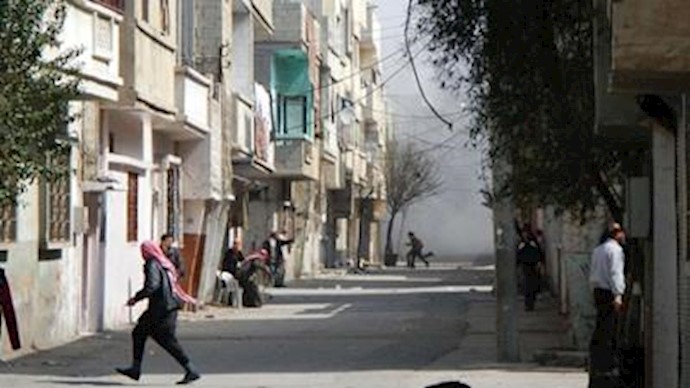
The Washington Post, Beirut, 14 March 2012 — When ordinary Syrians began taking to the streets in March last year, in small numbers at first just to call for greater freedoms, and then later in the hundreds of thousands to demand the overthrow of President Bashar al-Assad, they had no idea just how hard it would be or how long it would take.
Today, a year after the tentative first stirrings of what is becoming the Arab world’s bloodiest and most far-reaching revolt, whole cities are under siege. Residential neighborhoods lie in ruins. More than 8,000 people are dead, tens of thousands have been detained, untold numbers have been tortured, others are missing and nearly a quarter of a million have been displaced from their homes, according to the United Nations.
Still there is no end in sight. President Obama said this month that Assad’s “days are numbered,” but few are prepared to take bets on what that number might be. Privately, officials in Washington and diplomats in the region acknowledge that it is far from certain the government will fall, at least not any time soon.
And yet the opposition, to the extent that the thinly organized and largely leaderless communities that have risen up against their government can be called an opposition, shows no sign of giving up.
The romanticized idealism of the early days, when protesters chanted “peaceful peaceful” and braved bullets with their bare chests, has yielded to harsh realities. The regime is not swiftly going to collapse or cave, as it did in Egypt and Tunisia. Western military intervention, as happened in Libya, remains a remote possibility in strategically sensitive Syria, a combustible mix of religions and ethnicities in which a minority, Alawite-led regime is facing down a protest movement dominated by the Sunni majority.
Many across large swaths of Syria have taken up arms, tilting the populist uprising toward armed rebellion and a civil war many fear could embroil the region. The taint of sectarianism, indications that al-Qaeda may be trying to muscle into the action and fears of what may come next have given pause for thought to many of the regime’s foes, including the United States.
But those who took the first bold steps to try to bring down what was perhaps the region’s most entrenched and also most brutal regime say capitulation is not an option.
“If we had known it would reach this point, we probably wouldn’t have dared,” acknowledged Bassel Fouad, 30, an activist who fled the onslaught against the opposition stronghold of Baba Amr in Homs this month and is now in Lebanon. “But we did it, and now we can’t stop, because if we do, they will kill us all.”
‘Better than joy’
The Syrian uprising sputtered rather than burst into life, with a handful of false starts in the early weeks of 2011, as the Tunisian, Egyptian and Libyan revolts raged, seeming only to affirm suspicions that Syria was different, that its government was too strong, its people too cowed and even that Assad, champion of anti-Western causes, was too popular to be vulnerable.
Most date the start of the revolt to March 15, the second call for a Syrian “Day of Rage” inspired by the uprisings elsewhere, but the first to draw a response, albeit a small one. Perhaps the real beginnings came three days later, on March 18, when huge numbers surged onto the streets nationwide. The biggest crowds gathered in the southern town of Daraa, where anger was fueled by the detention of 15 teenagers for writing graffiti on the walls.
It was a life-changing experience for many of the ordinary men and women who held down regular jobs and had nothing to do with politics before they were caught up by the sense of possibility sweeping the region and now consider themselves activists. Jarrah worked for an import-export company, but quit his job and was forced to flee to Egypt last fall after the authorities discovered his identity.
“The revolution does good things to our souls,” said Omar al-Khani, the name used by a former marketing manager who also quit his job to become a full-time activist and now is in hiding in a Damascus suburb because he is wanted by the authorities. “We can’t give it up.”
As the government sought to quell the revolt by shooting protesters and detaining and torturing participants, the anger only grew, and so did the crowds. Tanks were dispatched to quell the revolt in Daraa in April, then in the summer to the eastern town of Deir el-Zour and to Hama, where hundreds of thousands of protesters had taken over the city center.
By September it was clear the protest movement was evolving into an armed rebellion, as defectors from the regular army banded together to form the loosely organized Free Syrian Army and frustrated protesters also began to fight back.
“You can’t fight tanks with fliers and graffiti,” said Khani, who insists the only role for the Free Syrian Army rebels is to protect the protesters when they take to the streets.
Debating the rush to arms
Whether peaceful demonstrations could ever have worked in this volatile part of the world, where guns are readily available and wars frequently waged, is a question that may never be resolved.
In some places, such as Homs, protesters picked up weapons in the first weeks of the uprising, organizing impromptu guards to flank demonstrators and deter the security forces from opening fire, activists there say. A growing number of ambushes and roadside bombs targeting security forces in recent months belie the claims of activists that the Free Syrian Army’s role is purely defensive.
But in the wake of the brutal assault on Baba Amr, in which as many as 800 are feared to have died, and with tanks bearing down on strongholds of the Free Syrian Army in the northern province of Idlib, some are questioning the wisdom of the rush to arms.
In a hospital bed in the Lebanese city of Tripoli, an injured Free Syrian Army fighter who asked to be identified as Abu Berri, said there was no choice but to fight because ordinary civilians who had participated in protests were in danger of being hunted down and killed.
But he acknowledged that the heavily outgunned rebels, with their Kalashnikovs and rocket-propelled grenades, can’t take on a well-equipped army.
“The Free Syrian Army will not give up,” he said. “But if things stay like this, they will die.”
Osama Nasser, 33, one of a tiny number of pro-democracy campaigners active in Syria before the revolt erupted, fears the militarization of the movement only played into the government’s hands, allowing it to portray the uprising as the work of terrorists and extremists.
“It gives the government an excuse to crack down harder,” he said, speaking from a hiding place in Damascus because he is wanted by the authorities. He has tried to persuade fellow activists in his home town of Daraya to remain peaceful, but in vain.
“We didn’t understand the dangers of civilians using arms, and I think we will learn this lesson the hard way,” he said. “I don’t blame the revolutionaries. They feel they were forced to pick up weapons by the extreme violence of the regime. I blame myself and people like me. We should have worked harder to convince people that nonviolent resistance works.”
He, and other activists interviewed, admit they are growing despondent as the crackdown escalates and a belated world effort to initiate diplomacy falters.
“When we get depressed, we comfort each other,” said Fouad, the former Baba Amr resident who once had his own computer store. “We tell each other, we are going to win, because everybody knows this is a one-way road.”