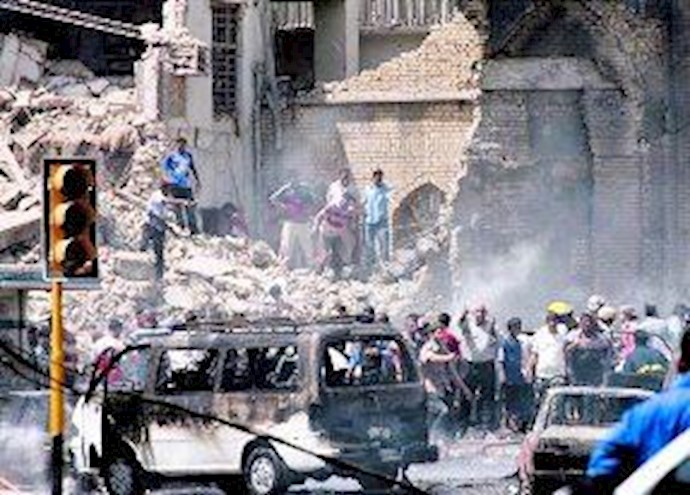
AFP, Baghdad, April 23, 2010 – A wave of attacks across Iraq including five car bombs, three as prayers finished at Shiite mosques in Baghdad, killed 58 people on Friday just days after the government said Al-Qaeda was on the run.
The violence wounded dozens more and underscored the unrest that continues to plague a nation whose politicians are struggling to form a government almost seven weeks after a general election seen crucial to its long-term stability.
A statement from Prime Minister Nuri al-Maliki’s office said the bombs were a direct response from insurgents angered by the purported killing of Al-Qaeda in Iraq’s (AQI) top two commanders in a joint Iraqi-US military raid on Sunday.
Abu Omar al-Baghdadi, the political leader of AQI, and Abu Ayub al-Masri, an Egyptian militant and the insurgent group’s self-styled ’minister of war,’ died when their safehouse north of Baghdad was bombed, Maliki and US officials said.
’The aim of (Friday’s) attacks is to overshadow the big success achieved by the security services in killing the devil terrorist leaders and an attempt to prove their existence after that strike,’ said Maliki’s statement.
In Washington, White House spokesman Robert Gibbs said President Barack Obama was briefed on the latest bloodshed but stressed that it would not alter US plans to withdraw all combat troops by the end of August.
Two parked car bombs in the impoverished Baghdad district of Sadr City killed 39 people and wounded 56, an Iraqi security official said.
The first exploded near the political office of Moqtada al-Sadr, the radical Shiite cleric whose Sadrist political movement could well be the kingmakers in the country’s next government. The second blast occurred near a busy market.
Sadr is in self-imposed exile in Iran, but the lunchtime attacks led an official to urge the movement’s dormant Mahdi army militia to return to action, as some soldiers and police had shown ’clear negligence in their duties.’
’I am confirming that this is a call from Moqtada al-Sadr for the Mahdi army to take responsibility to guard and protect the mosques by cooperating with the security forces,’ cleric Hazim al-Araji said on Sharqiya television.
A third parked car bomb exploded outside a Shiite mosque in Al-Ameen district in the east of the capital, killing eight people and wounding 23 as worshippers headed out as prayers finished, the security official said.
Earlier, at Abdel Hadi al-Chalabi mosque, named after the father of former deputy prime minister Ahmed Chalabi, a Shiite, a car bomb killed five people and wounded 14.
No one immediately claimed responsibility for Friday’s attacks, but the tightly timed sequence of destruction bore the hallmark of Al-Qaeda.
A total of 115 people were wounded in the five car bombs and two other incidents, the security official said.
The violence in the capital followed early morning attacks in Al-Anbar, a Sunni Arab province west of Baghdad, where an anti-terror judge’s home was targeted in four house explosions that killed six people.
The judge, who recently sentenced three insurgents to 15 years in jail, escaped unharmed but two of his sons were wounded.
Maliki had said Al-Qaeda was ’bleeding’ and its leaders ’falling’ after the deaths of Baghdadi and Masri, which US Vice President Joe Biden described as ’potentially devastating blows.’
But defence analysts cautioned that Iraq’s fledgling security forces must also remove AQI’s mid-level commanders if attacks, such as those on Friday, are to stop.
The conflict-wracked country held parliamentary elections on March 7, the second such vote since Saddam Hussein was ousted in a US-led invasion in 2003.
Maliki narrowly lost — 89 seats to 91 — to his main challenger, former premier Iyad Allawi, but neither came close to the 163 seats needed to form a government on their own, ushering in weeks of as yet fruitless negotiations to put together a ruling coalition in a 325-seat parliament.
There are currently around 95,000 US troops in Iraq. Obama pledged last year to withdraw all combat soldiers by August 31, leaving around 50,000 troops in the country before they also pull out by the end of 2011.