

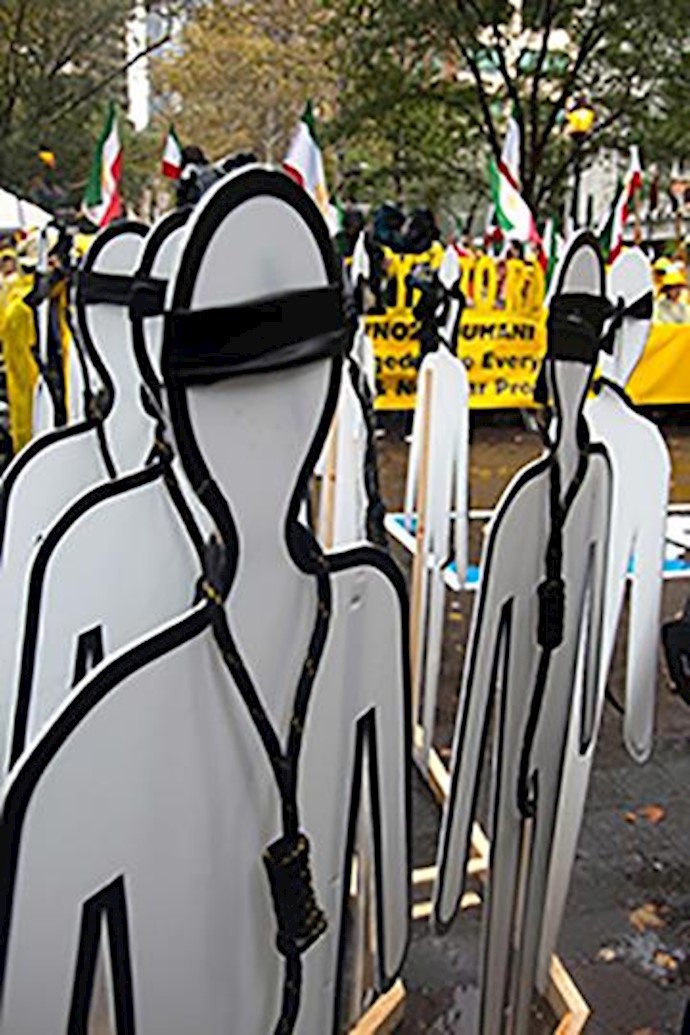
Huffington Post: A steady stream of rain last Thursday did not prevent protestors from crowding together on East 47th Street and Second Avenue to protest Iranian President Hassan Rouhani’s appearance at the United Nations. Yellow umbrellas bobbed up and down between picket signs as the crowd chanted. A marching band played to energize the crowd in between speakers representing grassroots organizations, universities, and both Republican and Democratic parties.
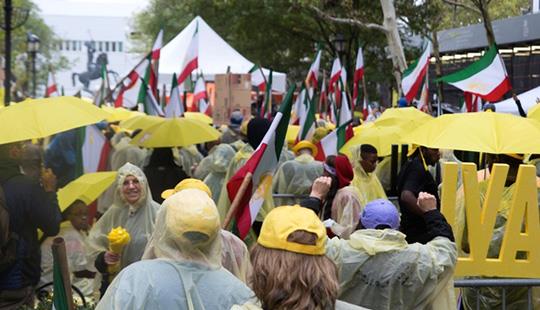
Despite incessant rain, Iranians came out to protest President Rouhani’s arrival at the UN. Protest organizers estimate that the anticipated crowd of 4,000 was quelled by the storm.
The introductory speech was a message from Maryam Rajavi, President of the National Council of Resistance of Iran, a collation of five Iranian political opposition organizations in exile. She pinpointed the increase in capital punishment under Rouhani as a sign of growing human rights violations. UN monitors in Iran say that no less than 1,000 people have been executed during his first year in office, making Iran the country with the highest rate of executions per capita in the world. This ranking excludes China, whose death penalty data is a state secret but is estimated to total in the thousands, according to Amnesty International.
The protest was scheduled to coincide with Rouhani’s speech at the 69th UN General Assembly but also overlapped with a high-level afternoon meeting led by the UN Office of the High Commissioner for Human Rights (OHCHR), entitled “Moving Away from the Death Penalty.” Deputy Secretary-General Jan Eliasson asked nations to ratify a new UN protocol that would work toward the abolition of capital punishment worldwide. The event comes just after the release of an OHCHR report of the same name, which drew attention to discrimination – ethnic, economic and social – as a major problem in the application of the death penalty.
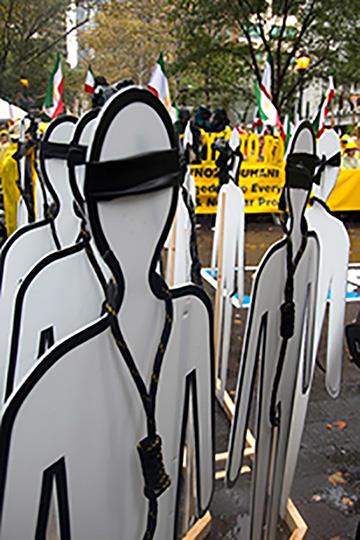
An installation of human cutouts with nooses around their necks represents the estimated executions of 1,000 Iranians in the last year of Rouhani’s leadership.
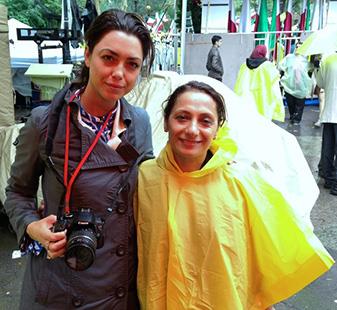
Shirin Nariman discussed her harrowing first-hand stories of experiencing executions while being held in a prison in Iran from 1981 to 1983.
Some of the protestors recounted first-hand experiences with execution. Shirin Nariman, an Iranian woman now living in exile in Virginia, spent 1981-83 in a prison for speaking out against the regime. She described her harrowing experience; “I was a senior in high school when I was taken. Every night, you would say goodbyes, knowing that 200-300 people would be executed by firing squad. Then hearing the sounds, you knew you were hearing your friends being killed.”
In November, the UN will vote on a resolution that requires all nations that maintain the death penalty to establish a moratorium on its use with a plan to move toward abolition. But, like all General Assembly resolutions, it would not be legally binding even if it passes.